
WALKING STORIES
By Kathryn Bender, Star-Bulletin
Nets pile up on the beach at Malaekahana.
Litter mars
By Tim Ryan
shoreline beauty
Star-Bulletin
Day 6: Kaaawa to Malaekahana, 12.7 milesEarly in my walk from Kaaawa to Malaekahana, I figured a way to not only balance the city budget each year but to even provide a surplus. The idea loomed in front and around me during most of this pleasant and serene journey along the wind-battered coastline.
Litter. Some places it was piled so deep I had to walk around it. So much of the shoreline and where streams pond before emptying into the ocean is thick with it, despite signs warning litterers with a $500 fine.
So here's the plan: Even one litter ticket issued a day would more than pay for the litter cop's time and equipment. He wouldn't even need a car. He could ride a bike, or walk.
That's because there's litter EVERYWHERE so someone has be dumping this stuff all the time!
Even with the litter, this is a truly lovely stretch of coast and the number of walkers out yesterday morning -- unlike my treks through Kaneohe and Hawaii Kai -- seem to prove my point. Ironically though, where I was prevented on the other hikes from walking the shore because of human intrusion -- mainly development -- here it was nature rebuffing me.
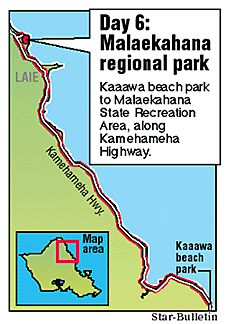
Wind gusts of up to 40 m.p.h. and the narrow beaches alongside Kamehameha Highway were awash in tiny breaking waves that had me dodging the spray behind seawalls. But mile after mile presented a magnificent view of monster waves breaking a mile or more out and the trails of currents slashing this way and that just offshore.On this blustery Kaaawa morning, I am alone in these elements. It isn't until 20 minutes after I head out at 7 a.m. that I even hear a rooster crow in this sleeping community
There is a lone shoreline fishermen, his three poles standing tall, their lines taut, his catch bucket empty. He smiles when I pass but he is busy and has the look of not wanting to chat. Across the street, a home with a wonderful view has an elephant tusk displayed across the large picture window.
Kahana Bay is a respite from the wind and there is an inclination to slow my pace to enjoy the serenity of a small estuary and the Huilua Fishpond. On the mauka side of the highway, a farmer grows taro. The patch is surrounded by electrified wire and several "No Trespassing" signs. On the bridge crossing Kahana Stream, a shirtless man in shorts tells his female companion, "Cuz I love you, dat's why. So don't go. OK?" When he sees me approach he pouts, goes silent, peers into the water below.
At the empty Kahana Bay State Park I walk between hundreds of ironwood trees which creak in the wind; the needles feel odd beneath my shoes after so many miles of walking on concrete.
There are two small memorials along Kamehameha Highway here. One small wooden cross has the name "Aubrey" carved in it.
When I see a sign that says "Do Not Pass" I stand there pretending it means walkers not cars. I laugh at my own silliness.
The beaches at Punaluu are empty expect for single man in shorts who stands ankle deep in the water with his hands in the pockets facing the wind. "It's wonderful," says Mike Smith, of Chicago. "I love the smell of the ocean. I slept down at the park last night; left my wife and kids in Waikiki at the hotel."
In the front seat of his car is an unfolded map; in the back seat is a rumpled sleeping bag.
"Papa" Williams is standing on the bridge crossing Punaluu Stream with a shovel. He's been landscaping the stream bank with hao, vine, and palms, where it passes along his property. He and his wife Ruth Reed have owned the property for more than 40 years; they have another home in town. The couple visits Punaluu twice a week. "I love it here," says Williams, 86. "The nicest thing is the weather and my neighbors."
Last month, Williams finished the cement wall that protects his property from the stream. "Worked on that wall for 40 years," said the retired Pearl Harbor worker. "You can sit back here and fish for papio, mullet, catfish and Samoan crab. Oh the memories I could tell you."
It's 8 a.m. and the few shops in Punaluu are closed too. A few houses down from Pat's at Punaluu, a man sweeps sand off his lawn."This is the third day of this and I am getting tired of it," he says, pushing a sand-filled wheel barrow to the shoreline.
In Hauula, a tattered Hawaiian flag flies above a weathered home. A hand-drawn sign reads: "Brudder Iz N dis life Hawaiians we were blessed by you."
This section of Windward Oahu has lots of open stretches of beach where access is easy. Though it takes longer to walk in sand, every chance I have to cut through a park to the shore I do. The ocean is wild and marvelous this day. Pounder's Beach in Laie dramatically lives up to its name.
Down the road at the closed Polynesian Cultural center an older Japanese couple get out of a white limousine to have their pictures taken in front of sculptures of Santa Claus in a boat being pulled by a dolphin.
On the leeward side of Laie Point, I decide to walk the final mile along Malaekahana Beach. I'm still alone except for hundreds of dead or dying Portuguese man-of-war. And the litter.
There are stacks of colorful fishing nets rolling in and out of the surf. They must have cost thousands of dollars. Couldn't the city repair then, and resell them?

