By Ken Sakamoto, Star-Bulletin
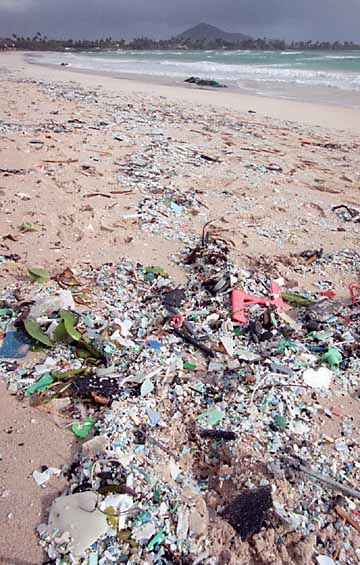
Junk rests on Kailua Beach near the 800 block of
North Kalaheo Avenue yesterday. “We’ve
never really had this many things wash up in all the years
I can recall,” said Mike Pundyke, acting district
superintendent of the city Road Division in the Windward
Oahu area. Many who live near the beach say the
problem is getting worse.
A torrent of debris has turned part
By Helen Altonn
of Kailua Beach pink, black and blue,
worrying beach-goers and the newly
named state health director.
Star-Bulletin"If I didn't know better, I'd think Hawaii had colored sand," said Ray Weinmann, taking an early morning walk along Kailua Beach off North Kalaheo Avenue.
The Port Angeles, Wash., visitor hiked through blankets of plastic pieces and assorted debris in pink, blue, black and other colors.
Bill Lech, an Aloha Airlines pilot who has lived seven years at the 800-block of the avenue, said he's never seen so much trash washed up on the beach.
Beach walkers who've lived longer in the area say the same thing, he said. "The problem is, it's getting worse. . . . The sand has almost disappeared."
Large fishing nets and paraphernalia, and masses of little pieces of bottles, plastic and other material are scattered along the north portion of Kailua Beach and other state shores.
Mike Pundyke, acting district superintendent of the city Road Division in the Windward Oahu area, said the crew cleaned Kailua Beach two weeks ago and will do it again next week. It has to be done by machine because the nets are so big, he said.
"We've never really had this many things wash up in all the years I can recall," he said, adding that he's been on the job 20 years.
"We're trying to catch it as quick as possible, but it's not our sole duty."
Lech said he called the state Department of Health, state Department of Land and Natural Resources and the city Facilities Maintenance Division about the debris.
He's worried about the amount of material and possible health hazards. "I'd like somebody (in government) to take a look at it and tell me it's not a health problem."
Lech said a study should be done to determine the age and nature of the materials, where they originated and what preventative measures can be taken.
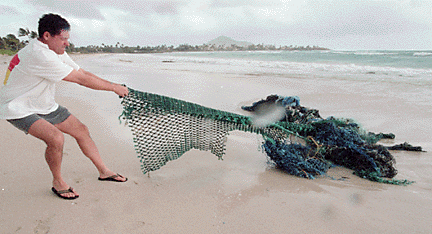
He's worried that the little pieces of plastic -- some with sharp edges -- eventually will mix with the sand and never go away. "It's looking to me like something that is an environmental disaster."The big question is: What has caused the growing deluge of beach trash -- recent strong winds, natural ocean conditions or the El Nino phenomenon?
Bruce Anderson, state deputy director for environmental health who has been named as the new state health director, suspects changes in ocean temperatures and currents may be responsible.
"My thinking is maybe we're now in an eddy in the Pacific where flotsam normally accumulates, and we're seeing a lot more debris because we're in the current line," he said. "Before, it might have been hundreds of miles north, and now we're right in it."
Of particular concern are cylinders used on boats to store ammonia gas or chlorine, which could explode, Anderson said.
The department has spent tens of thousands of dollars taking the cylinders to sea and shooting them, he said.
He said he saw a cylinder with a lot of other debris on the Big Island last week.
Anderson said his agency shares cleanup responsibilities with the land department and city public works crews, depending on the area and type of material involved.
Scientists say it's difficult to relate the onslaught of beach trash to atmospheric and ocean changes, but that those could be a likely explanation.
University of Hawaii oceanographer Roger Lukas noted large changes in the ocean and wind conditions associated with the 1997-98 El Nino.
A major frontal feature north of the Hawaiian islands moved southward with wind-driven currents, he said. "The debris which normally accumulates along that front would start to drift into the islands."
But if the ocean junk was trapped in an eddy and brought here, it might have nothing to do with an El Nino, he said.
Jeff Polovina, ecosystem environmental investigations director at the National Marine Fisheries Service's Honolulu laboratory, said his hunch is that strong tradewinds in recent months rolled the debris onto island beaches.
Immediate action is needed at an international level to stop dumping of marine debris in the north Pacific Ocean, says the Western Pacific Regional Fishery Management Council. Pacific-wide effort urged
against marine dumpingThe council issued a strongly worded statement about the problem at a recent meeting and is asking the U.S. State Department to alert other Pacific nations.
Council Chairman Jim Cook said the marine debris, including masses of discarded fishing nets, is a threat to rare wildlife in the Northwestern Hawaiian Islands that will continue until action is taken internationally.
The National Marine Fisheries Service estimates more than 70,000 net segments were discarded in waters there. Six tons of debris in six days were recently collected from the French Frigate Shoals.
Adult albatross pick up plastic objects, which may result in the death of many chicks through ingested toxins, intestinal blockage or piercing of the bird's stomach, researchers said.
The council is developing a management plan and will work with other Pacific councils on regulatory measures.