By Ken Sakamoto, Star-Bulletin
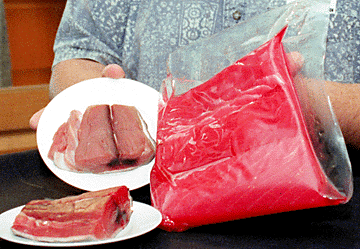
A carbon monoxide-treated ahi in a vacuum-sealed package,
compared with day-old ahi, rear, and a fresh one.
Sashimi lovers,
beware the
‘plastic red’
Experts warn of imported frozen
By Pat Omandam
tuna treated with carbon monoxide.
The fish looks top-quality, but it's not.
It could even carry a health risk
Star-BulletinAnyone who enjoys sashimi, especially during the holidays, knows that one telltale sign of top-quality ahi is the redness of the tuna. Generally, the brighter the flesh, the better the fish. But members of the Western Pacific Regional Fishery Management Council and others warn consumers not to be fooled by a growing number of imported frozen tuna that may look like the good stuff.
The unnatural brightness, they say, comes from a treatment that exposes the fish to carbon monoxide -- the same stuff blowing out of your car's tailpipe -- and chemically turns the tuna's flesh from brown or pale to bright red.
The product -- made in the Philippines, Indonesia, Taiwan and elsewhere but not in the United States -- allows these companies to sell and market lower-grade tuna as sashimi, even though it normally would be unfit for your New Year's Eve seafood platter, said James D. Cook, chairman of the Western Pacific Regional Fishery Management Council, the primary policy and management authority for fisheries in the U.S. western Pacific.
"The way that these factories work in these countries is that they have large rooms and they get the substandard-grade tuna, cut it up in blocks, put it on carts and roll them in," Cook explained.
"They produce carbon monoxide, and depending on the thickness of what they want to color change, they leave it in there for up to 24 hours. You can change a big loin to that color in 24 hours," he said.
The 16-member council on Thursday concluded its three-day meeting at the Hawaii Prince Hotel. To demonstrate the threat this product poses to the region's domestic tuna industry, Cook placed three pieces of ahi -- low-grade, regular-grade and gas-treated tuna -- on a platter and kept them at room temperature throughout the council meeting.
While the low- and regular-grade cuts turned brown, the gas-treated ahi remained bright red, disguising any decomposition.
"I think the greatest threat that it currently poses is the failure of the product to decompose as a normal fish. If I took these products and put them out on the sun a few days and you came back and it still looked like it did, you'd say, 'Gee,' " Cook said.
Dr. John Kaneko of PACMAR Inc., a consulting firm to the local tuna industry, distributed a five-page briefing paper to the council on carbon monoxide gas-treated frozen tuna.
Kaneko's report said the product poses a significant threat to the economic viability of the $60 million domestic tuna and swordfish industry in Hawaii, American Samoa, Guam and the Northern Marianas.
While discriminating sashimi tuna buyers and consumers can tell the difference in the "plastic red" color of the gas-treated tuna, Kaneko said the less sophisticated will believe the redness in the product means high quality, which it is not.
This amounts to a form of economic fraud, he said in his report.
Kaneko said there are negligible direct health implications from eating the gas-treated fish because of the limited amount of carbon monoxide in the product and because of the amount eaten.
Nevertheless, there is potential for secondary health problems because those lower grades of tuna are inferior in shelf life and size, he said.
"The health risk evolves from the lack of normal color and color changes, which are the most commonly used indicators of quality and tuna product safety," Kaneko wrote.
"Consumers lose their ability to judge when the product is no longer fit to eat."
Aimed at Japan
The Japanese market was the original target for these products, but the Japanese government responded by setting a limit on the amount of carbon monoxide exposure allowable in seafood products. Kaneko said this essentially restricted its importation.Locked out of Japan, the manufacturers began to focus on the U.S. market, with some success. In Hawaii, importers and wholesalers are taking advantage of the attractive price differential to use the frozen fish in sashimi, sushi and poke, which, until now, had been made using only fresh and occasionally high-quality frozen tuna.
The Food and Drug Administration considers the treatment of tuna with carbon monoxide an illegal form of product adulteration. Carbon monoxide is not an approved food additive, Kaneko said.
Both Cook and Kaneko said the FDA is concerned about possible economic fraud, but that its current policy is to focus on seafood safety issues and not on those related to economic fraud. They added that the FDA may not have enough resources to pursue these types of cases.
John Cook, resident-in-charge of the local FDA field office, yesterday said the agency considers the gas treatment of tuna an unapproved food additive. He confirmed the product is being imported to the United States, but deferred additional comment to FDA headquarters.
Ruth Welch, a spokeswoman for the FDA national press office in Maryland, when told of the council's concerns, reserved comment until she could consult with experts at the agency's Office of Seafood next week.
It's in local stores
The council on Thursday approved a resolution urging the FDA to enforce the laws on its books and help get the product out of the country. Council Chairman Cook said the gas-treated frozen tuna, found abundantly on the mainland, is in stores locally."All over this country, you can go into stores and buy this product," said Cook, who is also vice president at Pacific Ocean Producers, which catches and processes fish, including tuna.
Frank Goto, general manager at United Fishing Agency in Honolulu, agreed that government -- whether federal, state or city -- should intervene for the good of the consumer, as well as Hawaii's sashimi industry.
"You relate fresh, good sashimi to red color," Goto said. "So if you turn a brown thing into red color, then you're going to figure that's a good sashimi fish, which it's truly not, right?"
Goto's advice is to stay away from the frozen stuff and buy fresh tuna whenever possible.
Guy Tamashiro, seafood manager of Tamashiro Market, said the store carries the product, but the frozen sashimi hasn't replaced sales of top-quality ahi, in part because people can tell the difference.
Tamashiro said the store follows labeling regulations on those products to ensure the consumer knows what they are buying.
"I think everybody (who sells it) should," Tamashiro said. "Not everybody does, but I think everybody should. That's so the consumer is aware."