
Spouses honored for
By Lori Tighe
taking care of loved ones
with Parkinson’s
Star-BulletinCaryl Fujiwara's shrinking handwriting foretold of her Parkinson's disease. Then her thumb started to tremble, and she began falling frequently.
But when the doctor diagnosed her with Parkinson's, she asked, "What the hell is that?"
It is a degenerative disease among older people characterized by tremors, muscle stiffness, loss of balance and speech. The pope and U.S. Attorney General Janet Reno have it. And the disease can wear down marriages and families, as Fujiwara and her husband, Leslie, know.
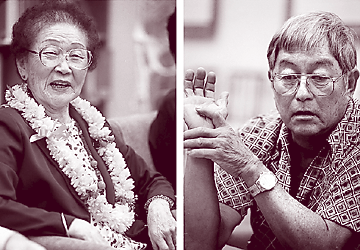
Leslie Fujiwara, 67, of Kona, and Nancy Shigeoka, 80, of Hilo, were two of 26 winners nationally of the SmithKline Beecham Caring Hands Award for being the primary care-giver of their spouses, who have Parkinson's. They were honored with awards at Kuakini Medical Center this week.
Fujiwara and Shigeoka are among 1.5 million Parkinson's disease caregivers in the United States.
Hawaii has a higher than average incidence of Parkinson's, whose cause still is unknown, said Dr. Melvin Yee, medical co-director of the Kaukini Parkinson's Disease Center.
In 20 years, 10 percent of the population over 65 will have Parkinson's disease and another 10 percent will be responsible for their care, according to the National Parkinson Foundation.
When Nancy Shigeoka learned seven years ago that her husband, Minoru, has Parkinson's disease, she accepted it as part of life.
"Whatever he has, I would take care of him," she said. "He can take showers, eat by himself. But little by little it's getting harder."
Minoru Shigeoka, 82, who has been married to Nancy for 57 years, watched her silently across the room at Kuakini Medical Center. The disease has taken his speech away, except in times of rare anger when he spits his words out.
Minoru, a retired accountant, lost control of his handwriting as well. When his eights started looking like fives, his wife took over doing their tax returns.
The handwriting grows smaller with the body's loss of free-flowing movement from a chemical the body produces called dopamine, which helps fire off nerve impulses.
"Dopamine is like grease for the body, it makes it flow smoothly," Yee said.
When her husband began dropping his rice with his chopsticks, Nancy Shigeoka bought him a big-handled fork and spoon, which have helped.
She must also ensure he takes his medication to control his tremors.
"If he forgets one day, you see the results," she said.
Proof of a person having Parkinson's is seen in their reaction to a medication, Sinemet, which helps the body to produce dopamine, said Leslie Fujiwara. People with symptoms of the disease, but not the disease itself, won't react to Sinemet.
When his wife, Caryl, 64, began using Sinemet, "her legs really took off," Leslie Fujiwara said. Her legs jerked uncontrollably, causing her discomfort and back pain.
After determining she had too much Sinemet, their attending doctor cut her prescription in half.
"Caryl went through a very traumatic period when her symptoms began," Leslie Fujiwara said.
She was in Seattle staying with her daughter, Jayme, who was getting a liver transplant. Her tremors began, her handwriting grew smaller and she felt stiff. She was diagnosed after she returned to Hawaii.
"It got so bad she couldn't work. A few times she fell in the office," he said.
"I don't do windows anymore," Caryl Fujiwara said with a wry smile.
The diagnosis changed both couple's lifestyles. Food has to be cut into small pieces because Caryl Fujiwara and Minoru Shigeoka can't chew. They also need to eat snacks hourly because they can't eat a lot at one time.
Although 20 percent of Parkinson's patients experience dementia, both couples said they escaped that symptom so far. For Nancy and Minoru Shigeoka, the restriction of his movement has slowed them both down. Nancy Shigeoka had to reduce her senior volunteerism and her Lioness Club activities.
She smiled at her husband and said simply, "You have to be patient."
