
Conservationist begins
By Helen Altonn
work in ‘amazing’ Hawaii
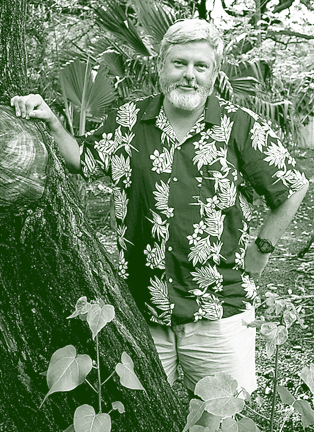
Star-BulletinThe new director of a program to preserve Hawaii's ecosystems says he learned while working with Alaskan natives that people can't be separated from natural resources.
"In Hawaii that's even more obvious just because there are so many people," said David C. Duffy, leader of the Pacific Cooperative Studies Unit.
Duffy feels people should learn more about Hawaii's ecosystems and endangered species. "To my mind it's just as important as preserving Hawaiian language, traditions and even the aloha spirit."
The U.S. Geological Survey, National Park Service and University of Hawaii operate the cooperative program, based at the University of Hawaii's Manoa campus.
It employs about 150 people, receives about $7 million annually and conducts more than 50 research projects.
For example, the unit is trying to eliminate or control aggressive non-native miconia trees on Maui and the Big Island, and is fencing off areas on those islands to protect endangered plants, birds and snails from animals.
It's also trying to save the po'ouli, a bird on Maui with only three known survivors; to restore park ecosystems damaged by exotic invasive species; and to help the park service re-establish turtle nesting on the Big Island.
These and the other projects "are going at once, which is sort of frightening," Duffy said. "We have a marvelous staff, otherwise I would have run screaming off into the a'a (lava)."
Duffy, also appointed as a UH botany professor, succeeded emeritus botany professor Clifford W. Smith, who recently retired after more than 23 years as the unit's director.
A conservation biologist and seabird specialist, Duffy previously was a professor and manager of the Alaska Natural Heritage Program at the University of Alaska in Anchorage.
He ran a project to see why birds and mammals have not recovered from the disastrous Exxon Valdez oil spill in 1989.
"It's not just because of the spill, but environmental conditions have changed," he said. "Once the oil spill knocked the populations down, they couldn't recover because food sources are poor."
He visited Hawaii for the first time when he was interviewed for the unit position.
"Hawaii's ecosystems have a reputation for sort of being on their last legs," he said. "But I was amazed at how much is going on and, really, the optimism of a lot of people to protect and restore them.
"Things people thought were impossible 20 years ago now are a reality, like keeping pigs and goats out of big areas and seeing forests recover."
After long winters and low light in Alaska, Duffy said Hawaii's environment was "seductive," as well as posing a big conservation and restoration challenge. "Very little of the landscape in Alaska has been affected by humans, and here most of it has."
With concerned agencies working together and pooling funds, he said, "We are able to administer projects and make them happen for much less than the agencies can do for themselves."
He feels conservationists and biologists should do a better job of "letting people know how amazing Hawaii is. I'm still learning. I have to learn enough about Hawaii to be able to tell people."
Duffy has a bachelor's degree from Harvard and a doctorate from Princeton University. He has written extensively and taught and done field work in New Zealand, Central and South America, and Africa.
He was an ornithologist and temporary director of the Charles Darwin Research Station in the Galapagos islands, executive director of the International Association for Ecology, principal investigator on a Lyme disease project for the U.S. Centers for Disease Control and the Seatuck Foundation, and a professor at the Marine Sciences Research Center at the State University of New York-Stony Brook.
