

By Dennis Oda, Star-Bulletin
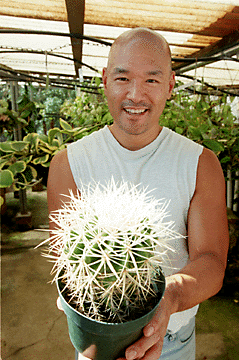
Mike Miyashiro holds a white-spined golden barrel cactus.
Imported from Japan, it is more compact than the
more common barrel cacti.
All cacti are succulents but all succulents aren't cacti. Succulents are plants with thickened, fleshy leaves, and stems and roots that store water to carry them through dry periods. A cactus is one form of succulent, with branches reduced to small pads with spines that protect the plant against browsing animals. Praise for prickly plants
Cactus and Succulent Society fall
sale to feature unusual varietiesThat's the garden manual definition, but cactus and succulent growers use a somewhat looser definition.
Certain orchids that store water within their structure are technically succulents, but not to the succulent collectors, who do recognize such desert plants as yucca which technically aren't.
Admirers of cactus and succulents tend to be on the defensive, says Michael Miyashiro, who has been growing these thorny plants since he was a kid. Anybody can admire an orchid or a rose or a flowering plumeria tree, but it takes understanding to love a spiny, fleshy little green hunk of plant material.
Miyashiro and other members of the Cactus and Succulent Society of Hawaii are hoping to drum up more enthusiasm for their choice of plants tomorrow at their Fall Sale and Show at Ward Warehouse.
Miyashiro explained the appeal of cacti. "You never have to rake because the leaves don't fall off. To transplant one, you just pull it out of wherever it is and put it someplace else. If you miss watering for a while, it might even be good for the plant. But people who don't know about cactus see one at a sale, look at it for a while and finally go off and buy a fern," says Miyashiro.
Miyashiro will be introducing his variegated Sweetheart Hoya, which he said is considered one of the top 10 variegated plants in the world. The plant has fleshy heart-shaped leaves in a deep green splashed with ivory.
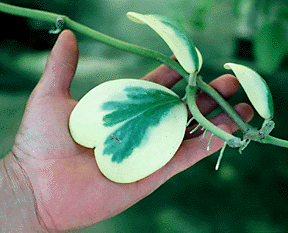
It grows easily, he says, either outdoors or in a hanging basket indoors. It can be kept compact by pruning, or will grow as a vine. It needs loose, well-drained soil and diffused or partial shade. It will bloom most often when potbound. Any hoya, Miyashiro said, should be watered only in the early morning so it has all day to dry out. If it regularly sits in water overnight, it will develop root rot.Variegated hoyas, he added, are so popular in Japan that before winter sets in, growers dig up and dry out their plants and replant them the following spring. The variegated Sweetheart Hoya once sold for $1,000 a cutting until its propagation became more common.
Another of his introductions is a purple adenium, often called desert rose. It has a thick stubby trunk, but thin leaves and a flower somewhat like an oleander. Ordinarily they are a deep pink, but this new one has bright purple flowers about 2 inches across.
Adeniums are succulents, and need heat, light and perfect drainage. They are heavy feeders and require fertilizing during the summer months. The plant is protected by its toxic milky sap, so be careful to keep it away from your eyes and skin. Cactus and succulent fans wear gloves when working with their plants.
Another wonder in Miyashiro's collection that will be offered at the sale is a sky-blue cactus. The whole stout trunk column that makes up the plant is blue instead of green. "It comes from Brazil where the climate is exactly like ours, and it is the first blue cactus adaptable to Hawaii." he said.
It is 3 feet tall, but it is the parent plant. Those in the sale will be smaller, but equally blue.
"As it ages, it gets a tuft of white hairs on the top of the plant. This is nature's protection to shield the plant from the desert sun," he said. "It's like a little hat to provide shade."
Or you might consider his white-spined golden barrel cactus, imported from Japan. It is slower growing than the more common barrel cacti that can grow to 6 feet, and that's too much cactus unless you live on the Arizona desert. This one seems to get to about the size of a pineapple, is dark green and sports long white spines.
Some growers with outdoor cactus gardens advise covering the garden soil around the base of the plants with a light-colored coarse gravel that will reflect the sunlight on to the plant and will keep the soil drier.
Cactus does best in direct sunlight, where it flowers more often than if left indoors; growth will be slower but healthier.
There will be cactus experts on hand for advice tomorrow, but if you are online, you might consult the Cactus and Succulent Society of Hawaii's web page at http://www.geocities.com/rainforest/vines/7706.
On the other hand, it's more fun to go to the sale.
Plant sale
What: The Cactus and Succulent Society of Hawaii's Fall Sale and Show
Gardening Calendar in Do It Electric!
Send queries along with name and phone number to:
Evergreen by Lois Taylor, Honolulu Star-Bulletin, P.O. Box 3080, Honolulu 96802.
Or send e-mail to features@starbulletin.com.
Please be sure to include a phone number.
Evergreen by Lois Taylor is a regular Friday feature of the
Honolulu Star-Bulletin. © 1998 All rights reserved.

