Bishop Museum repairs an
By Pat Omandam
Iolani Palace throne after a
controversial sitting affair
Star-BulletinOne stitch at a time. That's how conservators at Bishop Museum earlier this month fixed upholstery on one of the 115-year-old thrones on display at Iolani Palace, apparently damaged last April when Abigail Kawananakoa sat on it for a Life Magazine photographer.
It is unknown if Kawananakoa's actions were the reason that palace managing director Jim Bartels resigned -- Bartels has repeatedly declined to comment on the matter.
Nevertheless, Bishop Museum officials say the throne's silk and linen fabric is in such deteriorated condition that any touch would have caused damaged.
"It's not something that the average person would notice," said Valerie Free, museum unit manager of cultural resources and collections care. "But on close inspection, you can see a little bit of disturbance."
The museum is conducting its annual condition report of items on loan to the palace. Free said the yearly inspections -- to be done by year's end -- are required under a five-year revolving loan agreement to ensure the museum's collections are not being harmed while on display elsewhere.
Alice Guild, executive director of the Friends of Iolani Palace, stressed the report is part of the annual exam and has nothing to do with Kawananakoa's sitting on the throne.
The board is expected to meet today for its regular monthly meeting.
Currently on loan to the palace since the mid-1980s are the two thrones used by Hawaii's last two monarchs, King David Kalakaua and Queen Liliuokalani, as well as a third throne used by Kamehameha III that is not on display.
Also borrowed are the monarchy's two crowns, scepters and royal orders, along with three very important calabashes, the oldest of which dates back to a 16th century Big Island chief.
Palace curator Corinne Chun yesterday said these objects were part of the original palace collection.
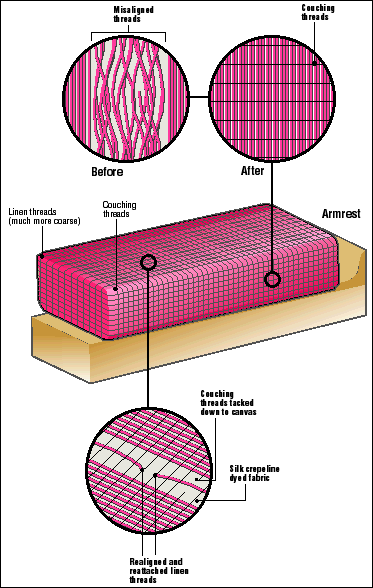
On Nov. 2 and 3, two conservators at the Bishop Museum conducted a "stabilization" project on King Kalakaua's throne at Iolani Palace. Since the throne's last major restoration in 1986, the slow degradation of the fragile linen and silk threads was accelerated by the incident involving Abigail Kawananakoa in April of this year. The repaired throne
Star-BulletinDisplaced threads realigned
Many of the threads on the throne are so fragile and disconnected from other threads that they are easily misaligned if touched or bumped. These misaligned threads on the seat, backrest and armrests were coaxed back into place with tiny brushes and tweezers and tucked back under the couching threads, which are very thin (nearly invislible) silk threads that tack down the loose or broken threads.
Broken threads tacked down
Threads that had been broken were tacked down to a more stable, underlying silk crepeline inserted under the weakened upholstery. Where couching threads were broken, the realigned linen threads were tacked down to stable canvas under the brocade, with new hairsilk pulled from red silk crepeline.After the 1893 overthrow of the Hawaiian monarchy, the provisional government sent many pieces to the museum, while thousands of other objects were sold at palace auctions.
Palace volunteers have mounted a worldwide effort to get those pieces back.
"The Bishop Museum has been very, very cooperative in wanting to return these pieces to the palace, and so it's been a really nice association with them," Chun said.
Chun said the objects on loan are insured, but she declined to disclose their value.
Free said a condition report is done with every item that leaves the museum. The documentation gives the museum a good grasp of any changes to an object when it conducts its annual reviews.
For example, a crack in a bowl would first be measured and then rechecked after a period of time to see if there's been any further deterioration that's taken place, she said.
Workers examine under, over, around and in objects, and rephotograph everything so it can be compared again next year.
"We check the environment that the objects are sitting in for temperature, relative humidity, light levels, housekeeping, if they are dusty If there are any problems, then we'll do a treatment proposal and actually do repairs and any kind of maintenance that is needed," she said.
Earlier this month, workers took the armrests off the palace thrones and brought them back to the museum for repair. The thrones were too delicate to move, Free said.
A museum inspection in August on the throne -- made in 1883 in Boston and upholstered with dark red damask brocade fabric -- found about 20 broken threads and others that were loose or disturbed.
Free said conservators very carefully realigned the silk and linen threads and stitched down those broken threads, in effect stabilizing it.
"Now you're never going to completely stop it because it is so far gone that just sitting in a room, it's going to continue to fall apart. But for the most part, that process has been slowed down so that it's imperceptible to the average museum goer or visitor," she said.
Chun said it's difficult to say which threads, if any, were damaged when Kawananakoa sat on the throne.
"I'm sure that some of them were, but I don't know," she said.
Meanwhile, Friends of Iolani Palace acting President Elia Long Sr. said the board today plans to discuss reorganizational issues. But he said it is premature to discuss any possible rehiring of Bartels before these issues are addressed.
"There's a bunch of things we have to do in-house before we get to Jim, so anyway that's still in the mill," he said.
The board last August voted to remove Kawananakoa as president. A month later, she and two other supporters announced plans to resign from the board. Kawananakoa, who had served as president since 1971, is a Campbell Estate heiress who is a descendant of Hawaiian nobility.
Six weeks ago, the palace received six original palace plates from a man in New Orleans. Chun said the man's family had bequeathed the objects to him but returned them after he watched an episode of the program "Treasures" on A&E cable network that focused on Iolani Palace. The segment was filmed in January and aired in April, she said.
History of the thrones
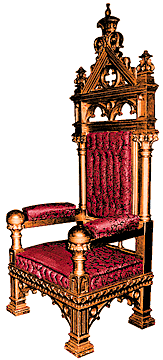
The Kalakaua thrones were made by D.H. Davenport & Co. of Boston in 1882 and arrived in Honolulu on two ships for the February 12, 1883, coronation ceremonies. The two thrones were part of a 225-piece order, including 12 matching side chairs for the Throne Room. They are gilded wood chairs in the Gothic revival style, topped with gilded wood crowns. The seats, backs and arms are upholstered with red silk brocatelle.
To see the thrones