By Craig Kojima , Star-Bulletin
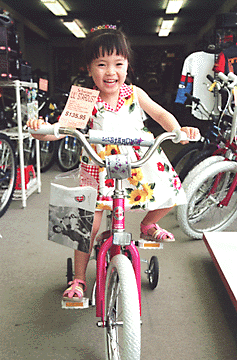
Four-year-old Cindy Nozomi Mashima takes a ride in Eki Cyclery
while shopping for her first bicycle as a birthday present.
Isle bicycle
shops spinning
their wheels
Merchants are trying to
By Peter Wagner
hang tough as they wait for the
economy to turn around
Star-BulletinTHEY'RE down to a skeleton crew at Eki Cyclery, the oldest bicycle dealer in town. Sales are off. Inventory has shrunk to the showroom, and the big warehouse out back is occupied by tenants, not bikes.
"Hopefully we can hang in there until the economy changes for the better," said Jayne Kim, granddaughter of the company's founder, Toichi Eki.
It may be small consolation, but most bike shops in Honolulu are wobbling along on the same deflated economy. It's a struggle for survival that has claimed many dealers in the past several years, including The Bike Way, Sports Nut, Fantasy Cycles, Island Spokery, Bike Planet and Kailua Bike Shop.
"People just don't have as much money to spend on fun things," said Faye Saiki, owner of The Bike Shop, where sales are off 30 percent.
The company has dumped its warehouse, trimmed its staff, and closed one of four stores. And Saiki said she's doing more fixing and less selling these days.
"That seems to be the trend in a bad economy," she said. "People fix things instead of replace them."
It wasn't always so. In the 1970s, when a fuel shortage forced people from their cars, bicycles became a necessity and bike shops sprang up like weeds.
"We sold every bike we could get our hands on," recalled Saiki, who had to scrape around on the mainland for merchandise because her distributors were sold out.
"We stayed up at night assembling them and the next day we sold them. It was a bike shop's dream."
Business was good even after the fuel crisis faded, with the advent of triathlons, mountain biking, and other crazes. But the state's economy began to cool in the early 1990s.And problems for bike dealers were compounded by the arrival of big mainland discount stores carrying high volume merchandise at half the price.
"It's not fair to see them as competition because we don't have the same quality," said Saiki. "But in hard economic times people tend to go to the lowest price rather than quality."
Trying to meet the challenge, McCully Bicycle & Sporting Goods cut its prices to the bone to compete with Costco, Sports Authority, Wal-Mart, Kmart, and Toys R Us.
"We've been going against the 'big boxes' more than our other competitors," said Benjamin Takayesu, president at McCully, who tripled his bicycle inventory to drop prices.
"We just have to sell more," said Takayesu, wary of a nationwide trend toward big outlet stores. "Instead of bringing in 50 bikes at a time, we bring in a container of 150."
But McCully is losing ground despite its high-volume strategy. Bike sales are off 10-to-20 percent and bicycles are losing ground to tennis rackets, shoes, fishing gear and other sporting goods that carry the store.
"It used to be a big part of our business, maybe 40 percent," said Takayesu. "Now bicycles are about 25 to 30 percent of our business.
At Island Triathlon, owner Frank Smith has mixed feelings about the discount chains.
"It gets people on board, and they might want to trade up for a better bike later," he said.
But Costco is cutting into his business, selling a model he carries for 30 percent less.
"The consumer definitely benefits from the very competitive retail environment but what we're seeing in Hawaii is we're losing our culture," Smith said.
"We're going to have this homogeneous retail environment like you have on the mainland and the individual personalities of small businesses are going to be gone."
Island Triathlon, which got off to a flying start with the Ironman Competition 15 years ago, has closed two of its four stores since last year.
"If I look back to 1993 or 1994, our sales are about half what they were," said Smith. "I've drastically reduced the quantity of bicycles I have on hand."
Meanwhile, McCully is making life difficult for other dealers with its price cutting.
"They just kind of screw it up for everybody else," said Jed Wakui of Island Cycle Center, who can't get by on a thin margin. The Mililani bike shop has been losing customers to McCully affiliate Waipahu Bike & Sporting Goods.
"We figured it was going to be kind of rough in the beginning but it just seems to have gotten worse," said Wakui, who opened about three years ago.
Sales are off 10 percent over the past two years, and Christmas layaways, usually strong this time of year, are down more than 50 percent, he said.
Conspicuous in its success despite Hawaii's down economy has been The Sports Authority, which had a 13 percent increase in bike sales in the past year. General Manager Raymond Musquez credits an expanded line of bikes and the addition of a service department.
"We've provided a service you normally don't see in department stores where you can come in and buy a bike from a knowledgeable sales clerk and also get a bike tuned up or repaired," he said.
Such services have been the hallmark of specialty shops like Eki, which bank on customer loyalty and close attention to service.
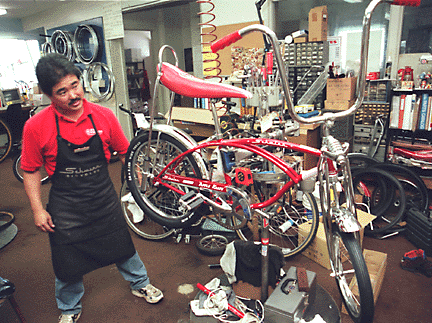
"Backing up our products is a big thing," said Kim, whose husband Jay also restores vintage bikes.
"We know our stuff. We know how a bike works."
The owners of Oahu's oldest bike shop stress their quality and service Pioneer family hopes
for better ride aheadFIXING up the old Firestone "Speed Chief" was a labor of love for "Jay" Howard Kim Jr., who keeps a picture of the 40-year-old bicycle on hand.
The photo shows a wide-wheeled cruiser gleaming in the sun outside Eki Cyclery on Dillingham Boulevard, where Kim and his wife Jayne can be found six days a week.
"We think it was a 'hardware store' bike -- not real high quality but kinda neat," said Kim, who has a roomful of old bikes he dotes over in his spare time.
But there isn't much time for tinkering at Eki these days, where the Kims juggle everything from the company's books to bike repairs.
It hasn't been easy for the oldest bike store in town, caught on a rough stretch of its 87-year history. Business is down, as it is at other bike shops, and it looks like a lean Christmas.
The Kims are hoping Eki's reputation for quality and service will carry them through to better times. "We've been able to survive all these years, through good times and bad, by being close to the business and being able to change," said Jayne. "And we back up each customer all the way."
Founded in 1911 on the corner of South and King streets, Eki became one of the nation's top Schwinn dealerships with sales of more than 1,000 bikes per year. A wall in the store is lined with wooden "1,000 Club" plaques, dating from 1967 to 1987.
Jayne credits her dad, former Eki president Shuichi Arakawa, who retired in 1995 after suffering a stroke.
"I give him credit for pulling the store up to the level we're at today, from a mom-and-pop," said Jayne, who grew up in the Dillingham store.
While Eki carries everything from mountain bikes to high-performance racing bikes, the company targets the family market with a selection of children's tricycles and bicycles and adult cruisers. The first Schwinn dealer in town, Eki now also carries the Trek, Nishiki and Raleigh lines.
The 15,000 square-foot warehouse that adjoins the showroom is now rented out for income and inventory is confined to the 2,000 square-foot showroom. With space at a premium, every bike, pump, helmet, water bottle, and reflector is calculated to sell.
Except maybe for the $3,000 Limited Edition Schwinn "Black Phantom" standing in its glory above the store.