
For those making the
By Gregg K. Kakesako
effort, Leonids worth
the wait
Star-BulletinIf you missed this morning's Leonids meteor display from the Comet Tempel-Tuttle, take heart: It'll be back 33 years from now.
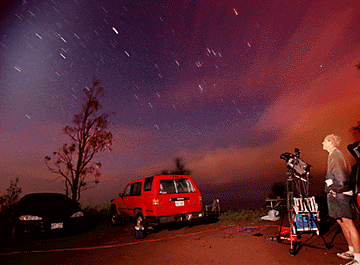
However, for 38 Oahu residents who braved the rain and cold at the 2,100-foot level at Camp Timberline in Makakilo, it was "an outstanding show."
Alison Hayami, a junior at Mid-Pacific Institute, described the experience as "beautiful."
"It wasn't a waste of time," said Hayami, who lists astronomy as her favorite subject at the Manoa school.
Mike Jones, education and evaluation specialist at the Bishop Museum's planetarium, estimated that about 86 meteors an hour streaked overhead in the darkened Leeward Oahu skies this morning.
"We didn't see a storm, but we did see seven or eight bolides (very bright meteors)," said Jones. "They were extremely bright, and some left a trail that lasted 40 seconds."
"There were a lot of 'ooh's and 'aah's."
The celestial fireworks, Jones said, are actually the long tail of the Comet Tempel-Tuttle.
The shower is nicknamed the Leonids because ancient observers thought the meteors came from the constellation Leo.
As the comet speeds through the solar system, it sheds swarms of particles as it nears the sun.
Jones noted that in 1966 when he first saw the Leonids while attending an Army flight school in Texas before he left for Vietnam, "the sky rained fire."
"At that time there must have been about 150,000 meteors per hour."
He said there shouldn't be any major problems caused by today's meteor shower except possibly to orbiting satellites.
"Typically, the meteors are the size of a grain of sand," Jones said.
Yesterday, technicians worldwide maneuvered the world's 600 satellites to reduce potential damage when the Earth plows through the wake of Comet Tempel-Tuttle. The speeding grit could poke holes in solar panels, pit lenses, blast away mirror coatings or cause damaging electromagnetic pulses.
Experts said the odds of any damage were slim, and meteor showers from the dusty wake of comets are fairly common.
The crew of the Mir space station was prepared for a too-close encounter and planned to enter the Soyuz escape capsule when the shower was at its peak.
"It is better to be on the safe side," Deputy Mission Control chief Viktor Blagov was quoted as saying by the ITAR-Tass news agency.
The peak of the meteor shower was pegged at 9:30 this morning with the best viewing place on Earth estimated to be in China at the same time, Jones said.
The best seats were wherever the sky was darkest and clearest -- from the Mongolian steppes to the mountains of northern Thailand to U.S. research planes breaking through cloud cover over Okinawa, Japan.
Besides dodging rain showers this morning at Makakilo, Jones said, the spectators were treated to a multimedia presentation prepared by the Bishop Museum to give them an idea what to expect.
"We also made a comet out of dry ice."
Jones said he had warned the spectators to expect no more than 100 meteors an hour since "we didn't want to mislead anybody."
The Associated Press contributed to this story.
