Hawaii doctors
pack aloha aplenty
for 29th mission
The group will leave Nov. 27 to
By Helen Altonn
provide free medical services for
the needy in the Philippines
Star-BulletinThe biggest Aloha Medical Mission team ever assembled will leave Nov. 27 to care for 15,000 to 20,000 patients in the Philippines.
"We will bring aloha with 76 people to help them," said Dr. Ramon S. Sy, medical mission president who will lead the group.
Specialists from the world over will participate in the 29th Aloha Medical Mission. About 45 or 48 will be from Hawaii, Sy said.
The team will include general surgeons, ophthalmologists, ear, nose, throat specialists, dermatologists, obstetrician-gynecologists, anesthesiologists, plastic surgeons, internists, nurses and lay persons.
They will head to Pangasinan, which was devastated last month by two typhoons and is the country's second-largest province with about 2.2 million people, Sy said.
More than 100 were killed and 90,000 left homeless in the typhoons. "Exactly the province we're going was flooded three weeks," Sy said. "No electricity. No water."
The timing of the 10-day medical mission to Pangasinan, a five-hour drive north of Manila, is a coincidence, he said.
"The invitation came two years ago. We have been planning this almost a year now. It took almost a year to scout the area. Fortunately, we have a lot of people this year."
They're calling it the Centennial Medical Mission in recognition of the Philippines' celebration of 100 years of independence from Spanish rule, Sy said. "It's our gift from Hawaii to them."
Last year, 39 mission volunteers cared for about 10,000 patients in the Philippines. With twice as many volunteers and some 200 people there to help, the mission expects to treat thousands more and perform about 300 operations, Sy said.
Three hospitals will be used -- one for eye operations, one for obstetrics and gynecology, the third for general and plastic surgery. Internists will see about 1,000 patients daily in a gymnasium, Sy said.
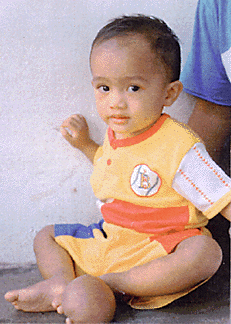
Juvenick Flores
A 3-year-old boy from the Philippines may grow up with both feet because of the Aloha Medical Mission and Shriners Hospital for Crippled Children. Mission hopes to help an
By Helen Altonn, Star-Bulletin
Ilocos Norte toddler stand
on his own 2 feetDoctors in Ilocos Norte wanted to amputate Juvenick Flores' left foot because of a deformity caused by an abnormal blood vessel growth, said Dr. Ramon S. Sy, medical mission president.
After volunteer physicians examined Juvenick on a mission last year, "we said maybe we should bring him here to help," Sy said. "It would be complicated vascular type surgery. Only certain people could do it. They think they can help this boy without amputating."
Shriners is taking care of all expenses, he said.
Sy said the boy and his mother, who are staying with relatives, visited him to say thank you to the Aloha Medical Mission after arriving Nov. 7.
Shriners spokesman Duke Gonzales said diagnostic tests have been done on Juvenick "to determine better the exact nature of his disorder so we can set the course of treatment for him.
"We feel it's something we can help with and hopefully the child will be able to leave Honolulu and go back home and have a happy, healthy life."
A 40-foot container of X-ray machines, wheelchairs and other equipment donated by local hospitals and groups has been sent to the Philippines, he said.
Traveling with the doctors will be about two tons of medications, gloves, syringes, sutures, lenses for eye operations and other supplies donated or bought by the mission -- totaling more than $500,000, Sy said.
People there get very little medical care, he said. "If you're poor, you're poor, period. The government has not much resources to support poor people."
The Aloha Medical Mission began in 1983 with seven volunteers going to the Philippines to provide free health care and surgery. The missions have grown and spread out to China, Vietnam, Vanuatu and other areas.
A smaller mission went to the Philippines earlier this year. Other groups went to Bangladesh and Laos.
"Usually, people want to go with this group," Sy said. "We time it after Thanksgiving. It's a feeling of giving back.
"It's fun because it's teamwork," he added. "All are volunteers. They pay their own way." Some have gone on the missions five or six times, he said.
Until now, the largest group had 54 volunteers who went to the southern part of the Philippines in 1989.
"We were caught in a revolution and stranded there one extra week," Sy said. "I was scared. Those 54 were under my responsibility and I had to get them out."
Grateful residents helped after radio stations reported that the American mission was stranded and out of money, he said.
"One fellow brought $5 from his savings so we could buy food. It was so touching."