Opposites
do attract
Students from Botswana, on the
exact opposite side of the world,
feel at home in Hawaii because of
shared values, though climate
and geography differ greatly
By Susan Kreifels
Star-BulletinIf they dug through the sands of Waikiki and didn't stop until they reached the exact opposite side of the world, they would be back home: Botswana.
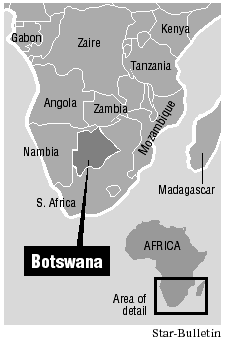
The landlocked, arid, cattle-and-diamond producing country atop South Africa is the "antipode" of this lush island tourist state. That means if you drilled a hole through the center of the Earth, starting in Hawaii, and stuck a pole through it, the other end would come out in Botswana.
The African nation is also home to 29 students who arrived at Hawaii Pacific University this semester on four-year government scholarships, and to one graduate student at the University of Hawaii.
But little may they, or most Hawaii folks, realize that the students are reviving a unique relationship between the two places that started in the 1960s.
Christinah Kjathi of Botswana didn't know. But the 22-year-old student in environmental studies always felt Hawaii was a special place. She passed up mainland universities for HPU, 12,500 miles away from home.
"Hawaii is unbelievably beautiful," said Kjathi, her impeccable English laced with a British accent. "People here are so welcoming."
Hawaii has a history of aloha for the people of Botswana. It started with the twirl of a globe in a newsroom.
Despite Americans who grew up believing they could dig their way to China, Hawaii is the only state to have a land antipode. This discovery by Honolulu Star-Bulletin editors in the early 1960s, led by Cornelius Downes, kicked off a decade of ties between Hawaii and Botswana, then known as the British protectorate of Bechuanaland. The State Department heard about plans to form a Hawaii-Botswana Alliance. Then President Lyndon B. Johnson sent Hawaii Gov. John Burns to represent the United States at Botswana's independence celebration on Sept. 30, 1966. Burns delivered America's gift -- a light airplane -- at a midnight ceremony amid a dust storm.That same day Botswana's flag -- symbolizing black and white living together in peace -- flew above Iolani Palace, while the Royal Hawaiian Band played a "Hawaii and Botswana" march composed by a Star-Bulletin reporter.
The Hana Botswana Fund gathered donations for what was then a famine-stricken nation. One of the first gifts was a prefabricated school building donated with the help of Hawaii songwriter Tony Todaro. St. Anthony's High School in Kailua started an annual Botswana Day that staff said lasted at least through 1976, with students raising money for missions there.
Two young men from the African nation received free tuition at the University of Hawaii, completed degrees, and returned home.
But the relationship started to fade in the late 1970s. The country had discovered diamonds and other minerals that helped raise its standard of living to among the higher in Africa. The government sent students on scholarships overseas, but none to Hawaii.
Then one graduate student from Botswana chose UH-Manoa last year to study public health, and 29 students showed up at HPU this semester.
Jeff Palm, associate director of HPU's International Admissions, said he hopes this is just the beginning. Palm was recruiting in nearby African countries when he heard about Botswana's scholarships.
"We showed them our diversity and threw our hat in the ring," Palm said.
Students said the adjustment has come easily to their temporary island home, despite differences such as weather and geography. Botswana gets hot, but only during summer season. And it's dry.
The country, about the size of Texas, has no ocean.
"The water is so salty," Kjathi said. "I'm used to swimming pools."
And the country's wild game reserves draw few tourists compared to Hawaii's beaches.
But more important, there are similarities. The two places share similar populations, who in turn share important values such as ohana and aloha.
Both were heavily influenced by missionaries, then dominated by powerful nations. But the family remained a core of the societies. Kjathi, like many in Hawaii, grew up with her extended family.
Both places are also noted for racial harmony and respect for individuals. Botswana's population is virtually all black, but its first prime minister, Seretse Khama, made sure the constitution guaranteed racial equality. When Khama married a white woman while studying in London, his tribe disowned him and the British exiled him from Botswana.
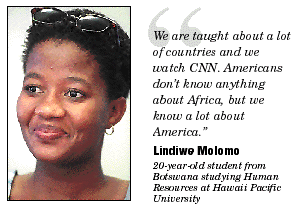
Khama also focused on education, and Botswana has one of the highest literacy rates in Africa. That's evident in the well-spoken Kjathi and fellow HPU student Lindiwe Molomo, 20, who studies human resources. Both completed the mandatory two years of national service before studying here.
Molomo says adjustment to Hawaii has been easy for her.
"We are taught about a lot of countries and we watch CNN," Molomo said. "Americans don't know anything about Africa, but we know a lot about America. If you're from Africa, people ask, 'Do you live in trees?'"
Both women mentioned Hawaii's friendliness.
"Hawaii is peaceful and quiet," Molomo observed. "It's more like home, not like Washington."
Molomo speculated that being on the opposite side of the Earth could, oddly, "be the reason" the places are so similar.
Emang Maphanyane came to America in 1969 looking for the "land of the free." He found it in Hawaii. Botswana student remembers
By Susan Kreifels, Star-Bulletin
visit to 'land of the free' in 1969Maphanyane arrived that year as a student at the University of Hawaii from the newly independent African country of Botswana. He went home four years later, learned in mathematics as well as social activism and racial harmony that would stand him well the rest of his life.
Although his nation was poor in wealth, it was rich in its promise of freedom and equality for all. The promise was all the more remarkable coming in the midst of racism that smothered much of Southern Africa. The apartheid governments of then Rhodesia and South Africa stood sentinel on Botswana's free borders.
America was ending a decade of its own civil rights battles and was in the midst of another battle over freedom on Asian shores.
"America in those days was the land of the free," Maphanyane said in a recent telephone interview from Botswana. "We were impressed by the American political system. We followed the Kennedys. People talked so much about personal freedoms and rights. America was everybody's dream."
In the growing relationship between Hawaii and Botswana, on exact opposite sides of the world, Maphanyane and Israel Mosele were awarded free tuition from UH by then-Gov. John Burns. Mosele, the victim of a serious car accident in Los Angeles during his UH years, died five years ago.
Maphanyane stayed with the family of Ah Quon McElrath, a social activist and labor organizer who today sits on the UH Board of Regents.
"The McElraths were intellectually stimulating and very aware people who knew a lot about the world and the struggles of southern Africa," he said.
Their challenging of authority "sensitized" Maphanyane, who today is the executive director of the Botswana Housing Corp., which provides low-cost housing.
Maphanyane also got to experience Hawaii's "melting pot," seeing people of different races and cultures living together peacefully.
"It opened the rest of the world."
McElrath visited Botswana last April. While there she advised workers who feared layoffs in privatization moves. She said the country, with only 2 percent of its land arable, has 13 percent unemployment. But the $3,200 per capita income far exceeds other African countries.
"There's no warfare, no rapid changes of government, no protruding bellies," McElrath said. "There's a freedom in Botswana that you can't sense in Johannesburg (South Africa). There's a desire for stability."
Maphanyane said he was happy that students from Botswana are again studying in Hawaii.
"There are very good people in Hawaii. I never felt alone."