Hawaii Pacific University
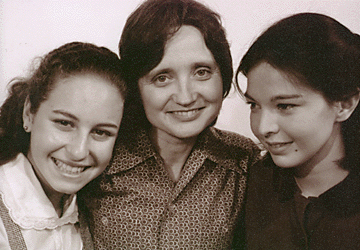
From left, Stephanie Fodor is Anne, Pam Saepae is her
mother and Therese Olival is Margot in "The Diary of Anne Frank."
Powerful acting
By John Berger
illuminates
‘Anne’s’ taleSpecial to the Star-Bulletin
The Diary of Anne Frank: 8 p.m. Friday and Saturday and 4 p.m. Sunday through Dec. 13; plus 7:30 p.m. Nov. 25 and Dec. 3, 9 and 10, Hawaii Pacific University Windward Campus. Tickets, $5-$12. Call 254-0853.
ANNA Frank would be one of the unknown tens of millions who died in World War II and its aftermath were it not for her diary.
The diary was rescued by a family friend from the detritus of a police raid, given to her father when the war was over, published in abridged form in 1947 and dramatized as "The Diary of Anne Frank" on Broadway in the '50s.
It has since been republished as Anne originally wrote it and is even more compelling in that form. Director Joyce Maltby's revival of the Broadway version at Hawaii Pacific University touches the heart and moves the soul in similar fashion. Few victims of racial, national or religious persecution over the centuries have had a more powerful memorial. Few modern plays say more about the human spirit.
Maltby and her cast do a magnificent job throughout. This production should not be missed.
Anne and her family went into hiding in 1942 after her father, Otto Frank, was ordered to report for deportation. The family -- Anne, her parents and her sister -- found refuge in the "secret annex" of an Amsterdam office building. Otto invited the Van Dann family to share the refuge with them; Mr. Van Dann had helped him when the Franks arrived in Holland in 1933. Another fugitive moved in later. They lived together in uncomfortably close proximity for more than two years. Anne wrote about them all.
On Aug. 4, 1944 -- three days after Anne's last entry -- the annex was discovered. The fugitives were arrested and deported. Otto was the only survivor of the war.
Playwrights Frances Goodrich and Albert Hackett grafted on a fictitious final entry to Anne's diary, but that brief bit of mawkishness doesn't weaken the impact of her writing. It is impossible to remain uninvolved in the day-to-day experiences of Anne and the others, even with fore knowledge that the Allies will not reach Holland in time to save them.
Stephanie Fodor (Anne) and multi-Po'okela Award-winning John Perry (Otto) are first among equals in a strong cast. Fodor seems to mature from school girl to young woman as the story progresses; she negotiates a tremendous amount of dialogue and an impressive range of emotions along the way. Perry should be in line for a fourth Po'okela with his flawless and finely shaded portrayal of Otto.
Anne was closest to her father and so Fodor and Perry have many of the best scenes, but Pam Saepae (Mrs. Frank) and Therese Olival (Margot) distinguish themselves in smaller roles as Anne's mother and "perfect" older sister.
George Hearn and Virginia Jones are a great team as the bickering Van Danns. Jones brought down the house on Friday with a single word in a scene where the adults discuss the propriety of Anne visiting the Van Dann's son in his room after dinner.
Krzyszpof Kolomar make a notable debut in local theater as inarticulate young Peter Van Dann. He and Fodor are a charming couple as the tentative and innocent star-crossed, would-be lovers.
Stan Jacobs adds an effective performance as abrasive Mr. Dussell. Patrick Casey and Leolani James complete the cast as two of the Dutch "helpers" who risked their lives to help the fugitives.
Wayne Kischer and Norman Boroughs (set design) share credit for the elaborate "annex" set. Kris Jarrett (sound) and Darren Hochstedler (lighting) do outstanding work in adding the sounds and other effects that suggest what's happening outside the annex.
As a historical footnote: A small error is noticeable in the costumes. Jews in Holland wore yellow stars bearing the Dutch word for Jew ("Jood") rather than the German "Jude."
John Berger is a free-lance writer who has
covered the local entertainment scene since 1972.