
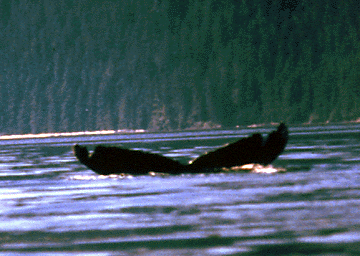
‘Big Mama’
The 'big cheese' of whales
By Lori Tighe
is full of intrigue
Star-BulletinShe's big, she's bad, she's "Big Mama."
First photographed in 1968, this female humpback whale is considered by scientists to be the oldest recorded whale in the North Pacific.
Alaska researcher Chuck Jurasz snapped her picture 30 years ago and tried to convince people it was possible to tell humpbacks apart by their tail, or fluke, markings.
Scientists eventually discovered Jurasz was right: No two humpback flukes are alike.
"It's akin to a fingerprint," said Sally Mizroch, a biologist with the National Marine Mammal Laboratory in Seattle.
Mizroch coordinates the North Pacific Humpback Fluke Data Base, which has more than 25,000 fluke photos with a number of whales named and followed for years. Many photos are multiples of the same whale, because only an estimated 6,000 North Pacific humpbacks exist today.
But no one recorded is as old as Big Mama. Humpbacks live about 40 to 50 years.
"Unlike most humpbacks, she's changed a lot over time," Mizroch said. "She's very distinct."
In the early years, Big Mama had a V notch on one side of her fluke. Then she developed a matching one on the other side. The notches don't appear shark-related because they are symmetrical, Mizroch said. But they define Big Mama's intrigue.
"No one realized what a special whale she was at the time," said Fred Sharpe, a marine biologist in Vancouver, British Columbia, who has studied humpbacks and Big Mama for 12 years. "She's the big cheese."
Big Mama is the ringleader of her pod, a sophisticated, socially complex group of three to 15 whales that hunt together in Alaska's Chatham Strait, Sharpe said.
"She appears to be one of the matriarchs, acting as a reservoir for cultural information. She organizes the hunting for fish and she calls the shots," he said.
She's the biggest whale Sharpe has ever seen. He describes her as "enormous," with a big dimple behind her blowhole. Humpback females are as big as males. They can reach 45 feet in length, weighing 45 tons.
"Big Mama's a crusty old gal," Sharpe said, "with lots of nicks and scars."
Humpbacks normally eat krill, a shrimplike fish. But Big Mama prefers herring, a quick silver fish, tastier but more difficult to catch.
When she craves herring, Big Mama organizes a hunting party, Sharpe said. She makes a loud sound, similar to "a finger rubbing on a wine glass," which drives the herring in a certain direction, Sharpe said.
Then other humpbacks dive below the herring school, swim in a circle and blow a curtain of bubbles around them like a net to trap the herring. The whales swim up the tunnel and eat the herring.
"It's a tool-using behavior," Sharpe said.
Scientists estimate humpbacks eat half a ton of fish a day.
Sharpe describes the whale's personality as unflappable, "steady as a rock," casual even. She's been tolerant of people who have studied her.
For the last two decades, Big Mama has hung out with three friends: "Rubber Lips," "Rake" and "Asymmetry," two males and a female.
Humpbacks don't mate for life, nor do they recruit their own young into their pods, Sharpe said.
"They are her co-conspirators, her running buddies," Sharpe said. "Whales do better if they feed in preferred groups."
Sharpe saw her as recently as July in Alaska's Chatham Strait. As large and distinct as she is, Big Mama manages to elude scientists in the winter.
She has not been seen in Hawaii yet.
But that doesn't mean Big Mama doesn't come to the area, Mizroch said -- she may have her own remote island.
It's unknown exactly what route humpback whales take to migrate the 3,200 miles from Alaska to Hawaii. Getting there
Researchers hypothesize the humpbacks may use an internal compass tuned to the Earth's magnetic poles to migrate from Alaska to Hawaii.
