Even as humpbacks continue
By Lori Tighe
their slow recovery from the edge
of extinction, new challenges to
their survival are emerging
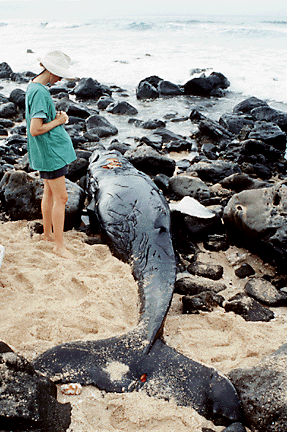
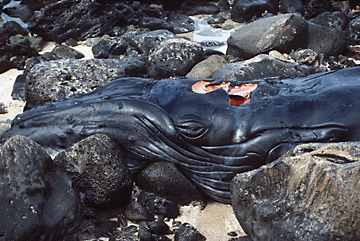
Star-Bulletinhe newborn humpback calf washed onto the rocks of Tracks Beach on Oahu in 1996.
The gouges on his back -- pink, churned flesh -- revealed the story of his death.
His mother had given birth to him, and then a boat ran over him.
"His umbilical cord was still attached," said humpback researcher Lori Mazzuca of Kona. "It would be like a woman giving birth to a baby in the street and then a car running it over."
As humpback whales recover from the brink of extinction, their chances of encountering humans are increasing.
"The whales face new challenges, pollution, vessel-whale interaction, net entanglement and development of the coastline," said Debbie Glockner-Ferrari, who has studied humpback whales for 24 years in Maui with her husband, Mark.
Only a few hundred North Pacific humpbacks migrated to Hawaii in the 1970s. Today, researchers estimate that about 3,000 whales, which is half the total population, winter here. They come in November to reproduce in the warm, shallow waters that serve as a maternity ward for mothers nursing their calves.
"We've seen a lot more mothers and calves," Glockner-Ferrari said. "I think there's been hope in the last few years. But I don't think we should let down our guard."
Glockner-Ferrari, who co-founded the Center for Whale Studies in California, belongs to the national humpback recovery team working to move the whale off the endangered species list.
Humpbacks, considered the backbone of the whaling industry, were hunted from the 1700s almost to extinction. The International Whaling Commission, made up of countries that hunt whales, agreed to halt the killings in 1966.
To move off the endangered list, the North Pacific humpbacks must reach a "sustainable level," or half of their original population at the turn of the century, when they were 15,000 strong, said Joe Mobley, Ph.D., a researcher with the University of Hawaii-West Oahu.
"Humpbacks have been slow to recover relative to terrestrial species," Mobley said.
The whales breed every 2.7 years and carry their unborn for 12 months.
"It's one thing for a humpback calf to be born, and another to grow up," Glockner-Ferrari said.
In fact, humpback deaths in Hawaii are increasing, especially among calves, Mazzuca said.
She reviewed the stranding data from the National Marine Fisheries Service over 25 years.
"We found the majority of humpback deaths were calves. It may actually be a natural mortality rate," Mazzuca said. "But it stuck out like a sore thumb."
About 26 humpbacks died in Hawaii over the past 25 years. Zero or one died each year up to 1995. But then the death toll jumped to eight in 1996 and is expected to equal that in 1997 when the statistics are tallied, Mazzuca said.She found that, of the deaths, 58 percent were calves and another 19 percent were juveniles, or yearlings.
The growing number of deaths could result from the humpback's population expansion, the public's awareness of whales, or commercial activity, Mazzuca said.
"Entanglements in nets, lines and buoys have increased the deaths. Whales become completely hogtied in the nets and are found with tiger sharks swimming around them," she said.
The Coast Guard recently pulled up six tons of fishing nets and lines off the Northwest Hawaiian Islands, said Maui naturalist Hannah Bernard, who helped in the cleanup.
"Old netting and line is definitely a problem for the humpbacks," said Bernard, education director for the Hawaii Wildlife Fund. "They end up towing the lines on their fins between Hawaii and Alaska."
Educating fishers is the key to preventing the problem, Bernard said."Fifty percent of the debris is intentional," she said. "Fishers toss their damaged nets overboard. We have to educate them to keep their discards on the boat."
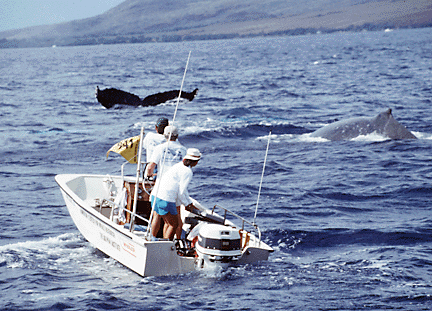
The growing whale-watching industry also poses a concern to humpbacks, said Gary Wood, deputy special agent in charge of enforcement with the National Marine Fisheries Service in Honolulu.
Although boats are not viewed as a threat yet, Wood said, the whale-watching industry has been warned to police itself.
All boats, as well as swimmers, surfers and divers, must stay 100 yards away from humpbacks at all times under the law, or face fines of up to $25,000.
The crew of the Navatek II, a whale-watching boat, thought they hit a humpback whale around Jan. 3 off Maui. They didn't see any whale beforehand, then felt a big bump and saw a whale swim off. A National Marine Fisheries Service agent investigated, but found no evidence of a dead or injured whale. On March 17, the captain of a Navatek vessel off Oahu reported the boat hit something. Again enforcement agents investigated and found nothing. No charges were filed in either case.
"Whatever is slowing their recovery, it doesn't have to do with vessel strikes," Wood said, "although the growing numbers of whale-watching boats does concern us."
But naturalist Bernard believes whale watching represents one of the biggest hopes for preservation of the whale species.
"We're watching them instead of killing them," said Bernard, who designed the naturalist programs for two whale-watching boats, the Navatek II and the Maui Nui Explorer. She finds that the more people understand humpbacks, the more they respect them.
"The commercial operators in Hawaii are conscientious, abide by the law and are not as much a concern for whales as the weekend warriors using their own private vessels, or visitors renting a vessel (who) don't know about the law," Bernard said.
To increase protection for humpbacks, Gov. Ben Cayetano last year signed into existence the Hawaiian Islands Humpback Whale National Marine Sanctuary. The $700,000 federally funded sanctuary covers most of the island waters where the humpbacks dwell.
"Increasing awareness among the public leads to increased protection," said Allen Tom, sanctuary manager.
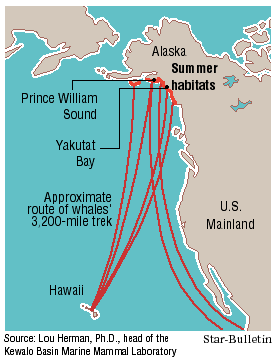
Humpbacks take about 39 days to travel the
3,200 miles from Alaska. They cruise an estimated
3 to 4 mph and are believed to swim 24 hours a day.The sanctuary sponsors research such as Mobley's and Mazzuca's and educates the public about the 100-yard rule.
"Hawaii is such a special ecosystem," said Paul Ortiz, senior enforcement attorney for the National Oceanic and Atmospheric Administration, in Long Beach, Calif. "Humpbacks have a great big bubble around them."
Ortiz prosecutes about five to six people a year who break the rule and fines them up to $2,500. But the word is spreading, Ortiz said, and violations decrease each year.
"We receive a lot tips of people violating the 100-yard rule from the public policing the ocean from their homes and condo balconies," Ortiz said.
The humpbacks' ultimate survival may depend on how long they remain protected from hunters, said Paul Nachtigall, Ph.D., director of the Marine Mammal Research Program at the Hawaii Institute of Marine Biology.
Growing their way off the endangered species list could be a "double-edged sword," Mobley said.
"They are internationally protected now. Once taken off the list, they can be hunted," Mobley said. "The Japanese used to routinely come close to the Hawaiian Islands to hunt them."
In the future, the question will be, according to Nachtigall, "Can we keep international treaties to protect the whales instead of returning to hunting them?"
Whales and the
mating gameHumpbacks perform unique
By Lori Tighe
courtship behavior
Star-BulletinThe singles scene for Hawaii's humpback whales rivals Friday nights for humans in Waikiki.
The whales sing their hearts out. They rumble with challengers and cruise the pods looking for love. They mate secretively, avoiding the curious stares of humans.
"Their mating and courtship behaviors are absolutely unique in the world of whales," said Sally Mizroch, a biologist with the National Marine Mammal Laboratory in Seattle, who studies humpbacks exclusively.
As the endangered whales return to Hawaii in mid- to late November, about seven leading scientists will also return to the oceanic classroom. They hope to unravel the secrets of humpback mating -- and the key to their survival.
"They're intriguing, mysterious and accessible to study," Mizroch said. "There's so much we don't know about them."
An estimated 3,000 humpbacks swim thousands of miles every winter from Alaska to Hawaii's warm, shallow waters to reproduce.
The season's first humpback, a yearling, was spotted on Oct. 13 by a charter boat captain off the coast of Lanai near Manele Bay.
"It's more exciting to see the first one of the season than the last one," said Alan Abdill, co-captain of Marlin Mischief Charters. "It means winter's coming."
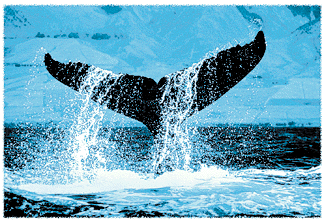
Like the arrival of the circus, humpbacks announce their return by their acrobatic displays. They launch their 40-ton bodies into the air and crash backward, a move called breaching.
They slap the surface with their tails, called flukes, and 13-foot flippers. Sometimes they'll float on their backs and slap both flippers on the water.
"They perform the most spectacular aerial feats of the large whales," said Lou Herman, Ph.D., a whale and dolphin expert who runs the Kewalo Basin Marine Mammal Laboratory of the University of Hawaii.
The humpbacks probably use their breaching to communicate, said Joe Mobley, Ph.D., a humpback researcher with the University of Hawaii-West Oahu. They may be giving information on where their pod friends can reach them, he said.
The male humpbacks soon begin their love serenade. Their songs have been called the most complicated display in the animal kingdom.
Only the males sing, and they each perform a unique variation on the same song, Mobley said.
A humpback can stop his song at the end of spring and pick up next year where he left off, Mobley said.
"One of the mysteries is what purpose song has," Herman said.
Singing humpbacks may be trying to lure females, or to strut their stuff to compete with other males, Mobley said.
"We're grappling with the fact that the songs are so complex and they change," said Jim Darling, Ph.D., with the West Coast Whale Research in Vancouver, British Columbia.
"Is this consistent with land mammal competition among males, or is humpback singing in a class by itself?" Darling said.
Crooning males are probably advertising their health status, rather than trying to out-sing each other, he hypothesizes.
In between sets, the males cruise from pod to pod checking out available females, Mobley said.
The showy humpbacks also have a private side, Herman said.
No scientist has ever observed the whales copulating or giving birth, he said.
The whales could be doing these acts in deeper water or at night, beyond scientists' prying eyes.
"If they had a bumper sticker, it would be 'Humpbacks do it deeper,' " Mobley said.
In the humpback singles scene, size does count.
"One male is the principle escort, and physically he's the biggest dude," Mobley said.
Scientists used to think humpbacks were the gentle giants of the ocean, but Herman and his research team recorded a male killed in competition with other males off Maui in 1996.
"It's always been assumed actions between males were more ritualistic than physical," Herman said. "This is the first time a death has been observed. It's very rare."
The females, once impregnated, carry their young for a year, then deliver them the next year in Hawaii, Herman said.
To the question "Got milk?" a humpback mother has plenty. She nurses her newborn with 100 gallons of milk a day, Herman said.
Calves have swum up to Herman in the water, when he's scuba dived among them. "They are very curious and playful," he said.
"They know you're there. They don't display aggression."
Herman has come within inches of being sideswiped by an adult's long flippers, but to his amazement they have never once bumped him.
Humpback facts
Who comes first: Beginning in mid- to late November, mother whales nursing their calves usually arrive first in Hawaii. Then juveniles and newly weaned yearlings come. The adult males arrive next, double the number of adult females who follow. Finally, the pregnant females arrive, after feeding up to the last minute in Alaska.
The Hawaiian Islands Humpback Whale National Marine Sanctuary will conduct an annual orientation and volunteer training Saturday from 9 a.m. to noon at its Maui visitor center. Volunteer training Saturday
The session is open to anyone interested in learning more about the National Marine Sanctuary program. Volunteers may work in the sanctuary's outreach program, host visitors to the Maui site, help in a native Hawaiian plant garden, renovate facilities, and provide office support.
Hawaii Wildlife Fund co-director Hannah Bernard will narrate a slide show on the humpback whale, and Hawaiian cultural practitioner Charles Kauluwehi Maxwell, Sr., will lead a discussion on Hawaiian culture.
Seating and parking is limited, so early registration is advised. Call (808) 879-2818, or e-mail hihwnms@ocean.nos.noaa.gov for more information.
Star-Bulletin staff
Boats, swimmers and surfers must stay 100 yards from humpbacks. To report a violation of the 100-yard rule, or the stranding of a humpback, call Hawaii's National Marine Sanctuary, 1-800-831-4888. To report a violation