
Palmyra owners
may sell
The Nature Conservancy
By Lori Tighe
and a U.S. agency would convert
the Pacific atoll to a refuge
Star-BulletinONCE called "a postcard paradise with a dangerous heart," isolated Palmyra Atoll, steeped in tales of murder and buried treasure, may be protected as a national park.
The Nature Conservancy and the U.S. Fish and Wildlife Service are negotiating to buy Palmyra Atoll, 1,000 miles south of Hawaii, from the Fullard-Leos of Oahu.
"I know there's a Spanish galleon with treasure, and I heard the tragedy of a couple murdered there. It represents points in the history of Palmyra," said Robert Smith, Pacific islands manager of U.S. Fish and Wildlife Services.
"We are interested in Palmyra because of its outstanding rain forest, incredible sea bird colony and beautiful marine life. It's a dense, tropical Garden of Eden."
Palmyra emerged as the No. 1 priority of roughly 130 potential land purchases of the Fish and Wildlife Service for 1999 because of its unique environmental features.
The 52 islets covering 8,320 acres sit on the "equatorial counter current," an unusual sea current that brings extra nutrients to Palmyra, Smith said. It has created 15,000 acres of coral reefs, with twice as many coral species as the Hawaiian Islands.
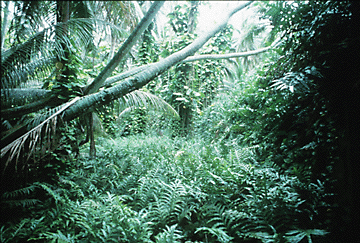
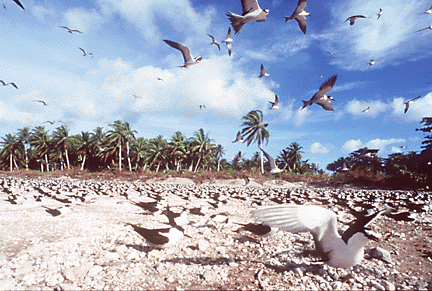
Palmyra also experiences the doldrums, or dead-wind conditions, which "make the place like a steam bath that the plants and animals just love," Smith said. Palmyra receives 175 inches of rain a year.The atoll provides one of the last intact rain forests in the Pacific islands, and the only nesting habitat for migratory sea birds within 450,000 square miles of ocean. A red-footed booby bird colony -- second only to the Galapagos Islands population -- is found there.
Endangered hawksbill sea turtles and Hawaiian monk seals, giant clams, bottle-nosed dolphins and a spectrum of birds and fish call Palmyra home.
The Fish and Wildlife Service issued an environmental assessment yesterday detailing ideas for a refuge with limited public access to fish, scuba dive, hike, bird watch and commune with nature.
The agency will receive public comment until Dec. 10.
The Fullard-Leo family, which has owned Palmyra since the 1920s, has refused offers of $50 million to develop it into a gambling resort, a fish processing center, a rocket-launching site or a nuclear waste dump, said Peter Savio, owner of Palmyra Development and Savio Realty.
The family listed Palmyra for $47 million but will sell it for less, perhaps $30 million, to the Nature Conservancy, although they aren't close to a deal, Savio said.
"The family recognizes the uniqueness of it. It's got to be one of the most beautiful places in the world," Savio said.
If the Nature Conservancy bought Palmyra, the organization would sell it to the U.S. government and then manage it.
A group of environmental engineers and scientists will fly to Palmyra Nov. 14-18 to study how many people could visit at one time without degrading the environment, said Chuck Cook, the Nature Conservancy's director of coastal and marine programs in San Francisco.
In 1974, attracted to the atoll's lush beauty, Eleanor and Malcolm Graham sailed their boat, the Sea Wind, to Palmyra. They were murdered and their boat stolen.
Drifters Buck Walker and Stephanie Stearns, who sailed into Hawaii with the Grahams' boat, were charged with the crime. Stearns got off, and Walker was convicted of Eleanor Graham's murder. Her husband's body has never been found.
