
Fed grant to help
revive Maui home
of Hawaiian kings
The restoration of Mokuhinia pond
By Gary T. Kubota
and Mokuula islet will take about 10 years
Star-BulletinLAHAINA - The dream of a number of native Hawaiians of restoring a legendary pond and islet that was the residence of Hawaiian kings appears close to becoming a reality.
The Friends of Mokuula recently received a $131,000 grant from federal officials to develop a plan to acquire the land at the county's Malu-ulu-olele Park.
"They recognized the importance of it by giving us the money," said Akoni Akana, the group's executive director.
Akana said the money, awarded by the Administration for Native Americans, will also be used to develop educational programs for native Hawaiians and students.
Akana says restoring the Mokuhinia pond and Mokuula islet will not be easy and the work, including research, will probably take at least 10 years.
"It's not going to happen overnight. This is just the beginning," he said.
The land covering Mokuhinia includes a basketball court, a bathroom, four tennis courts and two ball fields, one of which is not being used after human bones were found during archaeological digging.
Akana said the group wants to work with residents to relocate the activities to better sporting facilities elsewhere.
THE county plans to develop a 10-acre park mauka of the Lahaina Aquatic Center.
County Managing Director Richard Haake said Amfac/
JMB plans to transfer the ownership of the land once it receives a shoreline permit for its North Beach project in Kaanapali.
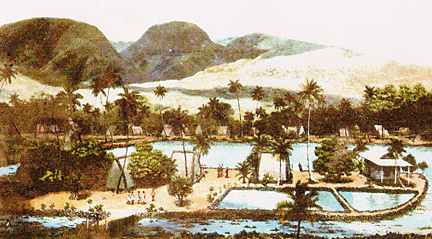
A study has been compiled by the Bishop Museum confirming the location of the pond and islet.
Mokuula was inhabited by Maui royalty before the arrival of Westerners in 1778 and later occupied by Kamehameha I after his conquest of the Valley Isle.
The island remained the home of the Kamehameha monarchy until the 1840s, when the capital was moved from Lahaina to Honolulu.
Akana says spring water that once fed the pond still flows underground and out to the sea.
HE said the pond, ranging from 14 to 17 acres, was bigger after a rain and supplied water for taro patches and other plants, and for brackish-water fish such as mullet, for the royalty.
An earthen berm served as a path to the 1-acre island.
Recently, native Hawaiians have used the site as a center for gathering with other Pacific Islanders and establishing a bond with them.
Rapa Nui (Easter Island) officials say Mokuula is referred to in their oral traditions as a place of origin in the north.
Akana says the discovery of a link between the two cultures seems to go contrary to conventional wisdom that Polynesians migrated from the south to Hawaii.
Genealogical chants describe how Maui King Piilani's daughter Kihawahine Mokuhinia Kalamaula was transformed into a moo, or water dragon, of the pond to protect the royal family.
