By Kathryn Bender, Star-Bulletin
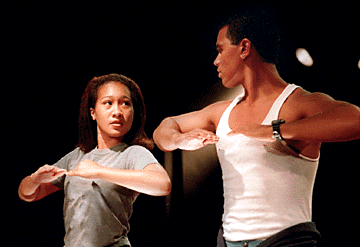
Kanani Leffew dances with Pokipala, played by Punahele
Sabagala, in "Mele Kanikau."
Kneubuhl’s ‘Mele’
By John Berger
hits right notes
Special to the Star-BulletinMele Kanikau: Presented by Kumu Kahua Theatre at 46 Merchant St., 8 p.m. Thursdays-Saturdays and 2 p.m. Sundays through Dec. 6 (except Nov. 26). Tickets are $5-$15. Call 536-4441
JOHN A. Kneubuhl completed "Mele Kanikau: A Pageant" in 1975 and died 17 years later without ever seeing it performed on stage. The plot is problematic in spots, but Kumu Kahua's world premiere production is must-see theater for everyone in Hawaii.
The cast is uniformly compelling, director D. Scott Woods maintains a sense of focus despite the narrative digressions, and tech crew members Kurt Wurmli (set design) and Chet Toni (sound) do Po'okela-worthy work in making a seemingly static set take on a life of its own.
Events that surface as the story plays out as may seem dated, even wrongheaded in 1998, but the core issues are timeless. What is Hawaiian culture? What is the correct way to portray Hawaiian history and cultural traditions?
Carl Alama (Rodney Kwock) doesn't worry about those things when he plays the king of Hawaii in something called the "Jubilee Festival Pageant." Haughty Lydia Jenkins (Kameha'ililani Waiau) is his Queen. Arthur Keoki (Vincent Kuuleialoha Keolainuiono lulu moku Elizarse Kupau) and Joseph Lokalia (Jerod "Kamomo" Bailon) are their courtiers.
When the pageant's director is called away, Alama prevails on the show's board of directors to hire reclusive kumu hula Noa Napo'o'anaakala (B.K. Cabigon). Noa and his Caucasian wife, Frances (Dana Alama), have spent years living with his halau in a distant valley. Noa speaks fluent Hawaiian, communes with extinct birds and the spirits of the dead, and guzzles whiskey straight from the bottle almost as soon as he arrives at the showroom. He addresses the cast with equal parts arrogance, vulgarity and contempt.
Noa announces that he is firing the pageant's Kodak Hula Show-style hula maidens and replacing them with the men and women of his halau. The Hollywood-Hawaiiana tourist fantasy format is out too! The halau will portray groveling commoners entertaining haughty, arrogant alii with the tale of a woman who left an alii for a commoner. The alii pursued the couple as long as they lived and refused to forgive them even after they died and returned as spirits.
Is it a coincidence that "many years ago" Frances left Carl for Noa, and that Carl used his power to make life difficult for them?
The story gets dark and ugly in other ways. Noa shoves Frances to the floor and begins kicking her. With the assistance of his acolytes Kamuela (Keoni Verity) and Pokipala (Adriano Paul Punahele Sabagala), he tries to rape the pageant's stage manager (Stu Hirayama). Did Kneubuhl intend these acts to be considered as traditional Hawaiian culture? Neither episode has a lasting impact on the development of the story.
Despite those dangling subplots, "Mele Kanikau" effectively conveys Kneubuhl's views on the spiritual underpinnings of traditional Hawaiian culture, and the differences between those perspectives and modern American values. The importance of the Hawaiian language in preserving the culture is quickly made clear. Several of the funniest and sardonic moments in the show involve the use, misuse or mispronunciation of Hawaiian phrases.
Cabigon is outstanding in a demanding and memorable role. Kwock and Alama add emotional depth as other major characters.
Waiau is a delight as the comically haughty Lydia. Kupau and Bailon deftly embellish their supporting roles. Michael Ng is excellent as an overbearing "country-club Hawaiian" type who pops up near the end of the show and is as jarring to the soul as fingernails scraping on a chalk board. It's an award-worthy performance by Ng.
Dance segments choreographed by John K. Lake heighten the cultural impact.
The story is slowed by passages in which The Author (Bob McGregor) introduces himself as the voice of the playwright, talking about life in Samoa without adding to our understanding of Noa's passion, or of Carl's efforts to deal with his newfound cultural insights.