

Monte Costa Photo
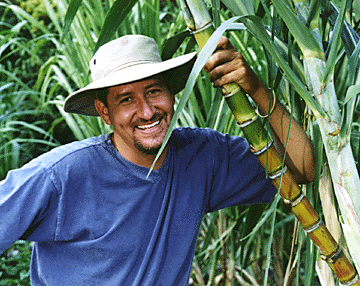
Winston Kauhane Morton, showing a stalk of sugar
cane, often talks to interested groups about the
connections between man and plant life.
HAWAIIAN ethno-botany sounds like a subject that somebody with a bunch of letters after his name, signifying graduate degrees, is composing footnotes to in some dim university office. And maybe somebody is, but it's not Winston Ka'uhane Morton. Hawaii roots prevail
The horticulturist, a student of the role of plants in the migrations of the first Hawaiians from the South Pacific, talks to school groups, to seniors and most recently to the membership of the Outrigger Canoe Club. A recital of facts and figures could not be called great entertainment, so Morton's talks are informal and strong on Hawaiiana.
Morton, through some scientific research and more study of the stories of older Hawaiian friends and relatives, sees plants as a living history of the islands, a direct link to his kupuna, or ancestors.
His talks, particularly to school kids, are important in giving young Hawaiians a true sense of identity with and respect for the great navigators of almost 1,500 years ago.
The first Polynesians to settle here in the 5th or 6th century came from the Marquesas, Morton said. The canoes of the voyagers were double-hulled and high-prowed to move through heavy seas. The navigator with remarkable skill found his way by the stars, the ocean swells, the cloud patterns that were known to form over land, the drifting debris and the seasonal flights of birds. That they ever found the Hawaiian Islands -- the most isolated land mass on Earth -- and were able to travel back and forth between here and the Marquesas and later Tahiti, attests to their superb navigation.
What these first settlers found here was ample fresh water and an abundance of fish, and not much else to eat. It is thought that they brought some plants with them on the earliest trips, watering them with the precious fresh drinking water they carried in lengths of bamboo. Among their earliest introductions were taro, sweet potato, breadfruit, yams, sugarcane and bananas.
"There were 232 forms of sweet potatoes, and more than 300 names for taro. The Hawaiians named things for what they were reminded of, by color or shape," Kauhane said. "There is a taro with a spotted leaf that they named elepaio for the native bird with spotted plumage.
"Kumu is a red fish that was an important gift or tribute to the alii, and every family was expected to made a presentation of the fish. But they were realistic, and if you didn't catch any, you could substitute kumu ko, a form of sugar cane with red stalks named for the red fish.
"A taro is called uahi a pele, because the leaves are a pale smoky color, reminding the Hawaiians of Pele, the goddess of the volcano."
The early Hawaiians, Morton said, were aware of selective breeding of taro and sweet potato varieties. "If a plant showed a desirable attribute, it was saved and its seeds or shoots were carefully propagated. That way they grew only the best."
Morton was born in Mississippi, where his father was then serving with the U.S. Army. His mother was a Kauai girl of Hawaiian ancestry who had married his father here, and then traveled the world with him, raising their family.
"But we always felt a tie to Hawaii. We ate rice, took off our slippers in the house and crack seed was shipped to us in Germany by my auntie," Morton said.
In 1978, when young Winston was entering the 8th grade, the family returned permanently to the islands. After finishing school and working at other jobs, he made a connection between his Hawaiian roots and the endangered native plants of his homeland. He went to work at Waimea Arboretum where Keith Woolliams who was then the director, taught him how to propagate plants.
When the staff was severely reduced at the arboretum after Woolliams left and the management changed, Kauhane started his own small nursery near Haleiwa. He has planted Hawaiian natives, particularly lei material, "to prevent people from going into the forest to collect it," he said.
His particular interest is in the minute differences between the same varieties of plants, depending upon where they have been grown.
"The state flower, Hibiscus brackenridgei, from Molokai, is a little different from the one growing near Waialua High School. The two should be kept separate, so you don't screw up the gene pool and lose the purity of the species.
"It's important to save them. Native Hawaiian plants are like living museum pieces."
Teachers or community groups interested in hearing Morton speak on the early plants of Hawaii, "The Plants of the Canoe," can reach him at the Office of Hawaiian Affairs at 594-1888.
Gardening Calendar in Do It Electric!
Send queries along with name and phone number to:
Evergreen by Lois Taylor, Honolulu Star-Bulletin, P.O. Box 3080, Honolulu 96802.
Or send e-mail to features@starbulletin.com.
Please be sure to include a phone number.
Evergreen by Lois Taylor is a regular Friday feature of the
Honolulu Star-Bulletin. © 1998 All rights reserved.

