By Craig Kojima, Star-Bulletin
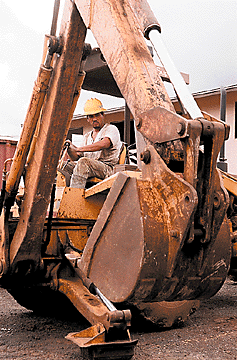
Uiki "Ricky" Teo operates a tractor as part of his
responsibilities at the $8.89 million Koolau Village
public housing project in Kaneohe.
Program helps build
better futures
A federal employment project
By Jerry Tune
enables a laborer to get
off public assistance
Star-BulletinHeavy-equipment operator Uiki "Ricky" Teo is helping build public housing in Kaneohe.
But it was his own job, at Metcalf Construction Co., that enabled Teo to leave public housing at Kuhio Park Terrace and move to a Waipahu apartment with his wife and four children.
Teo got his job about four years ago under a federal employment program designed to get people off public assistance by giving them jobs building federally financed housing and community development projects.
The Department of Housing and Urban Development program, known as Section 3, has been in place for decades, but the state recently has attracted more than 100 jobs opportunities from 50 contractors and is looking for qualified applicants to fill them.
"Out of those, 10 percent have been filled by low-income people," said Rick Speer, the Section 3 administrator at the state's Housing and Community Development Corp. Speer took over the job four months ago as the state made a push to help low-income residents climb the economic ladder.
Teo, 29, a Waianae High School graduate, was able to get a basic laborer job at Metcalf four years ago because of training in combat engineering and heavy equipment that he received while with the Army National Guard.
At the time of his hiring, Teo was living in public housing and unemployed after working previously on road paving jobs.
Dan Bowers, project manager at Metcalf, said Teo has adapted quickly to new jobs, moving from laborer to equipment operator, and is starting to work with concrete.
"I just want to keep moving up the ranks in the company," Teo said yesterday on the site of the $8.89 million Koolau Village public housing project in Kaneohe. Metcalf is building 80 homes and refurbishing a community center and office at Koolau Village.
Bowers said Teo is the only Section 3 program hire now working for Metcalf but the company has used six people from the program dating back to 1991.
Contractors choose what jobs to offer and the applicant must meet qualifications. Hires are chosen on a priority system: first, from those who live or will live within the government project under construction; second, from any of the state housing projects; and third, other low-income people.
Records have not been kept on just how many Section 3 people have been hired over the years but HUD is making this part of its annual reports.
The state has been using a similar program in public housing projects for more than 25 years. The "tenant aide" program has established about 30 jobs at housing projects.
But Section 3 is more expansive on the type of jobs available. Jobs in the federal program have included accounting, bookkeeping, payroll, purchasing, appliance repair, carpet installation, catering, computer/information, florists, janitorial, landscaping, manufacturing, marketing, photography, printing, transportation, architecture, bricklaying, carpentry, cement/masonry, demolition, drywall, electrical, elevator construction, engineering, fencing, heating, iron works, machine operation, painting, plastering, plumbing, surveying and tile setting.
The program is open to anyone receiving public housing or welfare assistance.
Bowers said Metcalf has a Section 3 coordinator and is eager to get more hires.
"The hardest thing to do is to get skilled labor," he said. "We'd like to see more training in trade schools. For some of these people, it would be nice to start in high school."