
Old Lihue Theater
becomes housing
for elderly
The historical features are
By Trish Moore
being restored before the theater
takes on its new role
Star-BulletinLIHUE -- There's something grand about the glamour and sophistication of Humphrey Bogart's era being preserved in a building that will house the elderly.
The old Lihue Theater, built in 1931 and adorned with the art deco style of the day, is being restored as a historical building and transformed into a low-income elderly apartment complex.
John Frasier, executive director of the Kauai Housing Development Corp., said the building is eligible for the National Historic Register.
The only alternative would have been to demolish it because there's not enough parking for commercial use, Fraser said.
The theater has always been a prominent landmark in downtown Lihue.
The original sign and marquee have remained, even during the building's various incarnations as a dance hall and cabaret in the late 1970s and a roller skating rink before it was closed down for good in 1982 by Hurricane Iwa.
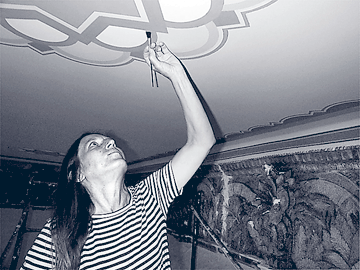
Charged with restoring the building's historical features is Olga Urminska, who cut her teeth in preservation work restoring medieval art works and a European castle in her native Czechoslovakia.
Urminska said growing up amid the devastation of postwar Europe instilled in her the desire to "preserve what is left."
She was a graduate art student when the Soviet Union invaded her country in 1968 and began destroying culturally important buildings.
"It wiped out history and replaced it with Russian aesthetics," she said. "When that happens, a whole place loses its individuality. Historical buildings are a daily reminder of the history of a place. It doesn't matter if it's 150 or 500 years old."Strolling through the front lobby with its flagstone floors and stone-carved walls and staring up at the 20-foot-high ceiling, Urminska can easily imagine what the theater might have been like in its heyday:
"It must have been incredibly uplifting for the people not having much money but being able to pay their 5 cents to go to the theater and be somewhere really glamorous," she says. "It was culturally uplifting. There must have been many marriages made here."
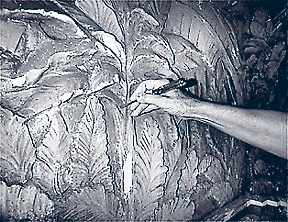
The plaster-cast frieze in the front lobby and the carved artificial stonework on the window that surround the building's outer facade are done in the modern-art style of the 1930s, but with the tropical motifs of banana trees, ginger stems, various fern species, even a Kauai pheasant.
"This was very sophisticated for that time," Urminska said.
When Urminska first began work on the project, the front lobby "looked like a cave," overgrown by black mold and caked with decades of dirt. The stenciled geometric designs on the ceilings had nearly vanished, and the frieze had sustained water damage after two hurricanes.
"It's a miracle that it's still here," she said.
The $3.5 million project, targeted for completion by January, is more than half subsidized by federal disaster funds, Fraser said. The complex will have 20 one-bedroom apartments for rent to residents at least 55 years old.
