On Tuesday, voters will be asked "Shall the Constitution of the state of Hawaii be amended to specify that the Legislature shall have the power to reserve marriage to opposite-sex couples?"The question has divided Hawaii residents along political, emotional and spiritual lines that aren't always clear.
Today, the Star-Bulletin examines the issue from the state's pulpits and pews to see how church members, and leaders, are looking for an answer to the same-sex marriage question.
Yesterday, we looked at some of the political divisions, alliances and possible consequences of the proposed amendment.
Voters turn to their religion
By Mary Adamski
for guidance on the
same-sex question
Star-BulletinFor thousands of voters, the choice on the same-sex ballot question isn't based so much on the political debates or the barrage of advertisements: It's a decision to be discerned through their religious faith. Christians of various denominations are weighing elements, selected quotations from Scriptures condemning homosexual behavior vs. Jesus Christ's teachings of love and forgiveness and his record of reaching out to outcasts.
Local Episcopal Church members wrestled with those viewpoints at their annual convention last weekend. After hours of intense and emotional debate, they chose a nonjudgmental middle path, vowing to explore ways in which to support loving and committed gay and lesbian relationships.
A vote of faith
The controversy generated by
By Mary Adamski
same-gender unions has created struggles
within many religious denominations
Star-BulletinFor Hawaii voters, the issue of redefining marriage is now in the political arena, a contest to be resolved by majority vote.
If they're church members, they most likely perceive it as a religious issue too. But they are by no means united on what they believe about same-gender marriage.
Local representatives from some religions have led the opposition to same-gender unions from the minute the Hawaii Supreme Court's 1993 ruling cast aside the historical presumption that marriage meant one man and one woman.
The stand taken by spokesmen for the Catholic church and Church of Jesus Christ of Latter-day Saints and fundamentalist Christian churches has been repeated frequently in legislative hearings in the intervening years.
Meanwhile, same-gender unions have been blessed and celebrated in other churches. Many have organized outreach to the gay and lesbian population.
The controversy has been divisive within the national or worldwide organizations of some denominations. The United Methodist Church's national judicial council this summer said pastors may be stripped of their credentials for officiating at same-sex unions. The leaders of the worldwide Anglican Church affirmed traditional marriage at its 10-year summit this summer.
One thing that church folk share is a wariness about crossing the line from preaching belief into political advocacy. Clergy and lay members cite their vulnerability, the threat of having a church or organization's tax-exempt status jeopardized if they make an outright pitch for a specific vote.
Many Protestant denominations circulated and pinned on bulletin boards an advisory from the Christian Legal Society of Hawaii. "The law allows you to teach and preach from a biblical perspective on marriage and how the institution of marriage may be impacted by the proposed amendment.
"The rule is 'no substantial part of the activities of your church may consist of carrying on propaganda or otherwise attempting to influence legislation.'"
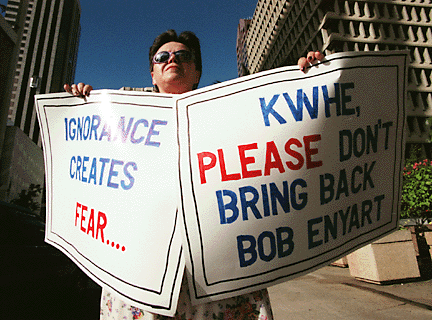
That is precisely what Section 501(c)3 of Internal Revenue Service law provides, said Gary Green, chief of the IRS examination branch in Honolulu."Where a group gets in trouble is where it crosses over, when they get into an action organization, which is not tax-exempt. Then they no longer are a church" in the eyes of the law, he said.
Catholic pastors received a letter from Bishop Francis DiLorenzo last month urging them to educate their congregations on the ballot issue but warning that churches and nonprofit organizations are restricted from advocating a specific vote.
The bishop laid out the history of the organizations that are advocating a yes vote on the question of reserving marriage to a man and a woman and mentioned he had spoken at the Save Traditional Marriage '98 opening rally.
The ballot question
This is the wording of the proposed constitutional amendment on same-sex marriage: "Shall the Constitution of the state of Hawaii be amended to specify that the Legislature shall have the power to reserve marriage to opposite-sex couples?"
Here's what will happen if you vote yes or no on the proposed amendment: What your vote does
If you vote yes
Means that the Constitution is amended so lawmakers have the power to forbid same-sex marriage.
If you vote no
The Constitution remains the same, and the issue would be decided in the courts.
Ratification
Passage requires more than 50 percent of total votes cast. BLANK and SPOILED ballots count as "No" votes.
WHAT THE BIBLE SAYS
A biblical reference that lived on in the English language is the word "sodomy," which formerly was a crime in the state statutes, defined as including illegal copulation between two of the same sex. It refers to the ancient city of Sodom, which God destroyed, along with Gomorrah, because of the sins of the inhabitants. The story, which refers to the homosexual proclivities of some men of Sodom, is found in the book of Genesis, Chapter 19, verses 1-14.
Other biblical texts that are used to condemn homosexuality include:
Leviticus 18:22, 20:13. "You will not have intercourse with a man as you would with a woman. This is a hateful thing. The man who has intercourse with a man in the same way as with a woman, they have done a hateful thing together; they will be put to death; their blood will be on their own heads."
About marriage
Views from the clergy
BAPTIST
‘God loves gays but
same-sex marriage isn’t in
the program, folks’Rev. Rick Lazor
By Mary Adamski
Star-Bulletin'I think the Bible's read on homosexuality is the best proof there is that it is not an inborn trait," said the Rev. Rick Lazor.
The pastor of Nuuanu Baptist Church can cite Old and New Testament chapter and verse referring to same-gender relations. His ministry seeks to reclaim gays and lesbians from the lifestyle and set them straight.
"One of the passages I am fond of using is 1st Corinthians, chapter 6, verses 9 to 11," In that letter, Paul lists categories of sinners including drunkards, thieves, slanderers and adulterers as well as "sodomites" and says none of them will inherit the kingdom of God.
"You can stand up in the pulpit and scream that at people," said Lazor, "But you cannot leave the next passage out. That's when Paul says 'And that is what some of you are.' I have thought about asking for a show of hands. I could be included in there, too.
"Homosexuality is a grievous sin, so are all the others. I appreciate it is placed together with a lot of other things many of us are not so uncomfortable with, such as drunkenness, perhaps," said Lazor. "Jesus sees all of our activity and behavior that comes from a sinful rebellion against God as grievous to his heart."
He said the passage from Corinthians has a joyous resolution and that is the message he promotes: "Some of you used to be of that kind, but you have been washed clean, you have been sanctified, and you have been justified in the name of the Lord Jesus Christ and through the Spirit of our God."
Lazor is on the pastoral board of Hawaii Family Forum, which prepares informational materials about the same-gender marriage question on the ballot but steers clear of advocating a specific vote. He has testified before Legislative committees on same-sex marriage bills.
The Ohio native entered the ministry after earning a master's degree in social work from University of Hawaii. He first took a stand against the homosexual lifestyle a decade before the current religious and political issue arose.
He was pastor of Kaunakakai Baptist Church on Molokai in 1985 when some residents began a fund-raising effort to send a children's hula halau on a mainland trip. The central attraction of a planned benefit carnival was the Miss Gay Pacifica Beauty Pageant featuring transvestites, men dressed as women. Several churches opposed it and the late Hannibal Tavares, then Maui county mayor, revoked a permit for public park use saying it was not a "wholesome" activity. Ultimately, a federal judge upheld the American Civil Liberties Union suit, finding that the ban violated First Amendment freedom of speech, and the show went on.
Constitutional protection again is being invoked in the current controversy, by opponents to the proposed ban on same-gender marriage. Lazor said "there is no civil right being violated ... by simply stating what everybody else in the world already believes. Marriage by definition is between a man and a woman" and he will cite Scriptural references for that belief, too.
"From the Christian standpoint, the No. 1 thing we do to weasel out of our accountability to our Savior is to blame God. When somebody who is homosexual says 'I was born this way' that means I blame God for who I am. Homosexuality is not a minority group, it is a lifestyle choice."
"Straight people don't get off by hollering about gays and think we have license to do whatever we want. Sexual immorality is the issue in all the different forms.
"Somebody has got to stand up and say 'this is what marriage is. God loves gays but same-sex marriage isn't in the program, folks.' It's not a hate issue, it's not homophobia. I have gay friends, we have ex-gays in our church who are trying to change."
Lazor's church has sponsored workshops and speakers from mainland movements such as Exodus International, which aim to change people from the gay lifestyle.
"When somebody called the phone number for Homosexual Anonymous, it rang at our church." He said the project similar to other 12-Step rehabilitation programs has been shut down because of staffing problems.
"I'm really sad that sometimes our passion about protecting marriage gets interpreted as hatred for the people who disagree with us. We don't hate anybody."
EPISCOPAL
Ballot question creates
deep struggles for church
members, clergyBishop Richard Chang
By Mary Adamski
Star-Bulletin'People are struggling with this issue," said Hawaii Episcopal Bishop Richard Chang, whose own informal poll on the same-gender marriage issue is taken in visits at a different parish church each Sunday.
"About 60 or 70 percent say they haven't decided. They are coming to a point of decision but haven't reached it yet."
Aside from a political issue in the state, the question is an issue within Chang's church.
An international gathering of the church's leaders in July passed a resolution saying that homosexual practice is "incompatible with Scripture" and that the choice for Anglicans is between "faithfulness in marriage between a man and a woman in life-long union" or abstinence. The 526-70 vote at the Lambeth Conference in England was among bishops who lead the world's 70 million Anglicans.
Their vote doesn't mean the answer is set in stone. "It's really like the 'mind of the house,' not a legislative law," said Chang, who cast one of the "no" votes. The presiding bishop of the United States, Frank Griswold, was one of 45 who abstained.
The subject was on the agenda of the annual Hawaii diocesan convention last weekend. The 200 delegates debated how far to go in affirming support of homosexual relationships in sessions that revealed a spectrum of opinion from conservative to liberal.
Resolutions that would have "honored" committed, monogamous gay and lesbian unions, or rejected homosexual practices as "incompatible with Scriptures" were discarded in favor of a middle-ground resolution to "explore how we can express our support for loving and committed relationships of gays and lesbians." Several delegates, including clergy, identified themselves as gay during the emotional debate.
Chang was one of 146 bishops at the Lambeth meeting who released a statement pledging that the church will work for the full inclusion of homosexuals in the life and ministry of the church, apologizing for "any sense of rejection."
Despite many other matters addressed by the bishops, this is the one that was widely reported in public and church media. "People have been asking me about it. I take the time to put it in context," said Chang.
"I feel it is an issue we have to discuss, hopefully in a non-legislative, non-judgmental environment where people can sit down with the wide variety of views in this diocese and stay engaged in the conversation. I don't think any one group has a corner on the market as far as truth is concerned."
Even if the law allowed it, there would be no ceremonies uniting same-gender couples in Episcopal churches here, he said. "Our national church canon does not permit same-sex unions. I took an oath to uphold that. I told the clergy of this diocese they may not authorize any kind of blessing of same-sex marriage."
Chang is not one of the activist clergy speaking out about the Nov. 3 ballot issue. "I don't want the state to pass legislation that would dictate my theology," he said.
"It's not an issue that's as simple as the advertisements. Any constitutional law change has tremendous implications ... to change one thing can cause greater harm to another part of the system. We need to look holistically at all the issues. Someone has to hold up the whole vision, which is not a very comfortable place to be. That is what the role of the bishop is.
"I'm a reflective kind of person. I like to sit back, think it over, test it out ... if yes, it means this happens and this and this," said Chang.
"I'm struggling."
BUDDHIST
Marriage is a spiritual
relationship, not a
biological oneAlfred Bloom
By Mary Adamski
Star-Bulletin'Legalization of same-gender marriage does not require or imply religious acceptance. What is religiously forbidden by particular traditions is not necessarily prohibited in society generally."
This is the language of the Hawaii Association of International Buddhists in a quietly released statement opposing the proposed state Constitutional amendment limiting marriage to a union between a man and a woman. The group also opposes calling a Constitutional Convention, saying the two ballot measures are "threats to civil rights and tolerance in our state."
"It's not put in combative language. We don't want to fight with anyone," said Alfred Bloom, president of the fellowship of members from several Buddhist temples and groups. It is rare for Buddhists to take a stand on a public controversy, he said, and the group does not purport to speak for all Buddhists.
"There is nothing in Buddhist teachings, no restrictions (against same-gender unions), it is up to a minister to decide." Bloom said he knows of no local Buddhist ceremonies for same-gender unions. "It came up at a recent mainland ministers' meeting. The minister at a Chicago temple said he just does it. A minister's affirmation of any union should be based on the quality of the relationship, if the people involved have a commitment.
"Marriage is a spiritual relationship of commitment and love," said Bloom. "The problem we see in this debate is a biological view of marriage rather than a spiritual view.
"Buddhism is concerned with how your ego is involved in relationship with the other person," Bloom said. "If you are using your ego in a dominant, destructive way, then this is not a true relationship. We are moved by our egos and we have to resolve our own ego problems in order to work with others.
"Christianity starts off with specific beliefs. Buddhists don't have teachings they see as the sacred, inspired word of God," said Bloom, who was ordained a Buddhist minister after he retired as a University of Hawaii religion professor. He was formerly dean of the Institute of Buddhist Studies, affiliated with the Graduate Theological Union at Berkeley, Calif.
"Doctrines are there in Buddhism, but they are quite secondary. Buddhism (is) an analysis of consciousness." Buddhists practice their beliefs by "an effort to understand and control the ego. Through gradual growth and development, we strive to become more sensitive to our own prejudices and become more compassionate to other people because they are going through the same thing.
"Christianity tells you to love your neighbor, but it doesn't tell you what are the ego barriers that keep you from loving," said Bloom, who was raised as a Baptist.
The Hawaii Association of International Buddhists affirmed in its statement:
REFORM JUDAISM
Gays and lesbians should be
allowed to marry in a
religious ceremonyRabbi Avi Magid
By Mary Adamski
Star-Bulletin'Reform Judaism feels that gays and lesbians are in the Jewish process, period," said Honolulu Rabbi Avi Magid.
There are rabbis who perform same-gender unions, there are gay and lesbian congregations, and no barriers to homosexuals becoming rabbis or cantors in the branch of Judaism that includes the majority of Hawaii Jews.
Magid attended the June convention of the Central Conference of American Rabbis, which has already endorsed the idea of same-gender civil marriages. A majority of delegates was prepared to approve a resolution at the Los Angeles meeting that rabbis may perform such ceremonies.
Instead, he said, the convention deferred discussion because a second committee disagreed with the recommendation of the Ad Hoc Committee on Sexuality. The Responsa, which answers questions about the law posed by rabbis around the country, found that such unions would not be kiddushin, would not meet the criteria of Jewish law.
"So the Reform movement has gone on the record on both sides of the issue and relies on rabbinic autonomy to make a decision."
Magid described that situation to his congregation at Temple Emanu-El at a recent Sabbath service. "I have reflected and considered both (opinions). I ultimately come out on the more liberal side. Consequently my opinion is that gays and lesbians should be allowed to marry in a same-gender religious ceremony."
The current situation, where differing conclusions are reached on an issue, is typical of Jewish tradition. Rabbis consult not only biblical texts but also the Talmud, an enormous collection of commentary and interpretation by scholars and sages compiled between the years 200 and 800 A.D. "The rabbis were very content to agree to disagree."
There's no source of reference in the Talmud on the subject of same-sex marriage. "I don't believe the rabbis of the third to ninth centuries could even have conceptualized this notion," he said.
"The biblical texts are uniformly opposed to homosexuality, even going so far as referring to it as an abomination," he said. The language "was pretty much symptomatic of the time," about 2,500 years ago when the scriptural writings were collected and combined.
"The texts are there for the taking, but in general, the liberal Jewish community would view them as being misused and abused. If you pull a text out of context, you do it a disservice, and in the process, inappropriately manipulate the text."
To take the biblical writings in context would require knowing the historical background and social history of the times. "I can get pretty far-fetched. For example there is a biblical law against mixing wool and cotton threads in making cloth, or against eating shellfish, or yoking an ox and a camel to plow a field."
The legal requirements for marriage "have been overtaken by the times." Marriage was supposed to be a union of two Jews, but many interfaith marriages are performed by rabbis. The legal concept of acquisition in a man's relationship to his wife "has been roundly rejected." And the traditional ketubah or wedding contract that set out specifics about dowry and the woman's rights has evolved into "texts more about spirituality, love and connection."
In the context of modern times, "most folks understand the advances that science has made in terms of the background and basis of homosexuality. While I don't say it is irrefutable, it is very clear."
Magid has been on the record for years as favoring same-sex unions, and has received letters and phone calls from critics. "Folks are entitled to feel the way that they do about their religious beliefs. I am first in line to argue that, even when folks say things I don't agree with.
"The Jewish world knows that when you live in a society where you can't say the things that are in your mind and on your heart, freely and openly without being taken to task, that is a community where Jews are not safe. And if we're not safe, I personally believe nobody's safe."
"I don't think anybody in Hawaii wants to live in an environment that tells anybody else that 'You don't have value.' I don't think that people do that in their families, and I don't think we want to do that in this ohana that we call the family of Hawaii."
CATHOLIC
Sexual intercourse exclusively
belongs within marriageRev. Randy Roche
By Mary Adamski
Star-BulletinAs an antidote to the mean-spirited pre-election exchange, the Rev. Randy Roche envisions a spiritual retreat, the kind of getaway gathering in which people pray together and share life experiences in the context of their religious beliefs. When it works, they leave profoundly moved and closely tied despite their differences.
The retreat he imagines would bring together all the church people who have been separated and polarized by their different views on the same-sex marriage issue.
"If people could go together on a retreat willingly, then find out the sister or brother next to them is really a wonderful person to be treasured ... maybe then, differences could be accepted.
"So many are angry, people are using judgmental words and condemnatory broad generalizations, accusations that presume bad will," said Roche. The Jesuit priest is pastor of Holy Spirit parish at the Newman Center, the Catholic campus ministry at University of Hawaii. About half the congregation members are students, including graduate students, and the rest, residents from around the island.
He had just fielded an enquiry from a television station seeking to cover a sermon on the issue of the day. But they're not going to hear a "hell-and-damnation" text from the Newman Center pulpit.
"We teach there is a responsibility to vote. We preach discernment, how to pay attention to one's relationship to God, how to avoid being manipulated by pressure groups," said Roche. "We would talk about principles from which to make good decisions.
"The church as teacher certainly has something to say about marriage, about not cheating on marriage, and it is also compassionate when there are people whose marriages break down."
A change in civil law won't change the church institution of marriage as a sacramental commitment between a man and a woman.
Roche said "The positive teaching of the church is that sexual intercourse exclusively belongs within marriage. Anything else is less than the ideal, is out of bounds ... is sinful behavior." But, he said, "There's not a very strong body of teaching that would address fornication, adultery, all kinds of sexual behavior. That's not the most important thing we have to talk about, it just isn't."
To select a particular scriptural passage as God's definitive word on a subject "is not a Catholic belief. (The church) doesn't stand back and say 'when you read this, it means this.' That's not Catholic. However, there are Catholics who will do that," he said.
"I don't think the church has found anything from revelation about specific affirmation of people in terms of sexual orientation. There are people who identify themselves as gay or lesbians who see themselves as believers, disciples of Jesus, good people. People should never be classified as sinners, as guilty according to their orientation. Respect is based on every human being's worth, not on orientation.
Roche wrote in a recent Sunday bulletin: "It seems to me that two men or two women can and do come together in a range of relationships, none of which in themselves say anything about sexuality. Any persons may intend to stay together for life, may adopt and raise children, and may be exclusive in their expressions of unity. Do any of these relationships call for or give witness to what we understand as marriage? It does not seem so to me."
The Newman Center hasn't planned any study sessions on the issue, Roche said, because "we haven't thought of a way that would be first, prayerful ... a way to bring our spirituality to apply. To merely have it out there at a level of teaching ... doesn't touch the heart."
UNITED CHURCH OF CHRIST
‘The gay and lesbian
community is just as much
a part of God’s creation’Rev. Joan Ishibashi
By Mary Adamski
Star-Bulletin'I think the clergy are afraid to take this issue on because it is divisive."
The Rev. Joan Ishibashi, associate conference minister of the United Church of Christ, said she has yet to hear the same-gender marriage topic being discussed from the pulpit or at church education meetings.
But she has been fielding questions in telephone calls to her office since she joined other Protestant ministers at a press conference last month criticizing opponents of the ballot question for "tactics of fear and intolerance."
The subject does come up in the church, which is the descendant of the first Protestant missionaries to Hawaii.
The 1996 annual convention of UCC delegations passed a resolution 88-71 affirming that "God's will for marriage partners is one man and one woman joined together in marriage blessed for life."
But on the second day of the Aha Pae'aina, the group voted 91-65 to reconsider that stand. They urged study groups in individual churches to have discussions on the matter. They haven't revived the subject at subsequent conventions.
"We don't have a bishop or pope telling us what we have to believe. We struggle together in growing in our faith, but we take different paths. We try to honor the difference of opinions of believers.
"I feel that the gay and lesbian community is just as much a part of God's creation, and is worthy of a lot of compassion, but not everyone agrees with me on that," said Ishibashi. "Or they will go up to a certain point and say ... except for same-sex marriages. For me, you can't separate that out."
She has presided at one blessing ceremony for a gay couple. "It was very powerful. These two men put a lot of thought into it, their families knew what was at stake, to make it public ... the commitment level was much greater than some. A lot of (heterosexual) couples don't take it as seriously as they should."
The national United Church of Christ organization has prepared a handbook for ministers on how to design a same-gender blessing ceremony, not called a marriage. Individual ministers have the choice, as they have the option of refusing to perform any marriage.
Ishibashi just returned from a meeting at the denomination's national headquarters in Cleveland which addressed the placement of gay and lesbian clergy.
She said a seminary official told the meeting that about one-third of today's seminarians are "out-of-the-closet gay, lesbian and bisexual people."
She said churches willing to accept homosexual ministers "prefer couples. Oftentimes the folks who are pastoring are in committed relationships."
Intolerance toward homosexuals reminds Ishibashi of the prejudice she endured growing up. Her Japanese-American parents faced a neighborhood petition protesting their planned purchase of a home in Downey, Calif. She "faced a lot of ignorance" when she attended the University of Nebraska. Ishibashi earned a bachelor's degree there, then graduated from the Princeton Theological Seminary in New Jersey. She was ordained in 1986, soon after her arrival in Hawaii.
"When I see even harsher behavior, really horrific behavior towards gays and lesbians in the name of Jesus Christ, it makes me so sad. Throughout all these years, I've always had this really deep, deep sadness that it's members of the Christian church that can be so cruel in their attitudes and treatment of people who are different."
Same-sex marriage:
Past articles