
Budget, taxes
main points of
TV battle
Jabs continue after
By Craig Gima
the camera fades at KHON's
gubernatorial debate
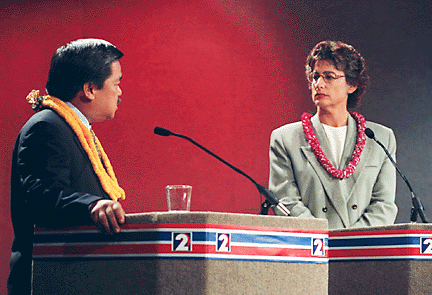
Star-BulletinEven after their contentious televised debate ended, Gov. Ben Cayetano and Maui Mayor Linda Lingle continued to jab at each other in answers to reporters' questions.
"She made many promises, but she does not have a plan," Cayetano said about his opponent.
"She never answered the question. She evaded the reporters' questions on many of the issues, and I think people can see that."
Lingle responded that the budget of the state is "obtuse" and "difficult to understand" because the state does not set performance measures.
"He controls the books right now, and he controls the bureaucracy. I couldn't have done it before being mayor, even though I was sitting on the council for 10 years," Lingle said.
"I think it is a red herring to continue to say, 'What would you do?' " she added.
The debate last night on KHON-TV -- the last meeting between the two candidates before next week's election -- was marked by feisty exchanges that highlighted the many differences of opinion between them.
When the candidates were allowed to ask questions of each other, Cayetano pressed Lingle on how she would pay for her plan for Hawaii's future. He estimated her programs would cost $280 million in addition to what Lingle estimates is a $500 million deficit.
Lingle said Cayetano's numbers "don't add up."
She said her tax credits to stimulate the economy would not cost the state money but would bring in new revenue.
She said she would begin to pay for her programs by cutting waste in government.
"That's where I would start, just as the other states have. They haven't raised taxes; they've just cut the waste and had the money available for the new programs that were proposed."
In rebuttal, Cayetano shot back, "If this was Texas, I'd call that a longhorn answer: a point here and a point there and a lot of bull in between."
Lingle questioned Cayetano's support for a 34-percent increase in the general excise tax.
"Why would you continually try to raise a tax that is hardest on poor and middle-income people?" she asked.
"The problem with you is that you only give half the story," Cayetano answered.
He said the general excise tax increase was part of a tax package that would have reduced taxes overall for everyone, and noted that the personal income tax cut that emerged from the Legislature was the biggest in Hawaii history and one of the biggest in the country.
He said if re-elected, he will push next year for a corporate income tax cut and other tax incentives for business.
"The tax cut you call the biggest in our history is really the only one that we've had in our history," Lingle said in rebuttal. "It hasn't gone into effect and won't until next year."
Lingle also pressed Cayetano about taking money from special funds to create a surplus in the general fund.
"The fact is, our state is taking in less money than our state is spending every day," Lingle said.
However, Cayetano said the law allows the administration to use excess special funds, and, like a good money manager, he used it to deal with the deficit instead of cutting important programs.
Cayetano also attacked Lingle over her environmental record and problems Maui has had with sewage spills.
Cayetano said the Sierra Club did not endorse Lingle because "you seem to be oblivious to our environmental protection laws."
Lingle accused Cayetano of using the sewage issue for political purposes.
She pointed to a consent decree signed by the state Department of Health in 1996 that says Maui has taken initiative to upgrade its waste-water system and made good-faith efforts to correct problems.
She said Maui was voted the No. 1 resort island in the world, and that shows that the county has found a balance between "a healthy economy and a clean environment."
Even when they agreed on an issue -- legalized gambling -- they disagreed on their reasons for opposing gambling in Hawaii.
Cayetano said he believes it would be destructive to Hawaii's people, culture and lifestyle, while Lingle said gambling would hurt small business as well as families.
In his closing statement, Cayetano compared his four years in office to a voyage on stormy seas.
"Now the waters are a bit calmer, the stars are a bit brighter, and the horizon is a bit clearer. Tonight I ask you, let us finish this voyage together."
Lingle appealed for a fresh start for Hawaii.
"I believe its time for us to roll up our sleeves and get to work," she said. "I look forward to working with you to bring about the kinds of common-sense solutions that will make life better for everyone in our state."
Debate points out
By Richard Borreca
candidates’ reasons for
political affiliations
Star-BulletinExactly how important it is to be a Republican or Democrat became one of the battlegrounds for last night's final television debate of this year's race for governor.
The debate, broadcast live on KHON-TV, featured the two major candidates, Gov. Ben Cayetano, a Democrat, and Maui Mayor Linda Lingle, a Republican.
When Lingle explained how she became a Republican, it caught Cayetano's attention.
"When I first ran, in 1980, I felt I was living in a bad system, and everyone I was running against happened to be Democrats, so I felt I had to run from the other party," Lingle said. "I felt I couldn't go on the side I was criticizing, so I went as a Republican.
"It has worked out well philosophically, especially how it relates to government not being the total answer to society's problems," she said.
"I believe the Republican Party clearly believes in the power of the individual and the power of the community to solve problems."
After the debate, Cayetano said Lingle's answer was shallow. "When she talked about why she went to the Republican Party, there was no substance," he said.
"She went to the Republican Party because she felt she could win. I would never do that. That's the difference between she and I: I'm a Democrat because I'm committed to the Democratic philosophy," he said.
To Cayetano, the Democratic Party "has been responsible for every social program that has uplifted the lives of every person in this country and in this state."
In reaction, observers who sent in their comments to last night's debate also disagreed about the importance of the political parties in modern life.
"Ben was clearly out in front because he stuck to his Democratic roots," said the Rev. Frank Chong, executive director of the Waikiki Health Center.
"He is best when he speaks spontaneously from his Democratic upbringing. . . . The community we have lived in for the past 30 years is the result of Democratic leadership," Chong said.
Leeward Community College political science instructor Bob Biggs noted that Lingle stuck to her own GOP roots.
"She articulated a clear Republican ideology with her message that government is not the total answer, stressing individuality and home rule, which have been conservative messages for a long time," he said.
But Lynell Takeuchi, a small-business owner, who said she "was semiactive in GOP politics until the far-right turn," said party really doesn't matter.
"Democrats vs. Republicans -- what's the difference?" she said.
Cayetano's closing remarks, in which he likened his position to the captain of a storm-tossed boat, was "warm and meaningful," she said.
"I have watched Mr. Cayetano since his days in the Senate and his temper; he has come a long way," she said.
Who looked more like a governor was also an issue with viewers.
John Radcliffe, assistant executive director of the University of Hawaii Professional Assembly, which has endorsed Lingle, said she "looked at least as gubernatorial as he (Cayetano) did."
