In Hawaii vs. oil
companies, conspiracy
is the question
The state must go far beyond just
By Rob Perez
showing that gas prices are high
Star-BulletinWhen local oil companies justify Hawaii's highest-in-the-nation gas prices, they often cite the high cost of doing business here.
But when the companies attempt to explain how those prices are set, they say cost has little, if anything, to do with it.
Pump prices, they say, are dictated by the marketplace and competition, not by what it costs to produce the gas.
Such seemingly contradictory positions are among the points raised by the state to support its $500 million antitrust lawsuit against the oil companies.
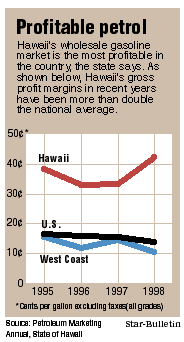
The state claims Hawaii's refining costs on average are about the same as those on the West Coast, where wholesale prices -- before taxes -- currently run about 50 cents to 57 cents a gallon. In Hawaii, the comparable price is roughly 90 cents a gallon. While the oil companies say the two markets are vastly different and can't be compared, the state does precisely that in supporting its price-fixing allegations. The lawsuit, filed earlier this month in federal court, accuses Hawaii's two refiners and several major wholesalers of overcharging dealers and consumers as much as 40 cents a gallon for years.
The companies deny the allegations, saying they will aggressively fight the lawsuit.
"The prices of gasoline in Hawaii are absolutely and unequivocally fair," said J.B. Riley, former Hawaii regional manager for Chevron Corp., the state's market leader.
But if the market were indeed competitive, the high Hawaii prices would prompt some wholesalers here to ship less-expensive gas from their West Coast refineries and, even after accounting for shipping costs, be able to undercut the competition, said Barry Pulliam, a Southern California economist who specializes in petroleum issues.
"It's hard to imagine how the (existing) price differential could exist in a competitive market," said Pulliam, whose economic consulting firm, Econ One Research in Los Angeles, is assisting the state with the lawsuit.
Spencer Hosie, a San Francisco attorney spearheading the state's case, notes that the cost of acquiring oil -- easily the largest expense of running a refinery -- is essentially the same in Hawaii as it is on the West Coast.
That means only nonfuel operating costs such as labor, electricity and maintenance can account for the price differences between the two markets, Hosie said.
Some of those costs are higher in Hawaii; some are lower; but overall they average about the same as in West Coast refining cities like Los Angeles and San Francisco, Hosie and Pulliam said.
Even if those costs were 50 percent higher here, though, that would add only 2.2 cents per gallon to the cost of making gas locally, they said.
Yet for the past several years, the gap between West Coast and Hawaii wholesale prices has averaged about 23 cents a gallon, their analysis shows.
This year, for instance, the 42-cent average margin between the bulk price of gasoline in Hawaii and what local dealers pay for that gas has been more than three times the national average, making Hawaii easily the most profitable wholesale market in the country, Hosie said.
Brant Fish, Chevron's marketing manager in Hawaii, said the company doesn't know enough about how Hosie arrived at that conclusion to dispute it.
Asked if he could dispute Hosie's findings using Chevron data, Fish said isolating one product made at the company's Oahu refinery and characterizing profitability for that product would be difficult. Refineries produce a range of products from gasoline to jet fuel.
But he added that high margins like those cited by Hosie don't necessarily translate into high profits, once costs are accounted for. "You can have big margins and no profit," Fish said.
Riley said a comparison between Hawaii and West Coast wholesale prices was absolutely irrelevant because there is no connection between what is charged in the two markets.
The Chevron executives said pricing is based purely on local market conditions and is driven by a complex set of factors. In the short term, they said, price has no connection to cost, including the going rate for crude oil.
But in the long term, the cost of running a refinery and operating gas stations has a bearing on prices and the willingness of a company to invest in a particular market, the executives said.
They declined to say what Hawaii costs account for larger wholesale margins here or to answer a written set of other cost-related questions, citing the pending lawsuit.
Likewise, Tesoro Petroleum Corp., which operates Oahu's other refinery, declined to answer the same questions.
Both refineries supply the other major Hawaii wholesalers, such as Shell Oil Co., Texaco Inc. and Tosco Corp., who also are named as defendants in the lawsuit.
A spokeswoman for Shell and Texaco, which recently merged marketing and refining operations, cited the litigation in saying the companies couldn't comment on why they do not import gas to Hawaii.
One petroleum analyst said looking at costs to evaluate Hawaii's high gas prices is off base.
"It's a bit like (the sex scandal involving) President Clinton and Monica Lewinsky," said East-West Center petroleum expert Fereidun Fesharaki. "The sex is irrelevant. The issue is whether the president lied."
Even if the oil companies were making outrageous profits here, which Fesharaki doubts, that wouldn't be illegal, he said.
"Outrageous profits mean a successful business," Fesharaki said.
What the state has to prove to win its case, he said, is whether the oil companies conspired to keep prices artificially high.
But Fesharaki and attorney Robert Miller, who headed the state's antitrust unit in the Attorney General's Office in the late 1970s, said that will be tough to prove.
Unless the state has an industry insider or a retired executive who can testify about a conspiracy, the government's case appears to rely on circumstantial evidence, Miller said, basing his comments on a review of the lawsuit.
"It strikes me as being a long, tough haul," he said.
Fesharaki, who has been hired in the past as an expert witness on behalf of oil companies, said he's convinced no conspiracy existed.
"I would bet a million dollars to one there is no way (the state) could prove anything like that," Fesharaki said.
But Hosie, who specializes in antitrust cases against oil companies, said this is the strongest case he's ever seen. That's one reason he said his law firm is willing to risk its own money on the case.
The firm agreed to take the case on a contingency basis, meaning it won't be paid attorney fees unless the state recovers money. The state, however, has agreed to cover up to $415,000 annually for the cost of pursuing the case, which is expected to take years to resolve.
But state officials said the money won't come from taxpayers. Instead, it will be drawn from a fund oil companies paid into years ago to settle federal price-control lawsuits, officials said.
Hawaii got millions of dollars as its share of the national settlements.
The state's lawsuit against Hawaii's two refiners and major gas wholesalers lists 13 defendants, including parent companies and subsidiaries. Aloha Petroleum
excluded from suitBut conspicuously absent from the list is Aloha Petroleum Ltd., one of the largest suppliers in the state and the only one importing its gas. Aloha began importing last year.
Spencer Hosie, the San Francisco attorney heading the state's case, said Aloha was excluded from the lawsuit because the company initially wasn't part of the group that allegedly conspired to keep Hawaii wholesale prices artificially high over the past decade.
While it was buying gas locally, Aloha was charged a higher price than the three other major suppliers that got fuel from Hawaii's refiners, Hosie said.
That helps explain why Aloha invested lots of money to build a storage terminal here, enabling the company to start shipping in less-expensive gas at significant savings, Hosie said.
But once Aloha started importing, he said, it didn't pass on the savings and kept pump prices up, benefiting from the alleged overcharging. "They're sure part of (the problem) now," Hosie said.
Aloha didn't return phone calls seeking comment.
The other companies have disputed the state's allegations.
Rob Perez, Star-Bulletin staff