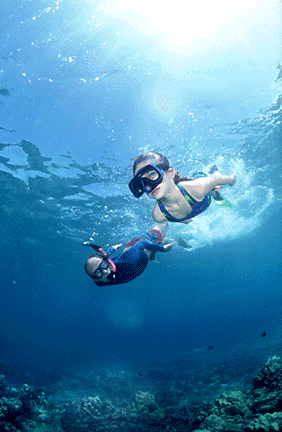
By David B. Fleetham, Courtesy of Wayne Levin
Wayne Levin with daughter Elise.
Levin shares a mystical
By Burl Burlingame,
universe through photos
Star-BulletinPHOTOGRAPHER Henri Cartier-Bresson called it the "decisive moment" -- that unimaginably narrow slice of eternity in which the elements of mass and volume and velocity arrange themselves in front of the camera lens -- the instant during which there is a photograph waiting to be captured, not a millisecond before or after. The elements compose themselves, and then hurtle onward.
But the process also takes place behind the camera, deep in the synapses of the brain. Training and instinct and personal mythology sense the coming moment in time to fire off a signal to the shutter finger. It's a random world, so it's best to be prepared for it.Wayne Levin's decisive moments, many of which are collected together in the book "Through a Liquid Mirror," are eloquent visual statements of a mysterious world. As an artist, he's clearly communicating this vision. The book was named the Samuel Kamakau Book of the Year in the Hawaii Book Publishers Association's "Ka Palapala Po'okela" awards, and won three other awards in the annual event.
By Wayne Levin, from "Through A Liquid Mirror"
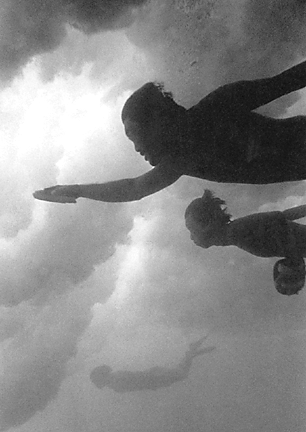
Bodysurfers in motion captured from undersea.
Levin's floating universe is the boundless sea. Like the old observation goes, it's a big ocean, and you're only seeing the top of it. Some of Levin's images, particularly those of body surfers drifting through crashing clouds that look like some of the deep-space nebula photographed by the Hubble telescope, have become some of the best-known photographs ever taken in Hawaii. They strike a deep chord in viewers.Levin became interested in photography in high school, and attended a photographic institute before joining the Navy, where, he said, "Naturally, they didn't assign me as a photographer. But the Navy allowed me to fall in love with traveling, and I got a new Nikon camera in Japan."
After his discharge, Levin worked for Honolulu photographer Robert Wenkam, and then went back to school at the Pratt Institute.
"I was in in love with water and the sea, and I tried taking photographs with a Nikonos with color film. But color film is a problem underwater. The liquid absorbs the spectrum except for green and blue, and it's too dense to illuminate with a flash anywhere but right in front of the camera."
He tried black-and-white film, abandoning the flash for natural light. Suddenly the sea, which for Levin's camera had existed only as far as the flash could reach, became a vast and seething universe. Levin began spending his days in the primordial, billowing soup of Makapu'u and Sandy Beach shorebreaks, in deeper water communing with whales and sharks, in the overgrown haunted houses of shipwrecks, and occasionally on dry land, as when he photographed Hawaiian archaeological sites on Kalaupapa and Kahoolawe.
The element of chance always comes into play, and Levin says "the most enjoyable part of photography" is scouring the contact sheets of newly printed negatives, looking for the happy accidents.
Levin uses a variety of traditional photographic techniques in his printing, such as selenium toners and prefogging the paper to get a feeling of depth. It isn't an exact science -- no two prints will be perfectly alike -- but once he gets on a roll, Levin prints "quite a number of images at once, and they're all pretty close."
Over the years, he's discovered that his ideal tonal range for an image has "become softer and more subtle. Photography is a legitimate art. I don't care how others define it, if I'm communicating with a viewer how I feel about the subject, then that's great.
"The ocean is a mysterious place. When you're in the ocean, you're in the hands of a greater power, and that feeling that you get from nature is what I'm trying to express. I've been told that even when I use large-format color film of above-water subjects, they still wind up looking like a 'Wayne Levin,' that is, like a black-and-white underwater print!"
Levin's work has become popular enough that he commands an average of $800 for a 16-by-20-inch print mounted into a 20-by-24-inch matte. (To buy a print, contact Levin directly at 808-328-9036 in Kealakekua or at inkona@gte.net.)
"The best-selling images by far are the one of the surfers flying through the water. The pictures have amazing ambiguity, and people read all sorts of things into them. What's ironic is that it took me a while to realize how strong they were."
The idea of a book had been bubbling for a while, and Levin had been egged on to produce a monograph by friend Thomas Farber. Mainland publishers sniffed politely at the concept, which, Levin said, "Worked out OK, because while it went on, I kept taking more pictures that wound up in the book."
Farber suggested Levin show his work to Gaylord Wilcox, whose Editions Limited publishing house specialized in high-quality visual productions.
"I was just floored by the pictures," said Wilcox. "I wasn't even sure what I was looking at at first, except that it seemed magical."
Wilcox published the book last year, and it has sold slowly but steadily. A supply recently went out to mainland surf shops. The hardback is $37.50 and the softcover version is $25.
Levin's current projects include photographing the artificial oceans in aquariums. "It's a high-tech way of reproducing nature, and the split between the worlds in and out of the water there are incredibly visual," said Levin.
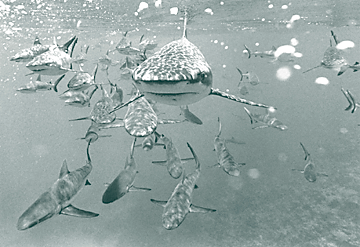
By Wayne Levin, from "Through A Liquid Mirror"
Grey reef sharks at Bikini Atoll.
Using a new "Hawai'i Book Academy" of librarians, booksellers and publishing professionals, the Hawaii Book Publishers Association Friday announced the winners of the 1998 Ka Palapala Po'okela awards for excellence in book publishing. 'Liquid Mirror'
takes top honorsThe event, which also welcomed new state librarian Virginia Lowell, was held at the Hawai'ii State Library. Ka Palapala Po'okela, which means "excellent manuscript," honors books in both general and technical categories. Last year's winners were also formally announced, although the awards were given earlier.
Winner of the Samuel Manaikalani Kamakau Book of the Year award went to Wayne Levin's "Through a Liquid Mirror," published by Editions Limited. The book also won three technical awards. Last year's winner was Jay Hartwell's "Na Mamo: The Hawaiian People Today," published by 'Ai Pohaku Press.
Inducted into a kind of Hawaii Book Publishing "Hall of Fame" was John Dominis Holt, who was recognized by HBPA members with the award that bears his name. Previous winners include Mary Kawena Pukui and O.A. Bushnell.
The 1998 winners are:
Excellence in Children's Books
Winner -- "Maui and His Magical Deeds" by Kats Kajiyama, Barnaby Books.Award of Merit -- "Tales From Within the Clouds: Nakhi Stories of China" by Carolyn Han, translator; illustrated by Li Ji, University of Hawaii Press.
Honorable Mention -- "Na Mo'olelo Hawai'i o ka Wa Kahiko: Stories of Old Hawai'i" by Roy Kakulu Alameida, Bess Press.
Excellence In Non-fiction Books
Winner -- "All Stings Considered: First Aid and Treatment of Hawai'i's Marine Injuries" by Craig Thomas and Susan Scott, University of Hawaii Press.Award of Merit -- "Illustrated Hawaiian Dictionary" by Kahikahealani Wight, illustrated by Robin Yoko Racoma, Bess Press.
Excellence In Literature
Winner -- "A Hawai'i Anthology: A Collection of Works by Recipients of the Hawai'i Award for Literature, 1974-1996," edited by Joseph Stanton, State Foundation on Culture and the Arts.
Excellence in Hawaiian Culture
Winner -- "Stories of Life in Old Hawai'i" by Caroline Curtis, illustrated by Oliver C. Kinney, Kamehameha Schools Press.
Excellence In Illustrative
Winner -- "Through a Liquid Mirror" by Wayne Levin, introduction by Thomas Farber, Editions Limited.
or Photography BooksAward of Merit -- "Sunday in Hawaii: Celebrating Life in the Islands" by various photographers, text by U'i and Steven Goldsberry, Mutual Publishing.
Excellence In Specialty Books
Winner -- "Gardening in Hawai'i: Handbook for the Home Gardener" by Peggy Hickok Hodge, photographs by Lee R. Hickok, Mutual Publishing.
Excellence In Guide Books
Winner -- "How to Hula" edited by Patricia Lei Anderson Murray, photographs by Joe Perrone, Mutual Publishing.
Excellence In Illustration
Winner -- Kats Kajiyama for "Maui and His Magical Deeds," Barnaby Books.Award of Merit -- Li Ji for "Tales From Within the Clouds: Nakhi Stories of China," University of Hawaii Press.
Honorable Mention -- Robin Yoko Racoma for "Illustrated Hawaiian Dictionary," Bess Press.
Excellence In Photography
Winner -- Wayne Levin for "Through a Liquid Mirror," Editions Limited.Award of Merit -- Linda Ching for "Story of the Stone," Hawaiian Goddesses Publishing.
Excellence In Design
Winner -- Barbara Pope for "Through a Liquid Mirror," Editions Limited.
Excellence In
Winner -- Caroline Curtis for "Stories of Life in Old Hawai'i," Kamehameha Schools Press.
Writing LiteratureAward of Merit -- John Kneubuhl for "Think of a Garden and Other Plays," University of Hawaii Press.
Honorable Mention -- Malcolm Champlin and Steven Goldsberry for "Luzon: A Novel," Mutual Publishing.
Excellence In Non-fiction
Winner -- Bob Dye for "Merchant Prince of the Sandalwood Mountains: Afong and the Chinese in Hawai'i," University of Hawai'i Press.