A report unsealed by the court
says 'there is confusion and a lack of
accountability at the top'Attorney Yuen demands sanctions against A.G.
By Rick Daysog
Star-BulletinBishop Estate's five trustees are underinformed when it comes to the trust's investments and appear to spend too little time in board meetings on matters affecting Kamehameha Schools, according to a financial and management audit by the Arthur Andersen LLP accounting firm.
The 336-page report, unsealed by Probate Judge Colleen Hirai yesterday, also said that as many as 16 relatives of trustees and top executives have been admitted to Kamehameha Schools since 1991 and that six relatives of trustees and key officers are employed by the estate.
In many ways, the Andersen report -- which served as a cornerstone for the scathing review of trust operations for the 1994-1996 fiscal years by estate special master Colbert Matsumoto -- paints an unflattering portrait of the trustees' management of the multibillion-dollar estate.
It also offers a rare glimpse into the exhaustive audit of the estate's operations by the Internal Revenue Service.
The state attorney general's office, which is seeking the permanent removal of at least three trustees for taking part in an alleged pattern of self-dealing and mismanagement, said the report underscores the need to remove board members and indicates that the charity's tax-exempt status may be in jeopardy.
"The compelling theme of the Arthur Andersen report is that there is confusion and a lack of accountability at the top which has seeped down and infected all aspects of the Bishop Estate," said Kevin Wakayama, deputy attorney general.
Kekoa Paulsen, an estate spokesman, said many of the issues raised by the audit have been brought to the attention of the court and are being addressed in an appropriate fashion.
Paulsen had no response to criticisms raised against trustees, but he noted that the estate already has agreed to implement many recommendations suggested by the Andersen report.
Trustees earlier this month agreed to set up a new management system headed by a chief executive officer, replacing the current trustee-management system. They also agreed to implement stricter conflict-of-interest policies.
"Management audits are often critical," Paulsen said. "They've identified areas of weakness, but they've also identified areas of strength."
The estate, founded in 1884 by the will of Princess Bernice Pauahi Bishop, is the state's largest private landowner and one of the nation's wealthiest charities, with assets listed at more than $5 billion.
One of the key findings of the Andersen report is that trustees have withheld funds from the charity's primary mission, Kamehameha Schools.
According to the audit, the estate accumulated some $350 million in income that it should have spent on the schools. The apparent withholding, projected to rise to $1.5 billion by the year 2006, goes against previous court orders and may have violated Bishop's will, critics have charged.
The Andersen report says trustees didn't appear to spend enough time on school matters during their twice-weekly board meetings. Based on minutes of trustees' meetings, board members spend more time on business and investment matters such as approvals of leases, reviews of financial reports and approvals of real estate and other transactions.
"The education group had relatively little documented trustee activity, often never appearing in the minutes at all," the audit said.
The Andersen report also faulted trustees' management and due diligence reviews of the estate's investments.
The report noted that many of the estate's mainland property investments are risky in nature and are highly illiquid.
Oftentimes, the estate relied on the advice of co-investors such as JMB Properties and former U.S. Treasury Secretary William Simon for investments that later went sour.
Overall, the estate's return on its investments has significantly trailed the stock market, averaging about 2.2 percent during the 1992-1996 fiscal years, the study said.
The review also warned the estate about its tax-exempt status and discussed in detail the IRS' three-year audit of the estate, soon to be completed.
According to the Andersen firm, the IRS is conducting a massive examination that touches on a wide range of the estate's daily operations. Key concerns include the relationship between the tax-exempt trust and its for-profit subsidiaries, the estate's lobbying activities, trustee compensation and the schools' racial preference policies.
The IRS audit, begun in 1995, initially covered the estate's 1992 through 1994 fiscal years but was later expanded to include the 1995 and 1996 years.
As part of the audit, the IRS has issued 479 information document requests, or IDRs, to the estate seeking specific records of financial transactions. The IRS has issued 279 IDRs to the trust's for-profit subsidiaries.
As previously reported by the Star-Bulletin, the IRS' inquiries take a close look at trustees' pay, which recently has averaged more than $800,000 a year.
The federal agency has requested copies of trustee compensation studies paid for by the estate and has asked current and former trustees to explain the amount of time they spent on estate work.
The IRS also has requested information about credit card expenditures, hotel accommodations, air fares, country club memberships and director's fees in corporations in which the estate is a large shareholder.
Benefits to relatives of trustees and top executives are also a target of the inquiry. Responding to an IRS document request, the estate said that between July 1, 1991, and June 30, 1996, a total of 16 relatives of trustees and estate executives were admitted to Kamehameha Schools, the Andersen report said.
The estate also said there are six estate employees who are related to trustees and officers.
Admissions of relatives to the estate-run Kamehameha Schools and the hiring of relatives could be interpreted by the IRS as an "excess benefit" paid to trustees and indicate that trustees are mismanaging the affairs of the Bishop Estate.
Many of the key recommendations of the Andersen report were discussed in an executive summary that was made public last
month with Matsumoto's review of the estate's operations.
But the major thrust of the audit is shown in numerous anecdotes of mismanagement and fiduciary breaches detailed by the unabbreviated version of the Andersen audit, Wakayama said.
"What the Andersen report does is give us actual and very specific examples of mismanagement," said Wakayama.
"Everywhere they looked, there were clear indicators that trustees should be removed . . . and that many changes need to be done."
Bishop Estate Archive
Trustee’s lawyer wants
By Rick Daysog
sanctions against attorney
general’s office
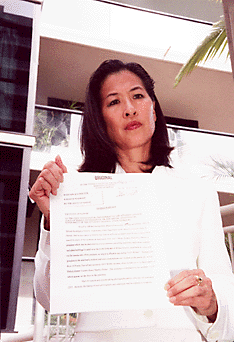
Star-BulletinLabeling it "Gestapo tactics," Bishop Estate trustee Henry Peters' attorney said she plans to seek court sanctions against the attorney general's office over a surprise videotaped search of Peters' Makiki condominium.
But the attorney general's office said that the actions were conducted under a court-approved search warrant and that investigators gave Peters due notice of the search.
On Tuesday morning, state investigators entered Peters' 12th-floor apartment at the exclusive 1015 Wilder complex and videotaped the property as part of an investigation into charges that Peters and fellow trustee Richard Wong received kickbacks from Wong's brother-in-law, Jeff Stone. All three have denied the charges.
The investigators -- accompanied by a locksmith and local real estate appraiser, Raymond Lesher -- videotaped the interior of Peters' home but did not take away any of the apartment's contents, according to Renee Yuen, Peters' attorney.
Yuen said she found it "absurd" that the state obtained a search warrant of Peters' apartment so that Lesher could conduct an appraisal. She blamed the heavy-handed treatment on the Cayetano "election machine," calling the state's investigation of the estate politically motivated.
Yuen said the scene got ugly when one of the investigators threatened a maintenance worker at the condo with arrest if he did not open a door. She said she plans to seek court sanctions against Bronster for the search.
"Why do you need four investigators to accompany an appraiser?" Yuen said.
"This is nothing other than a burglary under the guise of a search."
Cynthia Quinn, special assistant to Attorney General Margery Bronster, said the search was conducted properly, noting that a district judge issued the search warrant.
She said the state made every effort to obtain the information about Peters' home amicably and gave Peters ample warning that it would conduct a search.
The value of Peters' condo is a central point in an Oahu grand jury's investigation into charges that Peters and Wong received kickbacks from Wong's brother-in-law. According to the attorney general's office, Stone paid inflated prices for Wong's and Peters' apartments at the Wilder complex.
Bishop Estate Archive