
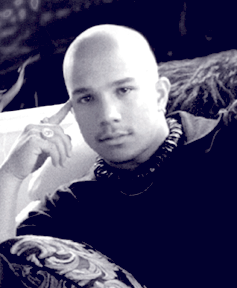
Jamin’s Jammin’
An MTV coup, a hot new
By John Berger
album, and more
Special to the Star-BulletinIF Jamin Wong ever opens a record store he'll put all the titles into two master categories before organizing them into the usual ones.
"If they're in it for the fame or the money I'll file them under 'Entertainers.' If they're in it for the music I'll file them under 'Artists.' That way, if people want to be uplifted they can go to the 'Artists' side first, and then get into the regular categories."
It's not the usual way of doing things, but Wong isn't your usual contemporary local singer either. At 13, he was playing local bars and concert arenas as a member of Ho'Aikane. Now, at 22, he's off and running as a solo artist with "Goldmind," an impressive solo album of original reggae and rap.
Wong takes his music to a national audience with a 2 p.m. appearance on MTV tomorrow as a finalist in "The Cut," MTV's national talent contest. Out of 10,000 hopefuls, only 160 will appear on the program.
"I'm there to introduce myself, do the show, and let people know what we're doing in Hawaii. If they see me they gotta say, 'He can't be the only one.'"
Wong is a dynamic, high-energy performer who usually opens his show wearing an aloha shirt with a lei of kupe'e shells or kukui nuts. He'll often lose the shirt as things heat up; the lei are a personal signature.
Unlike many contemporary artists, Wong avoids the usual obscenities in his music. Off stage, he is introspective, soft-spoken and a keen observer of the music business. In addition to his own career, he works with other Neos Productions acts as a songwriter, studio musician and background singer. He speaks with pride of his wife and 5-year-old daughter on the Big Island, and says that being away from them is the one thing he doesn't like about his work.
Music has been his life since he picked up the ukulele at the age of 8. He was playing percussion with Ho'aikane at 13. Bob Marley was one of his early influences, and he admits that as a beginning drummer he tried copying the licks of Jamaican stars like Sly Dunbar.
His tastes are diverse; his current list of favorites includes Aswad, Cecilio & Kapono, San-tana, Prince, jazz, gospel and Lau-ryn Hill. He saw "Phantom of the Opera" and found it "awesome."
"I like music with meaning. I like to gain knowledge from music. That's why I got into music, to learn from it. If the music's not teaching me nothing, I turn the station."
Wong feels that the positive perspectives in reggae make it perfect for messages of hope and inspiration. He studied Jamaican culture and Rastafarianism in his teens, but says there's an important difference between being a Hawaiian who likes reggae or rap and being someone who simply gloms on to another culture.
"People ask me, 'If you sing reggae and you get the lingo down in your music, why don't you talk like that, Jamaican, all the time?' Well, when I perform reggae music I do it in that way, but I'm Hawaiian-Chinese-Filipino from Hawaii and I'm always going to be that."
Wong adds that he isn't writing and recording Hawaiian-language music, partly because he doesn't speak the language -- yet.
"I like original music and I cannot speak Hawaiian now. When I get older and learn the language and can write my own Hawaiian songs I'll do my Hawaiian album. For now, I love Hawaiian music, and I can play slack-key and ukulele, but I get the most joy out of it singing in the back yard. That's where it is for me."
Wong became a solo act by default. Ho'aikane broke up. He wasn't ready to retire.
Wong had played a crucial role in the evolution of Ho'aikane. The original members came together in the mid-'80s playing beautiful traditionalist ki ho'alu (Hawaiian slack-key) on the back porch of their Big Island homes.
Ho'aikane recorded three slack-key albums in the '80s, then, a line-up change or two later, chucked slack key, and become one of Hawaii's hottest "Jawaiian," or pseudo-reggae, acts. Wong's father, Jamieson "Wongie" Wong, was one of the first new recruits.
By the time of the album "Is-land Irie," Wong had joined his father as an official member of the quintet along with Walter "Ace" Tavares Jr., Derek "Hoku" Tolen-tino and Nolan Hao.
By 1993 Ho'aikane had moved away from Jawaiian fodder and created an original style that combined Jamaican reggae with rap. Ho'aikane's 1993 album, "Bullet-proof," should have been a watershed in contemporary local music, but local radio stations were more interested in remakes.
Ho'aikane released "Massive" in 1995 but gradually wound down.
"Everybody had different goals, but I see them all the time and we're all family. But that was a major stepping stone (for me), being in Ho'aikane. I give much thanks to Ho'aikane. People don't even know about 'Bulletproof' and 'Massive,' but maybe someday they'll hear 'em."
Wong spent an intense two months completing the preliminary tracks for his solo debut album before going into the studio. Neos Productions reported re-cently that "Goldmind" made the preliminary balloting for the 1999 Grammy awards. If it survives the initial cut, "Goldmind" will be nominated for a Grammy.
Wong would love a Grammy, but he adds that there's more to his music than fame. "This is my living, but I don't need millions and millions of dollars. I just want to do good in God's eyes. That's the revelation of Jamin. If it's acceptable to God then I no need worry about anything else. That's the biggest pay-off of all time. That's the greatest joy."

