
To dance
Performers from the
By Burl Burlingame
Philippines make their point
in folk, ethnic and
classical styles
Star-BulletinBesides rock 'n' roll and animated cartoons, there are a couple of other original Western arts that have achieved a toehold in Asia. The Japanese are nuts about Beethoven. Koreans sing country-western. And the Philippines has ballet.
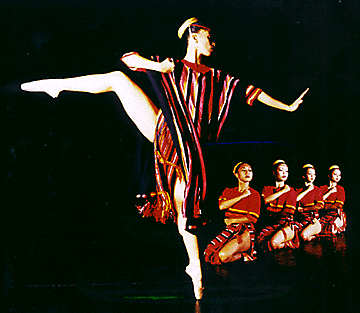
Part of the ongoing centennial of Philippines independence -- declared just before Spain sold the country to America -- Ballet Philippines is touring the world. This weekend the group debuts in Hawaii.
Ballet Philippines is rated as one of the most creative dance companies in Asia (Japan's Asahi News breathlessly reviewed the troupe as "dispelling the notion that Japan leads Asia in ballet," which is quite an admission) and it mixes up folk-dance influences from Malay, Chinese, Muslim, Hindu, Spanish and American, as well as modern avant-garde, choreography. As an added fillip, the Filipinos can also knock off a traditional classic like "Swan Lake" when they're in the mood.
The troupe has existed for more
than two decades, and was founded by choreographer Alice Reyes. The star dancer and artistic director in its current incarnation is Cecile Sicango. But much of the current buzz is coming from the works created by choreographer Agnes Locsin. We reached her at home on Luzon.
Locsin learned at her mother's knee at the family dance studio in Davao. "Just watching her was a whole education. She taught classical ballet, and my sister taught jazz and folk dance. It all mixed together in my head."
After earning an undergraduate degree, Locsin went on to Ohio State to nail down a master's in dance. "My impression of America was one of hugeness. The buildings were so tall! It was my first time there and I was very excited.
"What school did was make me aware of the things I was doing naturally. Luckily, some of the Filipino students already there had formed a little dance group. We were able to incorporate Filipino ethnic moves in our studies, and the teachers were very appreciative."
It's always "a struggle" to keep dance alive in hard financial times. "We exist mostly from private donations. You can't ask for a lot because there are so many other problems. In paid performances, we usually sell out of the traditional works, like 'Swan Lake' or 'Giselle.' But the ethnic works take awhile to gain momentum and acceptance."
It's time to define our terms. In a nation as ethnically and geographically diverse as the Philippines, it's best to think of "ethnic" dances as tribal dances, while "folk" dances are primarily Spanish, said Locsin.
"We're still discovering tribal and ethnic dances," said Locsin, who often uses a little bit of everything in her works. "Filipinos ARE dancers. We LOVE to dance. I love to explore the connections.
"Regionalism is still a big thing in the Philippines. Our culture is really so mixed. It used to bother me that other countries have 'indigenous' dances. It's become more important in the recent resurgence and rediscovery of Filipino culture.
"Filipinos are very quick to embrace new things -- sometimes too quick! -- so it can be hard to define what exactly 'Filipino' is. It covers everything. So, the dances can be eclectic. But that's the way we are!"
Sometimes, you have to sweat the details. In one of her pieces, "La Revolution," the central character, hero Apolinario Mabini, is paralyzed with polio. His physical dilemma is expressed primarily through music.
Rather than working backward from music, Locsin creates a scenario, clarifies it into dance sections, and then finds appropriate melodies. "I'm an explainer. I think while I talk. And I only complain if it's not working."
It keeps her busy. "What would I like to choreograph?" she repeated, stumped for the first time. "I don't know! I don't have the luxury of deciding! We've been too busy, with the company traveling all the time. And we have three whole new works next year!"
Ballet Philippines
On stage: 7:30 p.m. Friday

