
OCCC nears
end of federal
monitoring
Overcrowding will be
By Gregg K. Kakesako
further eased with another
transfer of inmates
to the mainland
and Rod Ohira
Star-BulletinThe state is close to ending a 15-year federal monitoring program at the Oahu Community Correctional Center if prison officials are able to end the practice of assigning three inmates to a cell and correcting other conditions at the Kalihi facility.
After meetings with Attorney General Margery Bronster and acting state Public Safety Director Cora Lum last week, Al Bronstein, director emeritus of the American Civil Liberties Union's Nation Prison Project, said the parties "are getting fairly close to an agreement" that would lift the 1984 federal court order.
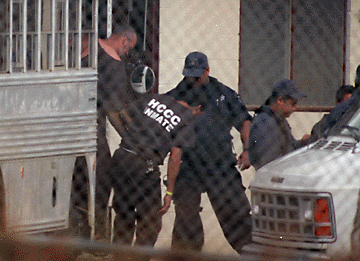
Meanwhile, state corrections officials today were planning to transfer another 300 inmates to a mainland prison -- possibly in Minnesota -- which would bring the total of out-of-state detainees to 1,264.
Hawaii currently has more than 900 inmates in prisons in Texas, Oklahoma and Tennessee to ease overcrowded prison conditions here.
Dan Foley, ACLU attorney who has clients in prison, yesterday said he heard that 150 inmates were being moved from Kulani Correctional Facility on the Big Island to Oahu for a mainland transfer possibly to take place as early as tonight.
Corrections officials yesterday began shuttling inmates from the Big Island to Oahu at about 3 p.m. The remainder of transferees will be Halawa Correctional Facility inmates.
Foley said sending inmates from Halawa gives the state the chance to ease crowded conditions at OCCC.
Bronstein, based in Washington, D.C., said the state last week agreed to stop the practice of "triple celling," which puts three inmates in one cell, and "to reduce the inmate population substantially."
OCCC houses 1,200 inmates, although under the consent decree resulting from an ACLU lawsuit, population there was to be limited at 1,000.
Bronstein said one of the buildings at OCCC was "a disaster area."
"It is crowded and filthy," he said. "Half of the plumbing in that annex doesn't work. Sinks were covered with trash bags because they didn't work."
But despite the crowded conditions, Bronstein praised the efforts of Bronster and Lum in coping with the problem. He also singled out OCCC warden Nolan Espinda as "being the best warden in the Hawaii system and a good warden by any system's standards."
Bronstein said the state has to do more than just move inmates to the mainland. Without policy changes, a planned 168-bed annex in OCCC's recreation yard will be filled the day it opens in the year 2000, he said.
In July, when the last 300 inmates were sent to the mainland, Hawaii's corrections system housed 3,900; its capacity is supposed to be 3,024.
The out-of-state prison picture:
460 male inmates at the 872-bed Newton County Fillyaw Correctional Center in Texas.
