
IN Washington, D.C., recently I learned more about another national Kaiser health improvement venture little known in Hawaii -- the Henry J. Kaiser Family Foundation. The Henry J. Kaiser
Family FoundationIt is totally independent of the Kaiser-Permanente Medical Care Program started here by Kaiser over 40 years ago and earlier on the West Coast. Kaiser, a leading industrialist, personally battled the Hawaii medical establishment to get it rooted here. Foes labeled it "socialist." It has grown into the biggest managed-care program here and nationally. It remains private.
Kaiser Family Foundation is another manifestation of the commitment Kaiser made to improve health care for the masses after his mother died in his arms when he was 16 for lack of medical care. He fulfilled it as he moved through a brilliant career that emphasized health care for his employees in all his diversified adventures -- dam-building, ship-building, autos, steel, aluminum and more. He even started Hawaii Kai.
The 50-year-old Kaiser Family Foundation focuses on government health policy and on the media as an instrument of public education. It make grants in four main areas: (1) health policy, (2) reproductive health, (3) HIV/AIDS, and (4) South Africa. But it also is in partnership with the Harvard School of Public Health on Medicare evaluations with the Washington Post as an active collaborator.
It has two offices -- a staff of about 40 in its headquarters in Menlo Park, Calif., and an additional 16 staffers in Washington, a couple of blocks from the White House.
One of its Washington-based vice presidents learned from his neighbor, my niece, that I had fairly frequently interviewed Kaiser during the 13 years after he retired to Hawaii in 1954 until he died here in 1967 at age 85 -- and had intensely positive impressions of him as one of the most remarkable men I ever knew. "A simple genius" is what his son called him at his funeral. Immensely insightful. Daring. Immensely dogged in pushing what he was sure was right -- as with his then-revolutionary plan emphasizing preventive medical care.
Since I was planning to be in Washington, I was asked to talk about him to a staff too young to have ever met him. I loved it. They seemed to, too, and are circulating more widely the poetry that I learned was a genuine part of his thought process, such as "To be alive in such an age! With every year a lightning page! ... Give thanks with all thy flaming heart -- Crave but to have in it a part."
Kaiser made grants of $200 million to start the Family Foundation. Investments in a diversity of domestic and international stocks and bonds, real estate and more have grown this to over $500 million. This year -- in contrast to Hawaii's tight-wadded, expensively administered Bishop Estate's backing of the Kamehameha Schools for Hawaiian children -- the Kaiser Family Foundation will spend over $30 million (more than 6 percent of its assets) on its programs and only $5 million (1 percent) on administration, including investment oversight. It budgets spending on a running five-year projection of income.
IMPROVING the health of South Africa's most disadvantaged people -- women, children, and people living in rural and squatter communities -- became one of its concerns after the late, great African-American congresswoman from Texas, Barbara Jordan, joined its board. She emphasized the need to invest in Africa while other investors were pulling out to protest apartheid. Kaiser's oldest granddaughter commented that this contrarian investment would fit with her grandfather's "delight in upsetting the status quo."
Kaiser-Harvard studies show the public still poorly informed on key health issues. While it continues to make grants, the Kaiser Family Foundation sees itself "first and foremost in the information business -- developing and supplying data and analysis..."
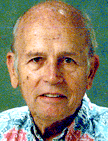
A.A. Smyser is the contributing editor
and former editor of the the Star-Bulletin
His column runs Tuesday and Thursday.