
Jury tainted by
homophobia?
'I don't think my brother
By Susan Kreifels
got justice,' says a gay
murder victim's sister
Star-BulletinGay-rights groups call it "homophobic panic," the kind of reaction that may have provoked Stephen Bright to brutally beat a gay man to death rather than walk away from his sexual advances.
It's the same reaction that could color a jury's verdict as well, they say.
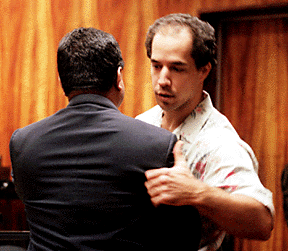
Bright was found guilty yesterday of the lesser offense of third-degree assault, a misdemeanor with a maximum punishment of a year in prison, for killing hotel executive Kenneth Brewer, a 58-year-old gay man.
Bright, who testified that he is not gay, told jurors that he thought Brewer was heterosexual when he went to Brewer's condominium a year ago for drinks after meeting him in a gay bar. When a naked Brewer later wanted sex, Bright said he hit the victim in self-defense, thinking he would be sexually assaulted.
'Systemic discrimination'?
William Woods, executive director of the Gay and Lesbian Education and Advocacy Foundation, said homophobia triggers "systemic discrimination" that has been helping defendants for the last decade in trials involving violence against gay victims."They think they are going to be raped by a gay, and they're so scared, they could kill them," Woods said yesterday. "The reaction goes way beyond the scope of the situation."
The government charged Bright with murder in the second degree. But the defense said Bright was guilty of nothing, acting only in self-defense against sexual assault.
Jurors, who deliberated 3-1/2 days, rushed away from the media yesterday to avoid answering questions on their verdict. Circuit Judge John Lim's chamber staff said they would not release jurors' names until a later date.
Bright, 30, has already served a year in jail awaiting trial and was to be released last night. He was also fined $2,000.
Woods said he would like a "neutral body" to do a "jury autopsy" to see what impact Brewer's sexuality had on their decision. "What went through their minds? Was this an issue or not?" Woods asked.
Deputy public defender Jack Tonaki spoke with jurors after the trial but would not comment on what was discussed. Tonaki said that under the law, there is no distinction on whether a sexual assault involves a gay person or straight person. Making a distinction would be an "unethical argument and inflame prejudice. . . . If you sat through the whole trial, you would be satisfied that kind of argument was never used."
Tonaki has said fighting back in self-defense against the threat of sexual assault is the same whether it involves women or men.
But Woods said if homosexuality is involved in a trial, "that colors it."
The Gay and Lesbian Community Center, in a press release, said the verdict "underscores the need for more education so that homophobia can't be used as a defense for taking the life of an innocent, law-abiding human being."
Deputy Prosecutor Wayne Tashima would not comment on the verdict.
City Prosecutor Peter Carlisle would not speculate about whether Brewer's homosexuality colored the verdict.
Carlisle said the evidence was entirely circumstantial. "Two people know what happened. One is dead," Carlisle said.
Louise Brewer, the victim's sister, called the verdict "unbelievable . . . . I don't think my brother got justice.
"Recently, someone kicked a dog to death and got a year" in prison, she said.
Lim said Bright had no criminal record before the killing and had been gainfully employed but that he would still "throw the book" at Bright because "somebody died."
"In part, your indiscriminate use of alcohol put you here," Lim said.
Bright had drunk heavily the night he met Brewer.
Woods said the law should be strengthened so that a misdemeanor cannot be considered in a crime involving killing. Carlisle agreed, saying murder law should be based on actions rather than state of mind.
Probably the government's strongest evidence was the victim's blood found on the inside of Bright's pants, not the outside, suggesting Bright took off his clothes and defeating the idea that he was sexually assaulted.
Bright said he never took off his clothes and couldn't explain the blood found in his pants.
