
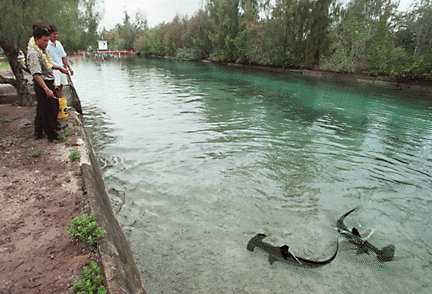
Coconut Island
marine biology
facility dedicated
The Pauley family
By Pat Omandam
had invited UH to build
a lab on the island
in 1947
Star-BulletinSTEPHEN Pauley recalls that his father, Edwin, who died in 1981, enjoyed being around scientists even though he was not one.
He remembers his father's words about the need to use the ocean's protein resources to feed the hungry -- work that a new Hawaii Institute of Marine Biology research facility on Coconut Island that was dedicated yesterday can help develop.
Pauley told the 200 people who were ferried to the island for the dedication of the Edwin Pauley Marine Lab and the Barbara Pauley Pagen and William R. Pagen Library that his generation has neglected to maintain Earth's environment and resources for future generations.
He challenged them to become personally involved in making the environment a front-page issue that prompts global ecology.
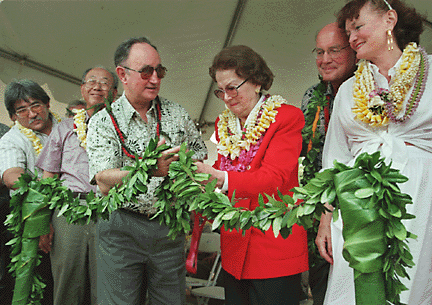
"We will not fight to save what we do not love," Pauley said.Edwin Pauley, a California oil executive, and four other investors bought Moku o Lo'e, or Coconut Island, in 1946 from the estate of Christian Holmes.
A year later, the family invited UH to start a marine laboratory there, starting a relationship that eventually led to the Pauley Foundation's 1993 donation of $9.6 million to the UH Foundation so the university could buy back part of the island sold in 1987 and build the new, state-of-the-art marine lab.
UH President Kenneth Mortimer said that in the 50 years since the first field station was set up on Coconut Island, the institute has grown to prominence as an important center of tropical marine research and education, allowing trail-blazing studies of the coral reef ecosystem and the deep ocean.
Larry Riley, a graduate student in zoology, said the new facilities will allow more students and researchers to study on the island.
Riley said he almost attended Oregon State but was drawn to the possibilities of research at Coconut Island.
"It really will make its mark on a map," he said.
One person who was a little disheartened to see the new buildings was Robert Miranda, a Honolulu police officer whose father, Basilio, became caretaker of the 23-acre island after it was purchased in 1946.
What came to his mind were memories of his childhood, and a large backyard filled with chicken coops at the spot where the new buildings stand.
"For years, everything around us changed except here," Miranda said.
