
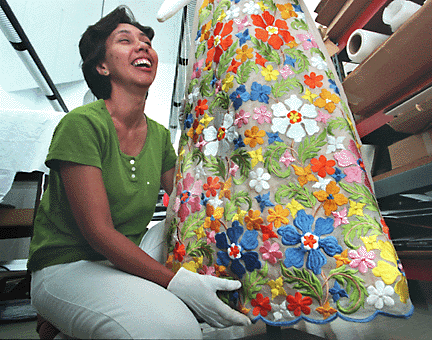
Here’s looking
at two, kid
BISHOP MUSEUM TAPS SENSES AND
By Burl Burlingame
CULTURE WITH A DOUBLE DOSE
OF NEW EXHIBITS
Star-BulletinIT'S always a big deal when Bishop Museum has a new exhibit, but now we've got two new exhibits in the museum's Castle Building. And they couldn't be more different.
Downstairs it's "Animal SuperSenses," an exhibit originally from the Witte Museum in San Antonio, and upstairs it's the museum's own "Filipino Americans of Hawaii: A Celebration of Courage, Service and Achievement," much of which hung in the State Department in Washington D.C. earlier this year.
Those amazing animals
The project manager for Animal SuperSenses is Tina Shaffer who's excited about the interactivity of the exhibits. There's isn't much standing and reading here; it's hands-on all the way.
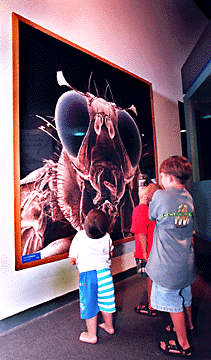
Using hands may be about the only thing humans have over animals. Our opposable thumbs and stereoscopic vision have made up for other senses that have atrophied over the millenia.When was the last time you could smell a fish in the water from a mile away, use echo-location to find your way in the dark, see 360 degrees all the way around your head at the same time, navigate by the Earth's magnetic field, carry on sub-sonic conversations, pick minute variations in someone's electric aura, or follow a scent like it was a line painted on the path?
The exhibit was originally developed as an adjunct to a BBC television series of the same name. "That's why in some of the video clips, the narrator has a British accent," said Shaffer.
The trick is illustrating the concepts. The subsonic speech of elephants is shown by a speaker disk that plays back regular (human-wavelength) sound, then plays the same thing at below 20 hertz, which is fine for elephants but inaudible to us. But some popcorn dancing on the speaker cone shows us that it is indeed transmitting sound.
"One the of the major differences between prey animals and predators is in the way their eyes are arranged," said Shaffer. "Animals that have to keep a look-out all the time have their eyes on the sides of their heads so they can look in all directions are once. But they have no depth perception. Predators need depth perception, so they have their eyes on the front."
There is local activity tied in as well. For example, she's drafted science educator Mike Levad to give daily demonstrations on the hypersensitivity of sharks.
"A shark can sense another fish in the water from a mile away, and different senses come into play the closer the shark gets to its prey," said Levad. "From a yard away, a shark can even use electroperception to target its prey. A shark has no sense of taste, which you discover as soon as you see their living rooms."
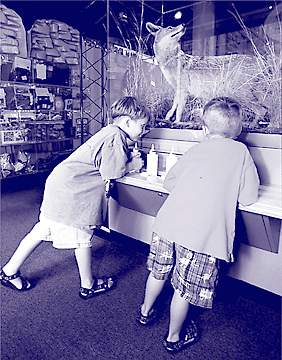
But seriously, folks, experiments with baby hammerhead sharks in Kaneohe Bay have shown that they can zero in on flat fish just under the sand, just from the electrical disturbance caused by their gill movements.Snakes hear through their jawbones. Resting your jaw on a pedestal at the exhibit, you can hear Pink Floyd vibrating through your skull, which is not that unusual for Pink Floyd fans.
Centennial inspires exhibit
Time to travel upstairs, where the Filipino-American exhibit is helped along by the museum's two Bettys -- Betty Kam and Betty Tatar of the collections staff.
"It started with the opportunity to display some of our collection in Washington at the State Department, where it was up May through July," said Tatar.
The trigger was the centennial of the Battle of Manila Bay, a key event in American history as it was the moment the United States became a world power. Although the 100th anniversary of the Spanish-American War has largely been ignored by the popular press this year, it was enough to create this exhibit.
The year 1898 was also the year Filipino rebels declared independence from Spain and is properly considered the start date for the Republic of the Philippines. There were still a few hurdles to overcome, like Spain "giving" the Philippines to the United States in the Treaty of Paris, the subsequent Philippine-American War, status as an American territory and occupation by Imperial Japan.
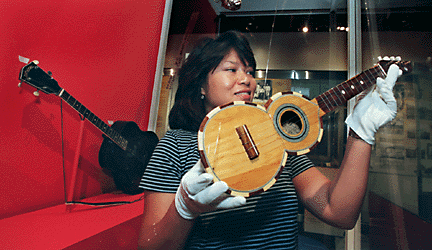
The net effect was that Filipinos could easily move from the home islands to Hawaii, also a U.S. territory, and plantations started recruiting Filipino laborers.Although some Filipinos had arrived in Hawaii previously, the first big wave came here in 1906. Since then, Filipino culture, customs, cuisine and celebrations have helped define modern Hawaii, to the point where the exhibit gives equal space to both the nation's first Filipino governor and fighting chickens.
Plantation life illuminated
The stuffed fighting chicken and various cock-fighting weapons are on loan from the police museum, said Kam.The exhibit was put together in conjunction with the Centennial Celebration of Philippine Independence, the Philippine Centennial Committee-Hawaii and Equitable, said Tatar.
This show is straight and dignified, less hands-on and more word-heavy. A major portion is devoted to the record of the First Filipino infantry of the U.S. Army in World War II, whose exploits are often overshadowed by Japanese-American veterans.
Displays include early plantation lifestyles that illuminate Filipino attitudes toward community and family, plus a wall of local Filipino heroes, which, naturally, includes Star-Bulletin artist Corky Trinidad, and the Gov. Ben Cayetano.
Kapalama School also got into the act, contributing dozens of excellent paintings by kids that reflect their views of growing up Filipino.
Staff contributed to display
Kam is particularly pleased that Filipino staff at the museum pitched in and helped, from building Christmas paroles and kites to planting a Filipino garden around the kid's outside play area."They did a beautiful job. The idea of using less space and high yield is very Filipino, and makes for some unique gardens," said Bishop Museum's groundskeeping czar Tommy Boyd. "And we learned a lot about the connection of Hawaii to the Philippines. For example, I didn't know that the national flower of the Philippines is pikake."
"The last time there was an exhibit on Filipinos at Bishop Museum was 1981, so we're very pleased with this one," said University of Hawaii Ethnic Studies professor Dean Alegado, one of the advisors for the exhibit. "It's a real opportunity to bring the community together, particularly since the centennial of June 12 (the Filipino revolutionary independence day)."
The centennial of the Filipino-American War, over the next few years, as both countries look back on their time together, will call for new interpretive challenges, said Alegado.
The war is largely overlooked in American textbooks -- how many of you have heard of Apache leader Geronimo and how many have you heard of Filipino leader Aguinaldo? -- although the nation was bitterly divided over the conflict at the time, a preview of U.S. involvement in Vietnam.
"That's because it's depicted as an insurrection, not a war," said Alegado. "An insurrection that required 70,000 U.S. troops and resulted in 600,000 Filipino deaths. We got off on the wrong foot."
Although, like most Bishop Museum exhibits, the focus is on culture rather than history, the parallels between the Philippines and Hawaii are explored. "Probably nothing short of a miracle could have prevented Hawaii and the Philippines being annexed by SOMEBODY," said Alegado.
"But it wasn't a sure thing. The vote in Congress to annex the Philippines passed by only one vote. One vote a different way, and our history would be completely different."
And Hawaii, the "melting pot" of Pacific cultures, would be short a vital ingredient.
Exhibit facts
What: "Filipino Americans of Hawaii" runs tomorrow through Feb. 28, and "Animal SuperSenses,"

