By Ken Sakamoto, Star-Bulletin
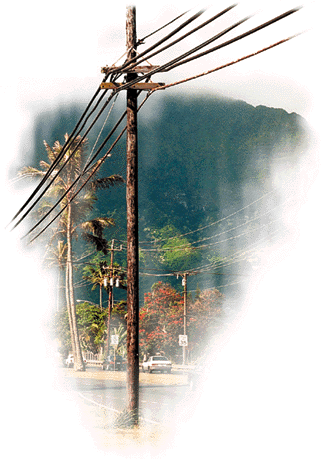
Little can be done about unsightly utility poles,
but you can hide the wires connected to your
house by burying them.
Bugged by unsightly utility wires
By Burl Burlingame
hitched to your home?
Star-BulletinWHEN electricity became a utility a bit over a century ago, there were more than 3,200 electrical companies in the United States providing power -- and no two companies provided matching voltages. Clearly, this wouldn't do, and there was a kind of summit meeting in 1891 among electricity enthusiasts that settled on the 120- and 240-volt standard.
The Hawaiian Electric company was also formed in 1891, and in 1893, secured an exclusive government contract to light the Republic of Hawaii's office buildings.
While Nikola Tesla's AC-current supporters and Thomas Edison's DC-current backers wrestled over the best way to let electricity flow, power lines were being installed all over the country, and it was done as quickly and cheaply as possible, simply strung on poles like wash lines. There were already poles standing to handle telephone lines, and these were drafted to do double duty. That's why your neighborhood utility poles are still generally called "phone poles," even though they also carry electricity, cable TV and garage-sale notices.
But when the concept of the "suburb" began taking root in the early part of the century, quality-of-life packagers and real-estate developers began to bury those ugly power lines underground. Many neighborhoods built prior to WWII are wire-free, while those built since the war are wire-heavy.
Manoa Valley, which was laid out in fits and starts by dozens of small developers, is a patchwork of above- and below-ground wiring.
In the teens (Hawaii Hall was built in 1912), the University of Hawaii campus was one of the first government districts in Hawaii to be designed for underground wiring, and the tradition continued when the campus was expanded in the early '60s. "We've been real happy with the way (the wiring has) held up," said Farouk Wang, UH Buildings and Grounds administrator. "The termites chewed through, causing some problems, but not so much lately. The biggest problem has been record-keeping, keeping track of where the lines are."
Even in downtown Honolulu, wires tend to pop out in older, poorer neighborhoods, and disappear in ritzier zones. Wires are heavy in Chinatown, for example, and vanish as you go a few blocks east into the financial district.
Most new neighborhoods have wiring installed underground, even on the Ewa plain, where wire-heavy poles are part of the historic fabric of the community. The trick is installing a number of underground conduits to handle future changes in a neighborhood's wiring. Where once a simple phone line sufficed, the modern home also has electricity and cable TV, and future homes will have dedicated modem lines and cell-phone stations.
This means that if you want to dispose of the wires around your house, it isn't a simple proposition. Unless your entire neighborhood by some miracle is able to bury wiring (parts of deepest Palolo, for example, were placed underground as part of an agreement with the power company to establish a booster station there) the only wires you'll be able to get rid of are the lines from the pole to your house.
The work is considered a structural change, and must be permitted and then handled by a licensed contractor. "Sweat equity" may be a waste of time and effort. The electrical permit number needs to be provided to the power company before they'll pull the line through.
To initiate a service request from Hawaiian Electric, call HECO's administrative department at 543-7846, 5623, 5604 or 9730, said Ken Morikami, HECO's director of project management. They will check the site and send the customer a letter that includes costs and requirements.
The letter explains that underground wiring standards must meet the state's General Order #10, known as "Rules for Underground Construction in the State of Hawaii." Also included is HECO's Service Installation Manual, explaining stuff like conduit sizes, trenching methods, installation of meter cans and pullboxes for cable, and how cables are spliced and terminated.
Essentially, a trench must be dug from the pole to the house with separate conduits for each utility line. These conduits are generally made of PVC pipe rather than metal these days, said Thomas Vincent of American Electric. Plus, you'll need to attach stout pipe conduit to the sides of the pole.
HECO says that 2-inch PVC is adequate, unless air-conditioning is used in the home, in which case they recommend 3-inch PVC for 200-amp loads. Also, if the distance from the pole to the home is more than 150 feet -- the distance causes a power bleed -- the 3-inch works better.
"You'll need three conduits, minimum, for each utility -- power, phone, cable," said contractor Roger Buccat of RB Electric. "The contractor will install the conduit, typically to a depth of at least 18 inches in the average yard. Then representatives from each utility must come out to pull the lines through and reconnect them."
Depending on the amount of labor and technology required, Vincent and Buccat estimate that burying the lines underground for an average house can cost somewhere between $700 and $2,000. Lanikai residents recently requested a cost estimate from Hawaiian Electric for underground house lines, and the cost ranged between $2,000 and $4,800 per house, depending on conditions, said Morikami.
Contractors can steer you toward some new technology that digs holes horizontally, so trenches don't have to be dug through sidewalks and driveways.
It's also a good idea to bury a yellow plastic caution tape at least 6 inches above the conduit (in case someone accidentally digs in the area later), and to paste a map of the buried conduit inside your circuit box.
Even with the cost, both contractors said burying these lines isn't that unusual. "Many people who are remodeling or rebuilding their homes have their lines put underground," said Buccat.
That done, the phone pole can revert to one of its best uses -- as a place to tack up garage-sale flyers.
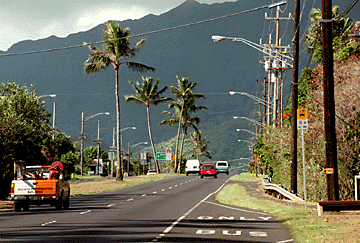
By Ken Sakamoto, Star-Bulletin
Utility poles with a mix of underground and above-ground
wiring line the road to Kailua. We asked the Department of
Transportation if poles could be restricted to one line down
the median, but it's a no go.
All that hard wiring comes
down to the polesEven if underground wiring isn't an option for a neighborhood, why are there so many utility poles? They pop up every 150 feet or so on a street, groaning under wires, and on major thoroughfares, there are often poles on both sides of the road. That means the most traveled routes are most visually blighted.In many mainland communities utility poles are anchored along the property lines in the back yards of the typical suburban block. This requires a utility-access easement, but it also means far fewer utility poles in the neighborhood, and they're largely hidden from street view.
The only poles visible are those used at points where the lines cross from one block to another, and street lamps. Some older neighborhoods on Oahu, such as Kapalama Heights and Waialae, have the utility poles at the rear of the property. Without the access easement in force here, the poles are harder to get at.
But this is also generally more difficult to achieve in Hawaii because of a unique arrangement local utility companies have with each other. Instead of one company or the county owning (and maintaining) the poles, Hawaii poles are jointly owned by each utility using the pole.
That means if Hawaiian Electric, Hawaiian Telephone and Oceanic Cable are all using the pole to bring service to your home, there's a three-way partnership to manage the pole. All parties must agree to and fund any changes to the pole, which, in practical terms, means a stalemate.
HECO, as a rule, tries to maintain poles in front of homes. The average homefront is 50 feet, which means every third house probably has a pole in front.
All those poles alongside the highway also fall under the jurisdiction of the Department of Transportation in addition to the utility companies.
"The placement of the poles is determined by juggling the highway right-of-way and the 'crash zones' alongside the road," said Pericles Manthos, DOT Highways Administrator. "They need to be within the public property of the highway, but in as safe an area as possible."
Why not run a single line of poles down the median? Wouldn't that cut down on the number of poles and improve the view planes from the road?
"If you look at the poles alongside the highway, like the Kailua Road corridor, you'll see the wires are at different heights," said Manthos. "The different elevations are needed for high and low voltages. They can't be at the same height. That's why you need so many poles."
The different voltages would all require separate passages underground as well, one reason "retro-fitting underground wiring to an already existing route costs so much," said Manthos. "And repairs, even if they don't occur as often, are more difficult. The newer plastic conduits are better than the older metal ones, which we're having a problem with as they corrode."
The median might also contain drainage or sewage lines that would preempt both pole and underground wire installation.
"This is a significant issue for the highway department, because putting underground wiring in a new stretch of highway is typically 30 to 40 percent the cost of the road. It can be very, very expensive."