

By Craig T. Kojma, Star-Bulletin
Marian Lash can be found four days a week
at work in the Rehab Hospital garden.
When Dr. Terry Lash, director of the U.S. Nuclear Energy Department, wants to send his mother a gift, he knows exactly what she wants, and that's what he sends her. It is a prize rose bush from a well-known mainland grower. But Marian Lash lives in a condominium in Aiea. What does she do with all those rose bushes? Cultivating
wellnessGardening is therapeutic
for Rehab patientsShe plants them in her gardens at the Rehabilitation Hospital of the Pacific. Forty years ago Lash was in an automobile accident in Oregon that put her into a steel body brace and a wheelchair. In acute pain, she was hospitalized 22 times in 26 years, and then she found a doctor who took her out of the brace and into therapy. One of his first pieces of advice was to get out of the cold Oregon winters and come to Hawaii.
So she and her husband wintered here until he retired 11 years ago, and they moved to Hawaii permanently. During those stays here, Marian Lash was an out-patient at the Rehab Hospital, and now she not only is out of the wheelchair, but she walks five miles a week and is the hospital's Flower Lady.
"I make 125 flower arrangements each month, and I grow almost all of the flowers here. I do all of the digging and the planting myself. It's been a wonderful thing. I can't wait to get up in the morning to see what's blooming," she said.
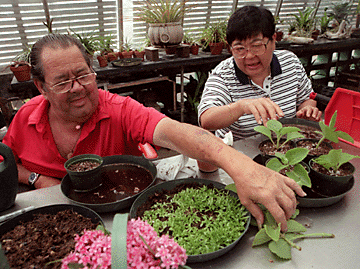
Lash is living, walking proof of the value of the hospital's Horticulture Therapy Program. The therapeutic value of gardening has been recognized for hundreds of years, but only recently have hospitals around the country begun to organize horticulture therapy programs. Therapists work with handicapped patients to the extent of their physical limitations in cultivating potted plants within a greenhouse. Some are regular patients at the hospital, others are in the out-patient program.
The program not only renews the patients' interest in gardening, but increases their coordination, attention span, endurance and motion skills, and offers an opportunity to be with other people, enjoying a hobby removed from a hospital environment.
The Rehab Center's greenhouse, built in 1981, has become a vital part of the rehabilitation program. The plants growing there are a selection of well-maintained and unusual plants that would be the pride of any gardener.
Lash's project is bigger, the planting of pocket gardens in several locations around the hospital. "I start 400 seeds at a time on my condo lanai," she said. "When the seedlings are big enough, I transplant them to peat pots and then bring them to Rehab. I usually choose only flowers that bloom, but I need some background greens like ferns and ti for the arrangements."
Not all of the patients are involved in the cultivation of plants. Wendy Albios, an out-patient who is recovering from a serious car accident, paints flower pots. They are gems, and when she gets a little ahead of the orders from the medical staff of the hospital, the pots will be on sale at the gift shop.
Other patients take standard red clay pots and paint them a solid primary color. Then Albios paints flowers or butterflies or other appropriate designs in brilliant colors around the pot.
They can be used, of course, as regular flower pots, but more often they are used as cachepots to contain potted plants indoors. Christmas isn't that far away, and these would make unique gifts.
And if you are visiting the hospital, look for Marian Lash. She works there four days a week for about five hours each day. "It's more than just growing plants and making the hospital look better," she said. "The patients here know my history, they know that I was in a wheelchair and a brace. When they see me walking around the hospital, working in the garden, they know that if I could do it, maybe they can, too."
By Craig T. Kojma, Star-Bulletin
Raymond Nunes and Eloise Marugame work
with plants in the Horticulture Therapy Program.
The techniques used by the therapists in the greenhouse of Rehabilitation Hospital of the Pacific are easily transferred to the home gardener who may be arthritic or recovering from a stroke. Here are suggestions of the Rehab program staff: Put your plants
within easy reach
Use raised beds instead of gardening at ground level to eliminate stoop labor. Raised beds are boxes or barrels filled with soil to a few feet above the ground. The height depends upon whether the gardener will be working from a wheel chair or sitting on a raised wall by the bed. The width should be no more than 2 feet to prevent having to reach and strain.
Gardening Calendar in Do It Electric!
Send queries along with name and phone number to:
Evergreen by Lois Taylor, Honolulu Star-Bulletin, P.O. Box 3080, Honolulu 96802.
Or send e-mail to features@starbulletin.com.
Please be sure to include a phone number.
Evergreen by Lois Taylor is a regular Friday feature of the
Honolulu Star-Bulletin. © 1998 All rights reserved.


