
Hawaii looks to
cash in on kava
Demand is growing for the
By Burl Burlingame
herb touted as a natural alternative
to Valium and Prozac
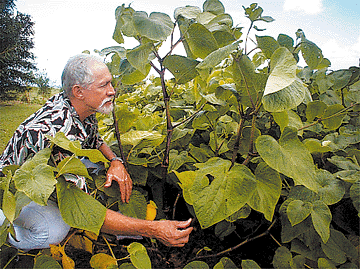
Star-BulletinKava, known in Hawaii as 'awa, often can be found tucked away in forest-reserve hillsides, growing wild and solitary. Or a couple of plants can decorate the corner of a yard.
Soon, however, you might see fields of the stuff.
Kavalactones, chemicals found in the plant, stimulate the brain into a sense of pleasant hyper-awareness, and it has been determined that these chemicals are generally safe and nonaddictive. More important for marketing purposes, kavalactones are touted as a natural herbal alternative to Valium, Prozac and other mood-management drugs.
Kava has become the herb du jour in the health-food industry, and demand has begun to spill over to the general public. This could create a tremendous demand for a plant that is not commercially grown and is available only from the Pacific.
Gearing up to supply kava to the world is the Association for Hawaiian 'Awa, a loose group of local farmers, cultural specialists and biochemists. The group was organized as a research, education and preservation nonprofit in May and has already produced a newsletter and a conference.
Apparently, Hawaiian kava is good stuff. The roots are rich with kavalactones, and the plants are largely resistant to kava-specific diseases.
Economist Reginald Sanbay predicted in Islands Business last year that "Hawaii will be a major player. . . . I think they could very well become the sole supplier to the American market."
Organizers of the group believe the time is right to introduce kava as a major cash crop for Hawaii. Since it takes three or four years for a kava plant to properly mature, and kava-growing has never been done plantationwide, it won't happen overnight.
Kava growing is "happening statewide. Oahu is actually the last to come on line," said Noelani Whittington, corresponding secretary of the isle organization. "Wild 'awa has been harvested almost to the point of extinction. So we're learning how to grow it all over again, and we're learning so much. . . . a lot is surprising. For example, we're growing 'awa in Kona, where it's sunny and dry, and it's no sweat. We'd always heard 'awa generally needs shady and humid."

"Although kava is not native to Hawaii, there are many varieties grown here," said Benton Kealii Pang, a doctoral candidate in botany at the University of Hawaii. "Hawaiians had their own unique system of taxonomy, very intensive, based entirely on the exterior characteristics and potency."
One potential problem, Pang noted, "is that while the plant is fairly easy to grow, and grows from slips or cuttings," this means that baby plants are essentially clones of the mother plant, and susceptibility to disease isn't as easy to breed out as it is in seed-bearing plants."
Chemist Ron Fenstemacher worries that acres of kava might deplete the soil.
"There's still a lot we don't know about the plant -- most things, actually," he said. "Maybe if you're not real aggressive about growing it, intercrop it with something else, like bananas or coffee, it won't take too much out of the soil. We just don't know. It's an agriculture problem. It's a big cash crop everywhere else in the Pacific, why not here?"
Recently, Ed Johnston, horticulturist and coordinator with the isle group, met with representatives from Schwabe Pharmaceuticals, a large German company. "They're quite serious about possibly growing kava in Hawaii," said Johnston.
"They are concerned about the quality control of kava they're getting from the South Pacific, and are impressed with Hawaiian 'awa. They're willing to pay a bit more for Hawaiian 'awa, if we can produce enough of it. We're talking tens of thousands of acres if that happens."
Can kava be the next pineapple or sugar cane? "No question. The potential is there, and it's far friendlier to the environment than sugar cane or pineapple," said Johnston. "But there are probably fewer than 100 acres of 'awa being commercially grown in Hawaii right now. A ranch on Molokai is about to add 100 to 500 acres of 'awa, and that will immediately employ 15 people."
"Hawaii has everything going for it for 'awa production, and this is just the starting point," said Whittington. "Worldwide sales of 'awa, or kava, at this point are more than a million dollars, up from virtually nothing just a couple of years ago."
The Association for Hawaiian 'Awa is at P.O. Box 636, Pepe'ekeo, HI 96783.
Information: 808-969-7079.
Kava, man—we know it
By Burl Burlingame
works, but little else
Star-BulletinAlthough kava appears to be a safe, nonaddictive method of reducing anxiety, "there is much to be learned about what this remarkable substance does and how it does it," according to "Kava: Nature's Answer to Anxiety," a booklet by Dr. Ray Sahelian.
In other words, although there may be hundreds of years of anecdotal gossip about kava, there's precious little scientific evidence.
In Germany, though, they've been serious about kava for more than a century. German chemists were the first to extract the root's active ingredients. Hawaii's main contacts with Germany prior to World War II were through kava exporters.
Kommission E, the German equivalent of the Food and Drug Association in the United States, recommends kava as a primary over-the-counter anxiety medicine. The FDA has not weighed in on the matter, and may not, since American companies market the product as a life-enhancing legal herb, not a drug.
A perusal of kava products in local health-food and natural-products shops shows virtually no claims other than banal statements such as "Promotes relaxation during times of anxiety." Well, so do breathing exercises.
Kava products are for the stressed-out baby boomer who wants a little less anxiety at the workplace. The tribal buzz from heavy kava ingestion is found nowhere in the marketing, and you would have to take hundreds of capsules to get the same numbing effect as drinking strained kava direct from a bowl.
How much kava should anyone take? And in what form -- pills in gel or capsule form, tincture, traditional soup style, gnawing directly on the roots? No one knows. (According to one kava Web page, however, the "real race" in commercial kava is in the gel-cap market.) Damian and Karen Paul, operators of The Source, a Kailua
blrb How much kava should anyone take? And in what form? No one knows. health-products store, simply advise, Read the directions on the bottle, and try different varieties.
Sahelian recommends a daily starting dose of 40 to 80 mg kavalactones (the active part of kava), and it may be a few weeks before anxiety is notably reduced. Since no one has scientifically tested the substance for longer than four months, no one recommends using it for more than four months. And, also because it hasn't been tested, it is not recommended for anyone who is under 18, pregnant, nursing or taking prescription drugs. Don't mix it with alcohol or other drugs.
And if you get swacked on the stuff at a kava-drinking party, don't drive. Even if your senses are heightened, your reflexes are slowed.
Recently, Utah convicted a Polynesian man of driving under the influence -- of kava. "This guy had had 16 cups of kava," said officer Paul Hiatt of the Utah Highway Patrol, as reported in the Deseret News. "He was all over the road.
"He got heavy fines, but they waived sending him to a drug treatment program, seeing that kava isn't an illegal drug and it's just part of life in the Polynesian community here."
See also Humble, Ancient Shrub in Features
