
Hawaii: Big taxer,
big spender
A Census Bureau report
By Pete Pichaske
ranks the state government near
the top in both categories
Star-BulletinWASHINGTON -- A new federal study confirms what most Hawaii taxpayers already know: When it comes to collecting and spending money, few states can top the isles.
Hawaii's state government spent more money per capita last year than every state except Alaska, according to the study compiled by the Census Bureau.
And Hawaii collected more money per capita, in taxes and other charges, than every state except Alaska and Delaware.
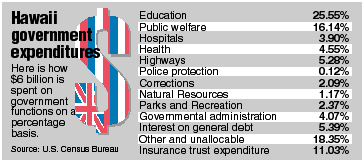
"That's traditionally been the situation for Hawaii," said Leroy Laney, an economics professor at Hawaii Pacific University. "We're a relatively high-tax state, and have a relatively small population . . . And we're a state that traditionally expects a good deal from its government."And state residents are getting a good deal from their government, at least a good deal of tax collecting and spending. The Census Bureau report detailed how states spent the money, and found that in almost every category, from education to highways, Hawaii spent more money per capita than the national average -- sometimes dramatically more.
Hawaii spent $233 per capita on health, for example, compared with a national average of $126. Hawaii spent $209 per capita on government administration, compared with a national average of $107.
On parks and recreation, Hawaii spent $121 per capita, while the national average was $14. On highways, Hawaii spent $270 per capita, while the national average was $225.
On education, the biggest expenditure, Hawaii spent $1,311 compared with a national average of $1,032. But that comparison is misleading, observers noted, since public schools in other states are also funded by local jurisdictions, whose spending was not included in the report.
John R. Kennedy, a statistician with the Census Bureau's governments division, said Hawaii has traditionally ranked high in the bureau's reports on revenues and spending. He attributed that to the state's high cost of living, which inflates such costs as salaries and procurement, and its relatively small population.
The cost of operating a local government in a small state tends to be higher per capita, he said, since there are fewer taxpayers to support the government.
Kennedy also noted that Alaska's top ranking is due to its size and, more importantly, to the hefty state tax on oil and gas revenues, which he said brings in "huge amounts of money" and thus skews the state's standing.
Paul Brewbaker, chief economist for the Bank of Hawaii, said Hawaii's high rank in the study begs the question that has loomed large in this year's political campaigns, where the main issue is the state's ailing economy.
"This goes to the whole question of whether the state government is too big," said Brewbaker.
"It's fair to say we have had a relatively progressive political administration in Hawaii . . . The state has tended to be more socially generous than others.
"But the question is, is our government big because we want it to be big, or is it big because it is inefficient?"
Education’s share of
By Debra Barayuga
state spending below norm
Star-BulletinMore than one out of every four dollars spent by the state of Hawaii last year went toward education, according to figures released today by the Census Bureau.
Some 25.55 percent of state expenditures, or $1,312 per capita, went toward education in Hawaii. Nationally, the percentage spent on education was 30.87, and the national per capita expenditure was $1,032.
While the Census data show Hawaii ranks No. 2 in the nation in per capita expenditure of $6 billion and third in per capita revenues of $6.7 billion, the numbers are misleading, said Earl Anzai, state budget director.
Still, school officials maintain the state is spending a lower percentage than most other jurisdictions on education and could do better.
In spite of the state's economic problems, "We know we're among the greatest revenue-generating and -collecting states, and because of that, a greater share could go to education," said spokesman Greg Knudsen.
"We need to look across the nation at other states devoting a larger share to education," Knudsen said.
The department's own data show the state spent roughly $5,792 per pupil in fiscal July 1996 to June 1997.
How the money is being spent is another matter, said Rep. David Stegmaier, chairman of the House Education Committee for the past four years.
"I contend that if we look at how money is being spent, we find that not enough is being spent in the classrooms for direct learning or direct education for our students."
Stegmaier believes there are personnel and programs at the state and district level that would be more effective if they were used at individual schools.
"I'm convinced, until we move all the wonderful, committed people we have in our education system to operate as fully empowered teams at the individual schools, we will not be effectively using the monies that we now have."
Even though Hawaii spends more than just about any state on education, the results public schools are producing are mediocre, he said.
The just-released SAT scores show Hawaii's public and private schools combined scored just a point above the national average in math but 22 points below the average reading scores.
Hawaii's public school students alone scored 459 in verbal and 488 in math, compared with national averages of 505 in verbal and 512 in math. Perfect scores are 800 in each section.
"If we were spending this much on education, one would hope we would be above the norm rather than just at the norm concerning our math scores, and we certainly should be at the norm or above in verbal scores," Stegmaier said.
