

TOM Coffman's extensively researched book, "Nation Within," is subtitled "The Story of America's Annexation of the Republic of Hawaii." Theodore Roosevelt’s
role in annexationHe is critical of achieving annexation in 1898 by a joint resolution passed by simple majorities in both houses of Congress -- this after a two-thirds treaty ratification majority could not be won in the Senate.
Critical, too, have been centennial events this month. Little mentioned is the identical 1845 admission of the Republic of Texas by joint resolution signed by the president after its annexation treaty was rejected. Should we both be kicked out of the union?
Coffman's book moves to center stage an American well-known for many other things, but seldom connected with Hawaiian history -- Theodore Roosevelt. We have a high school named for Roosevelt, as we do one named for President William McKinley, who signed the annexation resolution.
But I thought the choice of the Roosevelt name grew from his 1901-09 presidency. Coffman shows Roosevelt was deeply beloved by Hawaii's annexationists for things he did when his rank was no higher than assistant Navy secretary.
Roosevelt was born in 1858, just 40 years before annexation, as was Lorrin A. Thurston, the Republic of Hawaii's annexation negotiator. At Columbia Law School they studied separately under a professor who contended Northwestern European countries had a supremacy in the art of government unmatched even by such other whites as Celts, Slavs, Czechs or Hungarians.
Roosevelt and Thurston didn't become acquainted until later, and Thurston didn't know Roosevelt when he was a chief perpetrator of the overthrow of the Hawaiian monarchy in 1893. However, Coffman counts the thinking of Professor John W. Burgess as reinforcing both men's actions after getting out of law school.
Coffman notes that Roosevelt's seafaring was confined to rowing a boat in Oyster Bay, Long Island. Yet, by age 23 he had authored "The Naval War of 1812," a highly regarded study that established him on the path of wanting a strong navy to reinforce U.S. expansionism. He was joined by Capt. Alfred Mahan, a leading naval strategist, and Sen. Henry Cabot Lodge of Massachusetts.
Togetherness with Roosevelt in politics in New York had led McKinley to be wary of Roosevelt's assertiveness and power grabs, but McKinley nevertheless was persuaded to put Roosevelt in his sub-cabinet.
To pursue their "manifest destiny" goals Roosevelt, Mahan and Lodge were perfectly willing to be provocative to get Spain out of Cuba and then to use the Spanish-American War to get Spain out of the Philippines, Guam and Puerto Rico, too. Coffman suggests an indecisive president was more or less dragged along.
A base in Hawaii fit perfectly with their Pacific strategy. It also meshed with the different strategy of those who had overthrown the Hawaiian monarchy in 1893 and were itching to join the U.S. regardless of what happened elsewhere. The Hawaii revolutionists had their own economic and long-term stability goals for the islands.
Thurston seized on a chance to sell Congress on Hawaii's strategic potential by suggesting that coal to refuel the U.S. fleet be stockpiled in Honolulu. The assistant secretary of the Navy had it done, as he earlier had ordered up a Navy map showing Hawaii as strategically important.
AFTER Roosevelt became even more popular by leading the Rough Riders in Cuba, he went on the 1900 ticket as McKinley's choice for vice president.
Made president in 1901 by McKinley's assassination, Roosevelt soon sent our "Great White Fleet" of battleships around the world to dramatize U.S. naval power. On arrival in Hawaii, the ships sailed close in to the Kalaupapa Peninsula on Molokai to be admired by the leprosy patients isolated there.
As it turned out, under the U.S. flag Hawaiians won a much broader voting franchise than they had under the Republic of Hawaii.
Federal Judge Samuel P. King suggests Coffman's next book be on the post-annexation years. I second the motion.
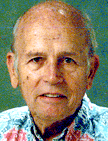
A.A. Smyser is the contributing editor
and former editor of the the Star-Bulletin
His column runs Tuesday and Thursday.