Six months on the job has
By Jaymes Song
told the graduates of HPD
Recruit Class 127 whether they
have a nose for police work
Star-BulletinThey call it "the Smell."
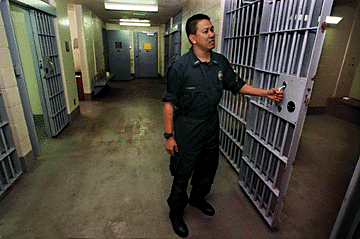
"The Smell" is the mysterious, overpowering odor -- like a musty body odor -- that grabs anyone who passes the heavy steel doors to the cellblocks at police headquarters.
It is one of the things that some of Honolulu's newest police officers are learning to cope with.
"It's (coping is) kind of like pig farming," said 37-year-old Brian Bascar. "You get used to it."
Despite such drawbacks, Bascar and 27 others in the Honolulu Police Department's 127th recruit class have stuck with their new careers.
"It's fun," Bascar said. "You gotta love this job. I've met all kinds of people."
In February, shortly after their graduation, the Star-Bulletin interviewed the seven women and 23 men in the class. The occupations they left behind -- from secretary to supermarket clerk -- were as diverse as their backgrounds. But their desire to help the community was uniform.
This month, some of the recruits were revisited to see if police work is what they expected, and if their perceptions of Oahu have changed after being exposed to life on the streets.
"I think they realize that no matter how realistic we make training, they know nothing," said Sgt. Robert Imoto, the class' training supervisor. "You can write reports, know the laws and have all the tools. But when you're on the road, you're starting from scratch."
Tested in Waikiki
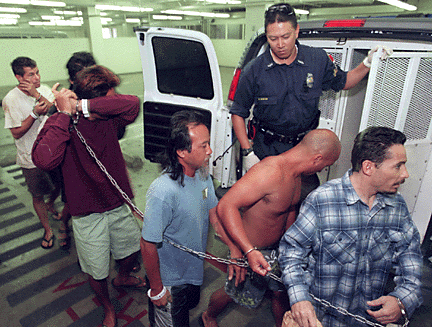
For Bascar -- as well as majority of the class -- starting from scratch partly meant being assigned to Waikiki. Their month in the tourism mecca was a crash course in dealing with people from all parts of society, including the prostitutes who would welcome the freshman officers."The prostitutes knew we were new, and they had fun with us," Bascar said. "They know the laws better than us. They know what they can get away with, and we're guessing."
Jaynelle Toguchi was also assigned to a Waikiki patrol. She said adjusting to varying work hours and dealing with drunk people were some of the most difficult aspects for her.Police work isn't just action-filled "cops and robber stuff," she pointed out. It's a lot of paperwork every day. But helping people is still what makes the job different and exciting, said Toguchi, a former substance abuse treatment counselor.
"I enjoy working in Waikiki and dealing with the public," she said. "It allows the average citizen to interact with us, not just in a negative time or in a moment of crisis."
Amy Garon, at 22 the youngest graduate of the class, said the work hours have been one of the hardest aspects of the job. She was assigned to the cellblocks with Bascar, working the "midnight watch" from 9:30 p.m. to 6 a.m.
Officer Glen Acierto said life as a police officer isn't as bad as he thought it would be.
"But it's still early in my career -- knock on wood," said Acierto, a former courtesy clerk and cashier. "I guess the academy teaches all the worst-case scenarios. It prepared me well."
For two class members who left the department after graduation, the preparation apparently wasn't quite enough.
"It's a culture shock," said Kevin Rodriguez, 29, who returned to his job as a GTE switchboard operator. "It's a new career. It's a little overwhelming at first, but I regret what I did. I should've hung in there. I left too prematurely."
Rodriguez has since reapplied to HPD, while trying to figure out why he quit.
"Through this day, I ask myself why," he said. "I kick myself in the butt every day."
Open rosters, tight budgets
The 127th class was part of an "accelerated hiring" program to fill officer vacancies in the department. There were 200 vacancies then. As of Aug. 1, there were 205 vacancies. HPD is allowed to have 2,128 officers.The class entered the ranks during an unsettled time for the department. It did not have a permanent police chief -- Lee Donohue was chosen in April -- and police shootings this year which killed three men and injured another have prompted public accusations of brutality and discrimination.
The shootings forced class members to face questions and criticism from the public.
"It was kind of hard," Bascar said. "I was just told to be careful on the road. The people wanted to find out what happened. But I cannot say who was right and who was wrong, because I wasn't there."
For several months, the new recruits also had to deal with the elimination of overtime pay.
And they continue to see a disparity in their paychecks when compared to mainland police officers -- who, according to the police union, make 18 to 21 percent more than them, an imbalance that causes an average of 50 officers a year to move to other states.
Class members interviewed said they were aware of the difference in pay scales, but outweighing that was the sense of job security and appreciation of even having a job in a struggling economy.
An officer's life by its nature is not an easy one, and Imoto said he trained the class to focus on, and seek guidance from, the department's mission statement: "Integrity, respect and fairness."
"They will get accused of things, get depressed and have marital problems," Imoto predicted. "I just stress to them, when you get stuck, think of the mission statement."
The new officers almost certainly have not faced the worst they will confront, and retain the hopes that drew them to the job. Bascar, who used to be an auto mechanic, talks to young suspects being booked in the cellblock, trying to convince them that stealing a $3 item is not worth being locked in "this cold and funky place."
"It's in my nature," he said. "Some officers ask, 'Who is that? Your friend?'"
Facing the darker side of life day in and day out would be a challenge for anyone. Yet Bascar feels becoming a police officer has not changed him -- and will not.
"Attitudes do change; I don't know why," he said. "But I stay down to earth and don't let the badge and a gun change me -- and just do my job."