
Isle firms
bidding to build
Navy power plant
The $93 million project in Diego Garcia
By Jerry Tune
would use the ocean's thermal energy
Star-BulletinFive Hawaii companies have formed a joint venture in a bid to build the world's first commercial power plant using thermal energy from the ocean.
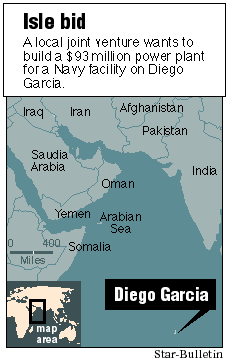
The proposed $93 million plant would provide power and water needs for the U.S. Navy support facility at Diego Garcia, located about 1,500 miles south of India.
The system -- known as ocean thermal energy conversion (OTEC) -- would save the Navy $157 million over 30 years, said Patrick D.R. Grandelli, project manager for O.T.E.C. Systems International, a new company formed in May to arrange project financing.
He said the OTEC proposal is being evaluated by the Navy Facilities Engineering Command in Port Hueneme, Calif. A Navy spokesman said that a decision would be made in the next two months.The OTEC technology, which gains its power by the reaction from cold and warm seawater, has been developed at Keahole on the Big Island at a small facility opened in 1993 for operational testing at the Natural Energy Laboratory.
The power plant sucks warm water from the surface of the sea and pumps it into a vacuum chamber. With air pressure in the chamber being only 2.5 percent of normal, the water boils at room temperature. The result is "cold steam" which runs a turbine that makes electricity. The steam is then condensed by cold water sucked from the deep ocean water. The condensation helps pull the steam through the turbine.
The proposal for Diego Garcia involves no government money upfront and private financing would be obtained from the United States and Great Britain, Grandelli said. The Navy would make guaranteed payments over the 30 years of the contract.
The Hawaii joint venture's five companies, and their expertise, are: Applied Technology Corp., barge design; Makai Ocean Engineering Inc., ocean pipes; Parsons Infrastructure & Technology Group Inc., architecture and engineering; Ocean Engineering and Energy Systems, gas diffusion; and O.T.E.C. Systems International, coordinating financing.
In addition, the joint venture involves Exergy, a Hayward, Calif.-based company that designs power plants; Burns and Roe Enterprises Inc., of Oradell, N.J., a power plant design and services company; and Thyssen AG, a German steel conglomerate that also builds ocean oil rigs.
The proposal for Diego Garcia includes building concrete barges and four 10-foot-diameter pipes ranging from 990- to 13,200-feet long. The pipes would go to a depth of about 2,600 feet.
Grandelli said Thyssen would build the pipes in Germany and the concrete barges would be made in Singapore and towed to Diego Garcia.
The OTEC group has competition from Sempra Energy Services, a joint venture composed of San Diego Gas & Electric Co. and Southern California Edison Co., which proposes to increase efficiency of the current diesel-fuel powered system.
"The U.S. Navy pays $12 million a year to operate and maintain the electricity and drinking water at Diego Garcia in the Indian Ocean," Grandelli said. "It's costly to bring in the oil, and the drinking water has to purified."
The estimated $157 million savings over 30 years from using OTEC's plant includes an expected rise in oil prices as worldwide supplies are reduced, he said.
"OTEC is like a dam," he said. "The big cost is upfront but the big savings is that they don't have to buy fuel anymore."
The OTEC plant would create 5.5 megawatts of power, 1.2 million gallons per day of potable water, and 1.4 megawatts of seawater air conditioning for the Naval facility, Grandelli said.
If OTEC is chosen, more surveys will be done in November at Diego Garcia to get the exact locations of the pipes.
After engineering design, it would take one year for construction and the system would be operational in September 2001, he said.
The private financing would be 60 percent debt and 40 percent equity raised from individual and companies in the United States and Great Britain, Grandelli said.
Diego Garcia, a British territory, is a horseshoe-shaped atoll about 17 miles long and home to about 3,200 people. Half are in the Navy and the others are civilians working for the Navy.
