By Dennis Oda, Star-Bulletin
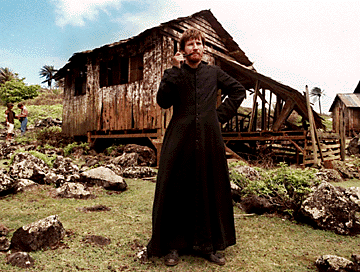
David Wenham poses as Father Damien during
filming of the movie on Molokai. Filming on Oahu
will be completed this week.
Damien biographer
finds a tempted,
pioneering healer
An isle friend led her to revise
By Mary Adamski
the tale of a priest who
aided the abandoned
Star-BulletinFather Damien admits to temptation and is accused of sexual misconduct in the movie about the priest being filmed here by a Belgian company.
It's not sensational fiction, says Belgian author Hilde Eynikel, whose 1993 book on the 19th-century missionary to leprosy patients was the basis for the screenplay.
"He himself (Damien) writes he was tempted by a lady. He often complains about the nudity of the women; it is difficult on him. As a historian, you have to accept it," said Eynikel, who spent the past five weeks at Kalaupapa observing the ERA Films production. The movie company is completing filming on Oahu this week.
Sex is not a major story line in her biography of the heroic Father Damien DeVeuster, who is on the Catholic Church track toward sainthood, nor is it in the movie. But "there has been some static on that, yes," said Eynikel.
The author of seven books in her native Flemish language, Eynikel will have her "Father Damien" published in English next year by Hodder & Stoughton of Great Britain. She said it is the result of research into previously untapped European archives of Damien's religious order, the Congregation of the Sacred Hearts of Jesus and Mary.
She had done an earlier volume on Damien, who died in 1889 of leprosy after ministering to the spiritual and physical needs of patients for 16 years. "In Belgium, I was raised up on Damien. I thought in cliches, that he was good, that he got dirty, that he was angry, that he was good at making coffins." When she started the more recent version, "I was flabbergasted at the depth of information available. I realized my first book was wrong."
She started the more recent biography at the urging of longtime friend Richard Marks of Kalaupapa, whom she visited in 1991. A Belgian publisher sought it in advance of the planned beatification of Damien. That event, the second step in the sainthood process, took place in 1995.
She said the archives included a stack of testimony from people who were questioned by church officials after Damien's death about whether they had observed him in any close relationships with women. No such encounter was ever reported. She found documentation of examinations by Hawaii Board of Health doctors which drove Damien to humiliated tears. It was an incorrect theory in his time that leprosy was the third stage of syphilis. "I have never had a woman, or a man for that manner," Damien angrily told his examiners, Eynikel said.
During her research, "Every day I reported to the fathers what I had found. It was a happy journey. I found such a different Damien."
Eynikel portrays Damien as a liberal priest in conflict with conservative church authorities, with polarization similar to that seen in the modern church. "He has joint services with Protestant deacons. He was doing things that nowadays are considered progressive."
"His main aim was to create normality: weddings, luaus, schools for the kids. Life should be better, because the time allotted them was shorter and more painful.
"He developed theories on palliative care, which wasn't even a medical theory in his time. (He knew) people surrounded by love have less side effects," said Eynikel.
"One of his major fights was against the pimps. A lot of the people (sent to Kalaupapa) were desperate and sought refuge in drugs, alcohol and sex."
The traditional story of Damien's life tells how he discovered he had the disease, when he felt no pain when boiling water fell on his foot. According to the tale, the priest announced to patients that he shared their plight in a sermon beginning, "We lepers ..."
Eynikel said Damien actually used that dramatic phrase to his flock on July 10, 1873, just two months after he volunteered to live with them on the remote Molokai peninsula. "His superiors had ordered him not to risk infection. He was obedient. When he went back to Honolulu after two months, he asked to return and to be allowed to dip into the common poi bowl, to pass the pipe, to risk exposure. That is when he said, 'we lepers.'
"He knew exactly what he was offering."
Eynikel, a former broadcast journalist in Belgium, started her book after an assignment in India, where she interviewed Mother Teresa and observed nuns' care of leprosy patients. Memories of another assignment, on Red Cross work during the conflict in Bosnia, haunted her as she watched the filming of "Father Damien."
"There is a scene in 'the dying shed,' the last place for patients," she said. "It reminded me so much of a place I visited, where 14 young men lay . . . with a look in their eyes.
"I had to go away to sit on a rock and cry."