Poll: 52% say
Hawaii government
is dishonest
That's up significantly from a
By Mike Yuen
1993 poll, and is an indication
of voters' mood
Star-BulletinBy a wide margin, Hawaii voters believe that government in Hawaii is basically dishonest rather than honest, according to the latest Star-Bulletin/NBC Hawaii News 8 Poll.
Fifty-two percent said government is dishonest; 31 percent, honest.
That's an increase of 6 percentage points over five years in the number of voters who perceive government as dishonest.
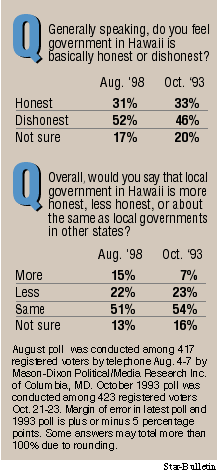
In October 1993, prior to the NBC affiliate joining in the poll, the Star-Bulletin's survey found that 46 percent viewed government as dishonest, while 33 percent saw government as honest.It is the current mood of voter disenchantment that isle Republicans hope to exploit, said state GOP Chairwoman Donna Alcantara. The isle GOP is convinced that voter distrust can be a key factor to loosening the Democratic Party's decades-long grip on state and county governments and even causing Democrats to lose the governorship, Alcantara said.
"People feel that the system is corrupted, that it is not open and fair, that it is who you know - not what you know - that counts," Alcantara added.
State Democratic Party Chairman Walter Heen acknowledges that he is concerned about the electorate's negative view of Democratic-controlled government. But he added, "I'm not sure how deep some of this stuff may run."
The Star-Bulletin poll from October 1993, he noted, reflected similar voter wariness when the last gubernatorial election was gearing up. But Democrats managed to retain control of the governor's office and state and county governments, Heen said.
"There is generally a discontent and dissatisfaction with government in some places that is worse than ours," Heen said. "They raise militias because of their disaffection with government."
The latest poll also discovered that the majority of isle voters believe that the level of honesty in local government in Hawaii is the same as in other states.
Poll respondents said their leading concerns were the candidates' positions on issues, their performance in a crisis and their source of financial support, generally similar to their priority rankings in a July 1996 Star-Bulletin poll.
Alcantara said she believes the public perception of dishonesty in government doesn't touch all government workers. Rather, it mirrors the feeling that "a very small circle of insiders, the so-called old boys' network, is operating behind closed doors and doing back-room deals," she said.
Like Linda Lingle, the Maui mayor seeking the GOP gubernatorial nomination, Alcantara pointed to the $40 million nonbid contracts that Cayetano's close friend and golfing buddy, Bert A. Kobayashi, received for Kapolei school construction projects. The contracts may be legal, as Attorney General Margery Bronster has concluded, but the deals make one wonder why other nonbid construction projects can't be fast-tracked and awarded to contractors who aren't politically connected, Alcantara added.
Heen said, "Without denigrating the effect of public anger on voters' reaction to candidates, I just don't know what needs to be done to convince people that, in essence, government is honestly run."
The fast-tracking of nonbid school contracts was supported by the Kapolei community and even by Republican state Rep. Mark Moses of Kapolei, Heen said.
Moses said he has told Lingle campaign advisers that they're off base with their criticism of the Kobayashi contracts and that they "should back off."
"I believe," Heen said, "it is generally accepted that there has never really been any claim of scandal on the part of the Cayetano administration."
Isle voters overwhelmingly do not believe that candidates for office in Hawaii keep their campaign promises after being elected, the latest Star-Bulletin/NBC Hawaii News 8 Poll has found. Campaign promises
are losing credibilitySeventy-six percent said they don't believe campaign vows are kept. That's 5 percentage points higher than in July 1996.
Seventeen percent said the campaign promises are kept. Two years ago, it was 21 percent.
Also, the latest statewide survey discovered that 54 percent of voters believe that candidates do not address the important issues and do not offer detailed plans. Thirty-five percent said they do.