The small decline is the first
By Russ Lynch
since monitoring began here
35 years ago
Star-BulletinConsumer prices in Honolulu are down from a year ago, the first decline since the federal government started monitoring local prices 35 years ago.
The decline was slight, only one-tenth of a percentage point through the first half of this year compared with the first half of last year.
But Hawaii economists said the latest Consumer Price Index for Honolulu shows the continuation of the low to flat inflation that Hawaii has been experiencing for at least the past year.
"There are no surprises there," said Leroy Laney, professor of economics and finance at Hawaii Pacific University.
"There is probably some upward bias to the index anyway, so that would mean we are actually in a state of deflation," said Laney, who was chief economist at First Hawaiian Bank for eight years before joining the university this summer. National inflation has also been low, Laney said, running 1.7 percent ahead for the year through June.
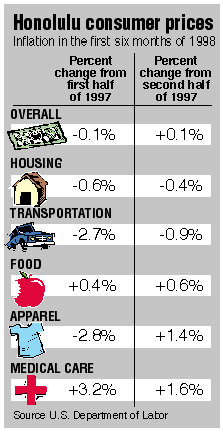
The biggest part of Consumer Price Index for Honolulu -- housing -- was down 0.6 percent compared with a year earlier, according to half-yearly figures announced today by the federal Bureau of Labor Statistics.
Transportation costs, which rank with food and beverages as the the next-biggest item in the household budget, were down 2.7 percent. The drop included a 0.7 percent dip in gasoline prices.
Food prices were up, but only slightly -- a 0.4 percent rise from the first half of 1997.
Clothing costs were down 2.8 percent, which economists say was at least partly due to the presence of large warehouse-type retailers competing for business.
Medical care costs rose 3.2 percent and there were increases in smaller categories, bringing the "other goods and services" costs up 9.4 percent.
Laney said lower energy costs are holding down the national inflation rate and today's figures show that energy prices are also down in Hawaii. Compared with the first half of 1997, Honolulu electricity costs are down 6.3 percent.
"Deflation, clearly measured deflation, an outright decrease in the overall price level, is an extraordinary situation," said Paul Brewbaker, chief economist at the Bank of Hawaii. But he said it is consistent with Hawaii's economic stagnation.
Lower prices may not be good news for those whose incomes or budgets are pegged in part to the index, such as federal employees receiving a cost-of-living allowance.
"It is difficult for many of us to accept, after a lifetime of inflation, the possibility of accepting little or no change in our income," said consulting economist David Ramsour. The trend could mean, in some instances, a drop in income, he said.
"It was not deemed totally absurd last fall when the governor and others suggested a drop in government salaries," said Ramsour, a former Bank of Hawaii chief economist.
"We live in a different time. Since (World War II) we've never known falling prices," he said.
Laney said those who are getting a cost-of-living allowance that hasn't yet been adjusted "are pretty well off, because they're being compensated for something that really isn't there."
Brewbaker agreed. "Even if you did not get a raise, your real income went up," he said.
Brewbaker also said people who continue to complain about the high cost of living in Hawaii ought to "give it up" because the gap between Honolulu and mainland cities has been shrinking since 1991. He added that Hawaii is bound to have higher prices because of its desirability as a place to live.
The BLS Internet site has more information about the CPI at http://stats.bls.gov/cpihome.htm.