

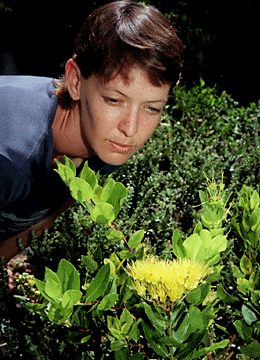
There is one thing you have to remember about endangered plants. One reason that nobody saved them is that nobody wanted them. Most orchids and gardenias and gingers and plumerias aren't endangered because they are beautiful additions to the garden. They have been cultivated and hybridized and are in better shape now than ever. Pretty faces rare
in at-risk speciesMany endangered plants sport
less than desirable characteristicsConsider the Lysimachia. There are nine native species in Hawaii, generally known as kolokolo-kuahiwi. They're part of the primrose family and most of them are deep trouble. One, the Lysimachia maxima, is on the endangered species list. Marie Neal, in her classic book "In Gardens of Hawaii," calls it "a weedy species of loosestrife." You might want to know that before buying it at the Lyon Arboretum Plant Sale Aug. 22. If it survives, it will turn into a sprawling shrub.
Another endangered native plant to be offered for the first time at the sale is the Tetramalopium. A member of the daisy family, it has a teeny-weeny purple flower, smaller than your thumbnail, and small leaves.
Neither plant will be in good supply at the sale, nor will any of the other endangered native plants, so arrive early if you want one. "We didn't realize the law would change so soon, so we didn't start propagating them early enough to have a good supply," Liz Huppman said.
Huppman, on staff at the arboretum, was referring to the law which had prohibited the possession or cultivation of an endangered plant by any private citizen. It has been amended so that gathering the plants from the wild by the public is still outlawed, but seeds and seedlings may be distributed by licensed nurseries.
Each of the endangered plants will be sold with an authorized tag from the state's Department of Forestry and Wildlife, certifying that it was acquired from a legitimate source. It's somewhat like the tag on a new mattress -- leave it on the plant, Huppman advises, or the plant patrol might throw you in the slammer on bread and water.
Among the other endangered native species that will be sold is one that is actually easy to grow and lovely to look at -- the state flower, Hibiscus brackenridgei. It has yellow flowers that Huppman says are designed for working people. "They open in the afternoon, when you get home from work, and they close the following morning. That way you have a bush with flowers on it when you can enjoy them. Most hibiscus flowers open in the morning and close in the afternoon."
If you have the space for one, the ohia lehua trees offered at the sale are real gems. "Because we've propagated them from cuttings, not from seeds, we can guarantee the color of the flowers," Huppman said. "Even if the young trees aren't in flower, we know that a cutting from a tree with yellow blossoms will flower in the same color." Seedlings don't necessarily do this.
Ohia lehua trees can grow to be very tall, but can be successfully pruned to manageable sizes. Huppman said that one of the volunteers at the arboretum has 18 of them in her garden, to provide material for lei, and that although she prunes them rather severely, they still flower.
The sale will offer trees with red, pink or yellow flowers. Haku lei makers prize the young leaf buds that vary in color from silver white to pink and red, regardless of the color of the flower, and are called liko in Hawaiian.
Non-native species available
The sale will also offer non-native plants, raised by the arboretum or by commercial growers around the state.
A new offering, and great as a potted plant, is a dwarf spider lily that grows to about 12 inches. It is a perfect miniature of the familiar species that grows to 3 or 4 feet, with clusters of lightly scented white flowers.
From Mauna Kea Daylily Gardens on the Big Island, Guy Pierce is shipping in about 12 varieties of blooming plants. Daylilies are the white rice of the flower industry. They are the most popular perennial plant in the United States, are adaptable to a wide variety of climates and rainfall, and just about everybody likes them, Pierce said.
He has three acres of daylilies under cultivation, growing thousands of varieties. In our climate, they bloom eight to 10 months of the year. "Think of them as maintenance-free," Pierce added. "They are one of the toughest plants around. They are drought tolerant, they don't like fertilizer and will grow in full sun or partial shade."
He said that he prices his lilies like cars -- the newest and the showiest are the most expensive. "Four or five years ago, I sold these plants to mainland growers for $100 each. Now, they're priced at $10."
Charles Nii, best known for his splendid hibiscus collection, will offer a selection of his most popular hybrids. He will also have several stevia for sale. The leaves of the plant can be used, either fresh or dried, as a source for a natural, noncaloric sweetener. It is said to be 100 times as sweet as sugar, and that's its claim to fame. "Otherwise," says Nii, "it's just kind of a little green plant."
New introductions from other nurseries include a reddish-pink ginger, "New Wonder," from Kawauchi Nursery that is good for landscaping and as a cut flower. Maragume Nursery has a dwarf lauae fern that grows to 12 inches and can be used as a ground cover or an indoor potted plant. It grows best in the shade.
Other nurseries will sell fruit trees, water plants, herbs, ti, succulents, orchids, anthuriums, gingers and bromeliads. The volunteers from Hui Hana Hawaii will give on-going demonstrations of lei making, and will sell their jams, jellies, seed jewelry, crafts and cloisonne.
And Blaisdell is air-conditioned, an important plus on these warm days.
Plants and more
What: Lyon Arboretum Plant Sale
Gardening Calendar in Do It Electric!
Send queries along with name and phone number to:
Evergreen by Lois Taylor, Honolulu Star-Bulletin, P.O. Box 3080, Honolulu 96802.
Or send e-mail to features@starbulletin.com.
Please be sure to include a phone number.
Evergreen by Lois Taylor is a regular Friday feature of the
Honolulu Star-Bulletin. © 1998 All rights reserved.

