

Ever Green

By Lois Taylor

Friday, August 7, 1998
By Craig T. Kojima, Star-Bulletin
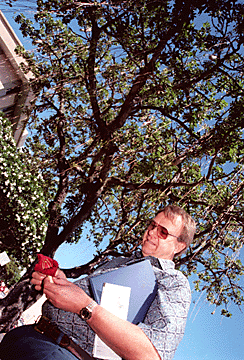
Gerald Carr examines a flower from the
sausage tree behind him.


Tree oddities
highlight tour

Enjoy UH landscaping
on self-guided walk

Although you may feel that we already have all the mice we need, there is another reason in addition to the cloning project to be proud of our university. The campus looks beautiful -- the grass is green, the trees are pruned, the hedges are flowering and even the undergraduates look good.

So if your visitors have been to the beach and the museums and the aquarium and the zoo, consider a campus tour.

Guided tours of the buildings and grounds leave at 2 p.m. Mondays, Wednesdays and Fridays from the Campus Center, but you can learn about and admire the landscaping on your own. Free brochures of self-guided walks with plant identification are available at the Campus Center during regular summer hours, from 8:30 a.m. to 4:30 p.m. Monday through Friday.

The center is located mid-campus between Hemenway Hall and the Engineering Quad.

The brochure has been updated by Gerald D. Carr, professor of botany, who also serves on the Campus Landscaping Advisory Committee. Carr admits to a vested interest in maintaining the landscape, since he uses the various trees and plants as laboratory material for his students.

"My concern is not so much the beauty of the planting, but the diversity," Carr said on a campus tour last week.

The brochure lists 81 plants, both native and introduced, that are easily accessible on campus paths. The crowd pleasers are often the ones with the odd names. Here are a few:

bullet A cannon ball tree is located near the oval driveway into the parking area off University Avenue. Its name comes from the hard, round, brown fruit that look like cannon balls. They develop from flowers that grow on tangled stems from the trunk of the tree. This one was planted by Pulitzer Prize novelist Thornton Wilder in 1933.

bullet A sand box tree grows near the moped parking area at Sinclair Library, near Campus Road. The name comes from the days when people wrote with ink instead of ball point pens or computers. The tree has small pumpkin-shaped fruit with about 15 flat, round seeds that spring open with explosive violence when ripe, scattering the seeds in a 3-foot radius. One of Carr's students once stored an unripe fruit in a glass jar, and when it matured the seed explosion broke the jar. The fruit was once gathered before it blew up, cleaned out, and used as a container for sand. The sand was sprinkled over wet ink to blot it. The split seed cases are now strung by lei makers.

bullet A jack-in-the-box tree grows on the mauka side of Sinclair Library. It has heart-shaped leaves and lantern-shaped fruit, and nobody knows where the name came from.

bullet The skunk tree, on the other hand, has an obvious reason for its name. Located in the courtyard between George Hall and the Architecture Building, the tree has red and yellow flowers with the unpleasant odor of stale tobacco.

bullet An octopus tree is located on the diamond head side of Crawford Hall. An ornamental often used as a potted plant, this one is about 20 feet tall. It is a native of Australia, and has red fruit growing on long stiff flower branches that resemble tentacled octopus arms.

bullet A devil tree grows nearby. It is a fast-growing, wide-spreading flowering tree from South America. It gives lovely shade, but never, never, never fall asleep under it, it is said, or the devil will steal your soul.

bullet Sausage trees are found in several locations on the campus. One of the biggest is on the ewa side of Miller Hall. The tree is native to Africa and produces large, sausage-shaped fruit which for many months dangle from its branches. The sausages are the source of an external medicine in Africa.

bullet A dead rat tree grows near the entrance to the Art Building. The tree gets its name from the long oval fuzzy fruits that hang from long stems like deceased rodents. It is actually a baobab tree that can be recognized by its bulbous lower trunk.

bullet A hutu tree grows on the mall in front of Bilger Hall. It has broad leaves and white flowers that look like shaving brushes. The tree is native to the South Pacific, and the name comes from Tahiti where utu means heart. The Tahitians claim that the first of these trees sprang from a human heart, and then they used it in a somewhat heartless way. They grated the seeds, which are poisonous, and threw them into the water to kill the fish, which they then scooped up. One would think it might be a gamble to eat those fish, and the practice is not recommended.

bullet An autograph tree grows below Jefferson Hall. In other places, it is called the Scotch Attorney tree, perhaps because Scottish lawyers are too frugal to buy note paper. The tree has short-stemmed leathery leaves, 5 to 8 inches in diameter. When the leaves are signed with a sharp instrument, that portion of the green leaf turns white, and the writing remains on the leaf until if falls from the tree. In the West Indies, the leaves were marked and used as playing cards.

bullet Be-still trees grow near the autograph tree by Jefferson Hall. The name probably refers to the fact that you would be still, very still, if you ate any part of the tree, since it is all highly poisonous. It is an attractive small tree with shiny dark green leaves and yellow-funnel shaped flowers, but don't plant one in your garden.

To learn more about the landscaping at the university, go to Carr's Internet site http://www.botany.hawaii.edu/faculty/carr. Or go see for yourself.

Tapa

All mapped out

bullet What: University of Hawaii self-guided tour of the campus landscape

bullet How: Follow a free walking guide with a map to 81 trees and plants on campus. Tour takes 1-2 hours to complete. Descriptions and directions are clearly given to each of the sites.

bullet Where: Maps are distributed at the campus center

bullet Call: 956-7235

Do It Electric!

Gardening Calendar in Do It Electric!


Send queries along with name and phone number to:
Evergreen by Lois Taylor, Honolulu Star-Bulletin, P.O. Box 3080, Honolulu 96802.
Or send e-mail to features@starbulletin.com.
Please be sure to include a phone number.


Evergreen by Lois Taylor is a regular Friday feature of the
Honolulu Star-Bulletin. © 1998 All rights reserved.


E-mail to Features Editor


Text Site Directory:
[News] [Business] [Features] [Sports] [Editorial] [Do It Electric!]
[Classified Ads] [Search] [Subscribe] [Info] [Letter to Editor]
[Stylebook] [Feedback]


© 1998 Honolulu Star-Bulletin
http://starbulletin.com