Japan’s woes
put Hawaii
at risk
Economic experts at an
By Russ Lynch
isle conference mostly see
big trouble aheadStar-Bulletin
Japan's financial crisis is deeper and more firmly rooted than most people realize, and the already-troubled Hawaii economy is at risk because of it, say prominent international economic experts.
The country's banks are close to insolvency; nobody is in a position to bail them out; and if something doesn't change within a matter of months, banks will collapse, loans will be called, and bankruptcies and layoffs will ensue.
That's what a number of international economic analysts told the Japan-Hawaii Economic Council meeting on Lanai over the weekend.
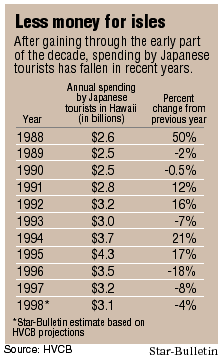
Without any of that worst scenario happening yet, there are already indications that spending by Japanese tourists in Hawaii this year could be as much as $130 million lower than last year.Local speakers said Hawaii is even more dependent on Japanese tourism than is widely understood, and a major fall in Japan - making the Japanese unwilling to travel and exacerbating the economic meltdown already happening in much of Asia - would be a major setback for the islands.
The conference at the Manele Bay Hotel spent most of its time analyzing the crisis and its possible global impact, a sobering experience for the 26-year-old organization which through the years did much to encourage the Japanese investment and tourism that the islands now depend on so much.
The news wasn't all bad, however. Sense of impending doom
Conferees were encouraged by changes at the head of the governments of Japan and other Asian countries and the financial restructuring already under way, but they were left with a sense of urgency and impending doom if change isn't rapidly achieved.
And the extent of the potential impact on Hawaii - already feeling a fall in the number of Japanese tourists and a much bigger percentage decline in the smaller market of tourists from other Asia-Pacific countries - left the Hawaii participants worried.
The importance of the Japanese alone was graphically illustrated by John Reed, head of Pacific retail development for DFS Group Ltd., parent of Hawaii's duty-free shops.In the glory days of the Japanese economic "bubble" that started in the mid-1980s, Reed said, Hawaii benefited from not only a big increase in Japanese travel to the islands but a similar increase in the buying value of the yen.
Reed estimates that Japanese will spend less than $3 billion in the islands this year. Two years ago, in 1995, they spent $5 billion.
"In 1997, Japanese visitors contributed 40 percent of total expenditures," Reed said. There are 6,000 Hawaii workers just taking care of Japanese tourists on the ground, he said.
Japanese tourism generates $240 million in annual payroll spending in Hawaii, and Japanese spending at duty-free shops and on other retailing and services in Hawaii produces $150 million a year of the annual airport concession fees the state receives, Reed said. Japanese visitors critical
"Japan has built essentially most all of our airports," he said, since those fees pay the debt service on airport construction financing.
Any significant loss of that business would be critical, and it is already showing, he said.
Hawaii Visitors & Convention Bureau figures don't exactly match Reed's estimates, but they tell a similar story.
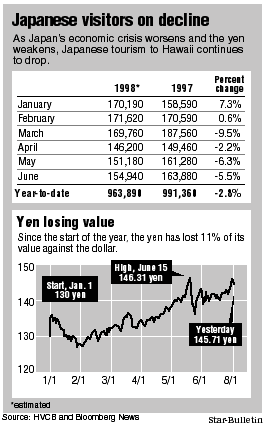
The HVCB's latest estimate suggests a 2 percent to 4 percent drop in Japanese arrivals this year. If the Japanese stay as long as they did last year, an average of 5.49 days, and spend as much as they did in 1997, $280 a day each, the best-case scenario indicates a loss of about $50 million in visitor spending.
If the dip goes as high as 4 percent, Hawaii will miss out on $130 million in tourist spending.
Visitor industry officials caution that with so many downward trends in place, it is by no means certain that length of stay and spending levels will be what they were last year.
Furthermore, since the trouble is in the Japanese, Asian and, to a lesser extent, global economy, there is virtually nothing Hawaii can do about it.
More visitor promotion might help, conference speakers said, but it won't work at all if economic collapse keeps Japanese at home.
The recently reported 2.8 percent fall-off in Japanese tourists so far this year is insignificant compared to what might happen if the most extreme prognosticator at the conference proves to be right.
Richard S. Koo, chief economist for Japan's Nomura Research Institute, said Japan's bubble collapsed eight years ago, but the government thought mistakenly that increasing government spending would keep the economy moving. Banks in big trouble
In April 1997, with the country in a huge deficit and political pressure mounting, the government turned around and cut spending in a hope of curing the sick economy.
"Now, I am not against cutting a budget deficit, but it's like putting somebody on a diet," Koo said. Before you do that, you have to check the condition of the patient. "Make sure the person is reasonably healthy to begin with," he said.
In April 1997, Japan was far from healthy. If government spending is the only pillar holding up the roof, you don't cut it down, Koo said. And five years of spending had created zero growth, a sure sign of sickness, he added.
Next, look at the condition of the Japanese banks, he said.
Japanese banks have been undercapitalized for a decade, but Japan for years refused to recognize that. When the government, under pressure from the United States and other countries, did pressure the banks this year to disclose their perilous condition, they had an easy excuse not to do that, Koo said.
Japan's deposit insurance fund had nowhere near enough money in it to cover the runs on the banks that would follow such disclosure. Now the government finally, in only three months through Parliament, managed to move 17 trillion yen (equal to $117 billion) into deposit insurance.
The banks are now being forced to disclose the state they have been in for years. But if that causes a run that brings any of them to the point of collapse, Japan's banks don't have the capital to pick up any assets, even the best loans. No capital to pick up loans
An example of what could happen came when the Hokkaido Takushoku Bank collapsed in November.
Japan's finance ministry tried to get someone to take over the good assets, such as loans to strong companies.
"There were no takers," Koo said.
The bank closed, ruining many of its customers and turning Hokkaido itself into an economic disaster area.
But Koo added his own positive note. Are remedies quick enough?
"This is all very gloomy," Koo said. "I believe that the pessimism has gone a little too far," he said. "Since December the Japanese government has realized the seriousness of the situation."
Japan is taking measures, he said. The big boost in deposit insurance and another 13 trillion yen - equal to about $90 billion - to restart public works will help.
The question is whether the government can move quickly enough, he said.
Another high-powered economic expert who spoke to the meeting agreed with Koo that Japan's banking problem is systemic, something that has developed over the years and provides no quick solution.
Kenneth Courtis, chief economist and strategist/Asia-Pacific for Deutsche Bank Group, said the economic failures of other Asian countries, although linked to what's happening in Japan, also result from structural problems that are hard to fix.
"The Japanese credit problem has gone regional," Courtis said.
But Japan can recover and the gloomy predictions don't have to turn into reality, Courtis said. 'Electorate has woken up'
"There is consensus for change. Now, finally, the electorate has woken up, too," forcing the election of a new prime minister, Keizo Obuchi, and the appointment a new finance minister, former Prime Minister Kiichi Miyazawa.
"The new team is probably the best hope at the moment," Courtis said. "We are today at perhaps the darkest moment."
If the right policies are invoked in Japan over the next few months, Japan can start getting a solid base under its economy, he said, adding that if that agenda is adopted in the other troubled countries, they can start moving up, too.
"(But) the traditional flows of tourism and capital from Asia aren't coming back anytime soon."