Kauai man
sounds 164-year-old
royal conch
The shell was recovered from
By Joan Conrow
King Kamehameha II's sunken
royal yacht in Hanalei
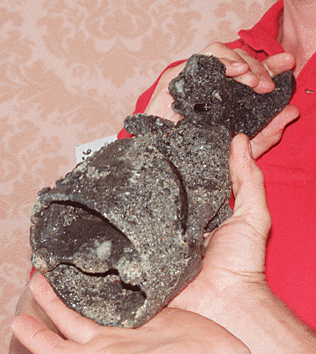
Special to the Star-BulletinPRINCEVILLE, Kauai -- Keola Baclayon thought he could "raise the dead, that something miraculous might happen" when he first blew the pu, or triton conch shell, that went down with the royal Hawaiian yacht in 1824. "But the miraculous thing is just being able to blow this," said Baclayon, a Kauai resident and Kamehameha School graduate who credited his "prayers and faith" for making him the only one who has been able to coax a tone from the pu.
The shell -- believed to have been used to herald the arrival of King Liholiho and his royal yacht Haaheo o Hawaii (Pride of Hawaii) -- had been lying beneath the shifting sands of Hanalei Bay for 164 years before it was recovered last week.
It is one of about a thousand artifacts recovered from the shipwreck over the past three years by an underwater archaeological team from the Smithsonian's National Museum of American History. Some of the artifacts were displayed for the media yesterday at the Princeville Hotel, which has sponsored some of the work.
The artifacts range from bits of bone, leather and wood to poi pounders, pieces of armament, gold-gilded beads that perhaps rimmed a mirror or picture frame, chunks of raw ivory, sections of rigging and plumbing, kukui nut oil lamps and one piece of jewelry: a tiny finger ring carved from a palm nut.
But while the artifacts help shed light on the lifestyle of the royal monarchy and that period of Hawaiian history, they aren't the most important part of the recovery effort, said Paul Johnston, curator of maritime history at the Smithsonian Institution and the expedition's leader. "I think the story itself is the most important thing because it's never been told before and that's where our contribution lies," Johnston said.
By Joan Conrow, Special to the Star-Bulletin
This item is one of the artifacts recovered from King Liholiho's
yacht. Liholiho purchased the yacht in 1820 for $80,000 worth
of sandalwood. On April 5, 1824, while the king was in Europe, the
vessel ran aground on a reef in Hanalei Bay in just five feet of water.
Much is known about the construction and early use of the yacht, he said, but far less has been reported about its ownership by Liholiho, son of Kamehameha the Great and his successor.The yacht, christened Cleopatra's Barge, was the first pleasure craft ever built in the United States. It cost $100,000 to build in 1816, a sum that Johnston said would be "almost incalculable today." So unusual was the ship that some 1,900 people a day went to view it in Salem, Mass., before it took its maiden voyage to 16 ports in the Mediterranean.
China traders bought the ship with the idea of selling it to Liholiho, who purchased it in 1820 for $80,000 worth of sandalwood. "He was madly in love with the yacht," Johnston said, and used it as a diplomatic ship of state and merchant vessel.
Its most famous journey was to Kauai, where Liholiho kidnapped King Kaumualii and used the 100-foot yacht to transport the rebellious Kauai monarch to Oahu.
The vessel's next voyage to Kauai was equally dramatic, for that's when it sank. Johnston said Liholiho had planned to take the yacht to Europe, but for reasons unknown decided instead to travel on a British whaler. While he was gone, the yacht was taken out, perhaps to investigate rumors of an insurrection on Kauai, Johnston said.
On April 5, 1824, the ship ran aground on a reef in Hanalei Bay in just five feet of water. Johnston said reports indicate the crew and perhaps the captain were drunk at the time. A gin bottle was recovered from the wreck.
"The Hawaiians on shore wove 12,000 yards of rope and tried to drag the yacht over the reef but they failed and it rolled over," Johnston said. "But no one was killed, or even injured."
Liholiho never heard the news of the wreck. He contracted measles and died three months after arriving in Europe. Johnston said it's still unknown just who was aboard the royal yacht.
Johnston said between 70 percent and 80 percent of the recovered artifacts have been conserved, a lengthy process that varies with each type of material recovered. Saturday's dive trip likely will mark the end of the underwater recovery effort.
Rick Rogers, an Aloha Airlines pilot and captain of the recovery vessel, said the royal yacht will be well-protected from vandals and scavengers.