
This art is heavy stuff
By Burl Burlingame
and is preserved for
the masses at
Hawai'i Convention Center
Star-BulletinYOU make the big building, then find pretty pictures to brighten it up. OK, that's way simplified, but not much off the mark when it comes to public structures. That's why we have a State Foundation on Culture and the Arts -- they select the pretty pictures for citizens to look at, and match them up with appropriate locations. That's the job.
But what if the pictures are fragile painted plaster, laid over thick concrete and rebar, and 42 feet long? In that case, the building is designed around the pictures -- which is exactly the case with some Jean Charlot murals at the new Hawai'i Convention Center.
On May 30, the art works at the center were dedicated, and all were commissioned specifically for their spaces at the center, and were created in the last two years. The exception is the Charlot pieces, originally created in 1956 for the Catamaran Cafe at the Hilton Hawaiian Village.
There they resided for 30 years, until the Hilton decided to renovate in 1986. Determined to save the pieces from the wrecking ball, the Charlot Foundation, which oversees the late artist's legacy, had the concrete walls cut away and carted off into storage.
"There was quite a bit of plan-changing and negotiating with the hotel," said potter Stephen Murin, chairman of the Charlot Foundation in the mid-1980s. "It didn't help that the hotel changed managers right in the middle of everything and we had to start again."As it turned out, the key was developing "a good relationship with the wrecking company," said Murin, particularly Richard Lee of RHS Lee, Inc. "He did a great job." The company cut around the wall, moved and stored the piece at a waterfront pier, he said.
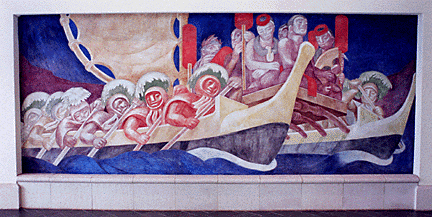
The longest piece, called "The Chief's Canoe," was part of a load-bearing wall, and was cut off and lifted away. Another wall, which contained smaller works, was laid atop hollow tile and the artists feared it would crumble. The hollow spaces were filled with concrete, and the wall of vignettes was disassembled into four smaller works.
"They weigh 12 to 13 tons, and it's scary moving them," said Murin. "I had to sign a release saying the contractor was not responsible if they crumbled, and that was scary too."
"We're not exactly sure what the original configuration was like at at the Hilton Hawaii Village," said Laura Ruby of the University of Hawaii-Manoa art department and chairperson of the Charlot Foundation. "If anyone has a snapshot of the cafe that shows the murals, we'd love to see it." (Her phone number is 956-5250.)
While the huge chunks of concrete sat in the pier warehouse, Murin tried for half a decade to find a home for the murals. Eventually the State Foundation became interested.
"At the time, it looked like the airport was going to expand its international terminal, a project that could have cost as much as a billion dollars," said Ron Yamakawa of the state foundation's Art in Public Places program. With 1 percent of the budget allocated for culture, "that was a lot of public art," he said.
The concrete slabs were moved to the airport. "The airport has a lot of covered storage space," said Yamakawa. There was a plan afoot to display them in a kind of lava tube connecting the airports -- "very cool, he said" -- but when the airport expansion bit the dust, victim to both recession and changing modes of air travel, the foundation looked for another home.
Placing heavy artwork isn't all that easy. "Not a lot of options," said Yamakawa. "We even thought of the state office building, but the tons of concrete would have broken right through the floor."
But then the convention center was fast-tracked. "It was perfect for the frescoes, because the theme of a Hawaiian sense of place, said Yamakawa. Architect Ty Sutton modified his plan to accommodate the murals, and they were emplaced in the structure.
But that wasn't the end of it.
"Major problems," said Yamakawa. "They were 40 years old, and got banged up in the hotel cafe when people bumped chairs into it, and to protect it the hotel put up plastic, but drilled holes in the fresco to hold the plastic. And then to move it, they had to secure it with more holes. Three-fourths-inch screw holes, all over, and there were a lot of them."
Conservator Larry Pace was hired to repair the mural. Luckily, the 1 percent art allowance in public buildings allows for repairs.
"He did an amazing job," said Yamakawa. "Only a couple of months ago it looked like hell."
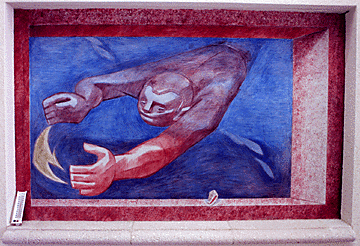
The murals are along a garden wall, centered by a heroic painting of a Hawaiian canoe charging through the surface. Bracketing it are ruddy chirascuro images of Hawaiian drummers and conch blowers. To the right is a swimmer in deep azure, a companion swimmer faces it on an opposite wall.
The center courtyard is named Pa Kaloka, Hawaiian for Charlot, said Patty Inaba of the center staff.
"As a teacher of art, I can say that, as pure composition, it's a superb example of engaging the viewer," said Ruby.
"The thematic imagery is one the average person can understand, and he places it in a scale and distance that you're swept right into it."
"I'm very happy with the way they look. It's a nice aesthetic balance," said Murin, who attended the May 30 dedication. But he doesn't have a snapshot to commemorate the event. "I fell down and broke my camera," he said. That's the way things go in giant heavy mural preservation.