

Sometimes it comes to him -- what is he doing out there? A man whose art hangs in 20 museums around the world, who has lived on the French Riviera -- why is he bagging rubbish at Maili Point? For the same reason, he'll tell you, that George Leigh Mallory gave for climbing Mt. Everest. "Because it's there." Showering attention
on WaianaeYouth project corps
beautifies Waianae CoastJerome Wallace, whose paintings and batiks are in many major collections, is running one of the city's summer youth employment programs of Work Hawaii. Wallace is assigned to Waianae where he supervises about 25 teen-agers who are paid by the city to do clean-up work in the area.
Wallace patrols his beat in what he calls his Beach Beemer, an elderly, rusted Pontiac with a side window knocked out. The back seat is stacked with handouts on job-keeping skills, avoiding AIDS, budgeting your paycheck, participants' handbooks and the penalties of sexual harassment. All of this is deemed essential knowledge to the kids by the city, and Wallace monitors this program as well.
Cleaning the beaches of the Waianae Coast has been a lesson in conservation for the participants, Wallace said. "You can't believe what we've found out there -- a dead horse for starters, plus car batteries and tires and old furniture and motors. And there's all the usual stuff -- empty cans and cups and newspapers and general trash.
"In the beginning, the kids felt shame to be seen by their friends, picking up and bagging rubbish as a summer job. But now they've developed a pride in what they're doing. There were a bunch of office people out the other day working on the Adopt-a-Highway program, and the kids noticed that the rubbish bags those people were using were a lot smaller than the ones I give them.
'How come?' they asked, and I told them that they were professionals while these other people are just amateurs. What they've learned is that there are a lot of slobs out there who don't pick up after themselves and leave it to someone else. And that it is hard work cleaning up after other people. They have vowed that when they go to the beach themselves, they won't leave anything behind."
Clean-up not enough
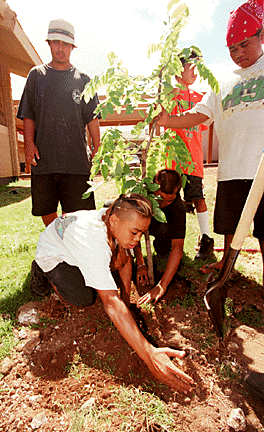
Then Wallace decided that restoring the status quo wasn't enough, and that the program should improve the area. "I told the kids about a place I visited in Scotland called Findhorn on the North Sea. It was a garbage dump, and the people around there turned it into a beautiful place by cleaning it up and planting trees. That's what we can do here, and we are starting out with one of the most beautiful but ill-kept places I've ever seen."So they planted their first tree, a yellow and white shower, on Tuesday on the barren campus of Waianae High School. Many of the participants attend the school and were aware that the only shade is offered by the shadows of the buildings, that there are no trees for the students to gather under.
Wallace picked up the tree, about 3 feet tall and planted in a 5-gallon plastic pot, in Kailua and jammed in into the back of the Beach Beemer along with piles of Xeroxed advice. He delivered the tree to the campus where the Work Hawaii team had already dug a hole for it.
"Not deep enough," Wallace said, and the digging team groaned. "Hey, man, hard work already," one of the sweating laborers said, and he was right. There are about two inches of top soil over a solid bank of coral at that part of the campus. So they chipped at the coral and brought pieces out by hand until they had a hole of a size that Wallace approved.
Professionals advise that a tree that has been in a pot should be planted in a hole that is 2 feet wider and 10 inches deeper than the pot itself. The soil should be loose so that the roots can penetrate. The Waianae team used potting soil to line the hole, and placed the tree in it so that it was at the same depth in the ground that it was in the container.
"Now, each one of you take a handful of dirt and throw it into the hole. That way you are each responsible for keeping it alive," Wallace said.
Somewhat self-consciously, each threw a clod on the roots. "Like one funeral," somebody commented. Then they soaked the tree with water.
Wallace is hoping for the best.
Before the program ends with the beginning of school, Wallace and his crew intend to plant two more shower trees at the Waianae Satellite City Hall. This will require city approval since both the trees and the property are city owned, and this is taking paperwork and time. Wallace is confident that it will not only happen, but that the mayor himself will attend the planting.
Rainbows in bloom
Shower trees are at their peak now all over the island. One of the best displays is at Kapiolani Park, and other beautiful plantings are on King Street between McKinley High School and McCully Street, and along the H-1 freeway near Moanalua.The rainbow shower, which most of the street trees are, is the official tree of the city of Honolulu. The first rainbow shower tree was a chance seedling from a hybrid growing on Lunalilo Street in the 1920s. It was cultivated in the yard of Miss Wilhelmina Tenny, and is now commonly known by her name. The Tenny Rainbow Shower grows rapidly and flowers profusely.
The colors are basically red, yellow and white, but in bright sunlight the overall appearance of the tree in bloom is pink and orange. It grows best in the drier, warmer areas of Oahu.
Plants are available at most nurseries, but think big. A 12-year old tree at Foster Botanic Garden is now 50 feet tall. And while they are gorgeous, all those glorious flowers eventually fall off, providing a brilliant carpet of petals.
Aesthetically, it's great, but it also creates a mess and is dangerously slippery to walk on. This may be why most shower trees grow on public property where crews like Wallace's will rake up the fallen blossoms.
Gardening Calendar in Do It Electric!
Send queries along with name and phone number to:
Evergreen by Lois Taylor, Honolulu Star-Bulletin, P.O. Box 3080, Honolulu 96802.
Or send e-mail to features@starbulletin.com.
Please be sure to include a phone number.
Evergreen by Lois Taylor is a regular Friday feature of the
Honolulu Star-Bulletin. © 1998 All rights reserved.

