
Waikele’s new
school a gem
The facility today
By Debra Barayuga
welcomes kindergarten
to Grade 2 children
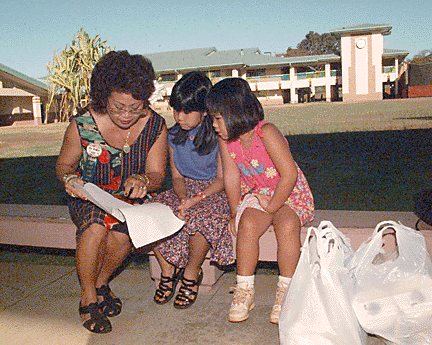
Star-BulletinAfter seeing the new Waikele Elementary School going up, Oregon transplants Wayne and Joyce Thompson knew where they were going to raise their family.
"This was the gem," said Wayne Thompson, who had scoured the island looking for a nice neighborhood for his family to settle in and a good school nearby. "After seeing this and talking to the principal, this was the No. 1 reason why we moved here -- because of the brand new school."
Thompson's daughter Alexis, 6, will be in the first class of first graders to attend Waikele Elementary, which opened its doors today to nearly 200 kindergarten to second graders. Situated in a residential neighborhood opposite Waikele Center, the school is one of three new ones opening this school year. Mililani Middle opened July 20 and Keeau Elementary is expected to be completed late this year and open in January.
A two-story 17-classroom building, administration building and 350-seat cafetorium greeted students and teachers at Waikele today.
A play court and 4-acre park adjacent to the school is expected to be completed soon. Meanwhile, there are lots of open grassy areas for students to play in.
Phase II of construction, which is fenced off and expected to be completed in spring of 1999, includes another two-story classroom building and library. Grades three to six will be added in the 1999-2000 school year.
Waikele was designed as a year-round multi-track school, capable of accommodating 1,000 students. For now, it will remain a year-round single-track school. The new school will help alleviate the overcrowding at August Ahrens in Waipahu -- one of the largest elementary schools on Oahu.Parent Ashley Kuakini is delighted her sons can attend a school in their own neighborhood, rather than be bused to Pearl City Elementary. Kuakini lives just down the road from the school, and sons Cassidy and Brandon hope to bike to school.
Kuakini is also impressed that students will remain with the same teacher for two or three years -- a concept called "looping."
Research has shown that children build self-esteem and security when they can establish meaningful relationships with adults for extended periods, said principal Diane Matsuoka.
Students recover from summer vacations so much faster because they already know the teacher's expectations. "They hit the ground running," Matsuoka said.
With looping, students don't have to adjust to different teaching styles each year, said special needs teacher Florence Pasion. "You get to know the kids better."
Students will begin a new loop in third grade and remain with that teacher in the fourth grade. Grade five begins another new loop.
In front of the school, the bus drop-off shelter resembles a train station. One can imagine the Waikele trolley pulling up instead of a school bus.
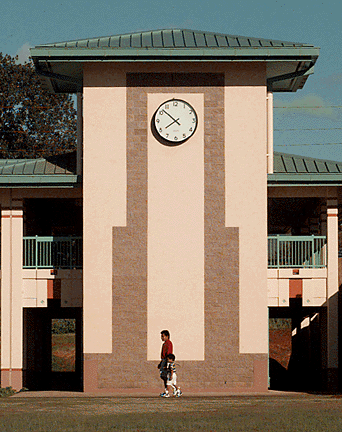
The shelter opens up into an expansive grass courtyard dotted with lauhala trees where assemblies will be held. And overlooking the courtyard is the clock tower, part of the completed two-story classroom building, on which a huge clock can be seen from the street.
Four classrooms are clustered around student learning rooms where students of different grades can collaborate on projects and develop relationships.
Each classroom is equipped with six computers, and the learning center boasts another computer, a high-end printer and scanner. Every classroom building will also have a 30-station computer lab.
The entire school is on a computer network. The cafeteria manager and the head custodian will be receiving work orders or messages via e-mail. The classrooms are also wired for the Internet.
Every building, except for the cafeteria which boasts a cathedral ceiling, ceiling fans and a skylight, is air-conditioned.
WASHINGTON -- When it comes to raising children, few states are better than Hawaii. Hawaii ranked 11th
on child-friendly scaleThe rating was made by
By Pete Pichaske, Phillips News Service
the Children's Rights CouncilThe Children's Rights Council, a Washington-based child advocacy group, today released its rating of the states based on how child-friendly they are, and found Hawaii tied for 11th.
Hawaii was rated among the best states in four of the 11 criteria: infant mortality rate, child death rate, number of single parents and number of alcohol-induced deaths among children.
Last year, Hawaii was 14th overall among the states, and the year before that it was 10th.
The top-ranked states this year were, in order, Iowa, Minnesota and New Hampshire. The lowest-ranked states were New Mexico, Arizona and Mississippi.
