Asian Americans
in Vietnam War received
rude awakening
to racism
Being mistaken for
By Susan Kreifels
the enemy or thought disloyal
were aming the problems
front-line soldiers faced
Star-BulletinDane Winston Galiza, dressed in his Army uniform, walked out of a dark Saigon alley and heard a loud voice yell "Halt." He saw the white faces of American military police, their guns pointed at his Asian face. Bullets sliced the air over his head. He hit the mud.
"I'm American. I'm American," Galiza yelled in panic, feeling handcuffs click on his wrists. They kept him in a cell several hours until they confirmed his identity. They never told him why.
"After years of dealing with white Americans, I immediately knew that if I ran, they would kill me," the 47-year-old Big Island fisherman from Kau said recently about wartime in Vietnam. "You were at greater risk with an Asian face."
Galiza became a victim of what Hawaii psychologist Chalsa Loo has coined "RAR" -- Rude Awakening to Racism, a phenomenon Loo has discovered during interviews with Asian-American Vietnam veterans from Hawaii.
"They didn't know racism existed until suddenly they were mistaken for Viet Cong or someone called them 'gook' or 'Jap,'" said Loo, an author on Asian Americans. "I commonly hear them say that, coming from Hawaii, they were never exposed to this."
Galiza suffers from post-traumatic stress disorder. Through interviews with 300 Asian-American Vietnam veterans here and in California, Loo hopes to determine if there is a link between the disorder and racism.
By Rod Thompson, Star-Bulletin
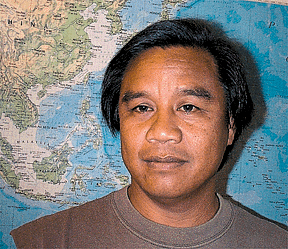
Dane Galiza of the Big Island experienced racism for
the first time when fighting in the Vietnam War.
The results could have far-reaching effects on the diagnosis and treatment of the disorder in the military and civilian populations. Combat, rape and natural disasters are officially recognized as causes of the disorder. Adding racism to the list could qualify more vets for disability and could shape treatment received by civilian victims of race-hate crimes.Research on Vietnam veterans who spent time in heavy combat triggered study of post-traumatic stress disorder, which can develop from life-endangering situations, intense fear and a feeling of helplessness. Symptoms include sleeplessness, concentration problems, irritability and anger.
Surveys have found higher rates of the disorder among black and Hispanic veterans. Loo's research on Asian Americans is funded by $200,000 from the Department of Veterans Affairs.
When Richard Dowling joined the Marines in 1966, he figured he "had more to prove for my country than regular people" because he had an Asian face. But when he beat 389 other Marines on an obstacle course, Dowling received no handshakes.
"The drill instructor beat the hell out of me in front of all these men for making them look bad. Here I was Oriental, the kind of people they were going over to fight. ... The only good gook was a dead gook."
Dowling, 52, believes he suffered from post-traumatic stress disorder when he returned from Vietnam.
Loo said it appears that the enlisted, especially on the front lines, suffered more racism than officers did, many of whom had positive experiences in Vietnam.
"People in the field had a higher probability of being mistaken for the enemy," Loo said.
Unlike the Japanese Americans who served in the same units in World War II, Asian Americans in Vietnam were isolated and lacked camaraderie and support, Loo said.
Galiza watched Vietnamese children run up to Americans and try to sell sodas. The GIs amused themselves by throwing rocks at them. He felt as though the rocks were hitting him.
The "same-same" faces of the Vietnamese, the food and the smells all had the familiarity of home. Born of Filipino, Chinese and Spanish blood, he never felt roots in Hawaii. But in this war-torn land, he started to feel them take hold.
"I was trying to connect with who I am, but I couldn't talk to them. I would be (considered) changing sides," Galiza said.
"How would you like it if guys treated your grandmother or sister with no respect? It was a terrible mind-set, demeaning the enemy."
Even though Asian Americans in Vietnam may not have personally experienced racism, Loo said many felt a cultural bond there that GIs of other color didn't. That feeling could raise as much emotion and trauma as threats to their safety.
"They felt a connection to the children that most white soldiers didn't," Loo said. "The children reminded them of neighborhoods in Hawaii. They couldn't express anything because they didn't want to be perceived as disloyal."